

Food for Your Garden: Starting a Traditional Compost Pile in Your Yard
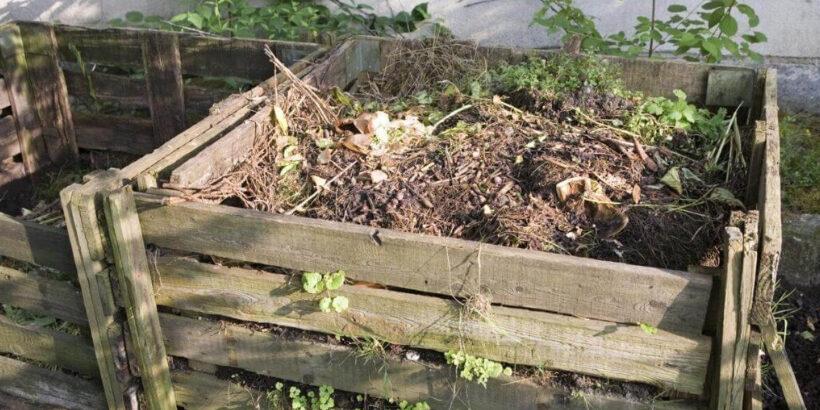
What can we do to reduce our waste? Use less, recycle and reuse packaging materials, and compost your organic waste. And if you’re a gardener, there’s no reason to throw away this beneficial (and cheap!) source of nourishment for your soil.
Compost is the key to a flourishing garden. Turn your kitchen scraps and yard waste into food your garden will love.
The following is an excerpt from Fresh Food from Small Spaces by R. J. Ruppenthal. It has been adapted for the web.
How to Start A Traditional Compost Pile
If you have enough space to start a compost pile in your yard, make sure your local city and county ordinances permit it. Some of them have restrictions because open piles can attract rodents and create odors. Assuming that your area allows open-air composting, consider whether you can fit three piles in your yard: one for new compost, one for aging compost, and one for the finished stuff that goes back on your plants. If you just have room for one, that is fine, but in order for your pile to fully break down, you will need to stop adding new material at some point and let it decompose.
Some compost piles are hot, while others never get very warm, and this is a function of the biological activity in the pile while the organisms do their thing. Getting your pile to heat up naturally depends on a long list of factors, including pile size, materials, layering, moisture, external heat, and other variables. But even if it does not heat up much, sooner or later the stuff will break down and you’ll have some good dirt to use on your plants.
Cold compost is perfectly acceptable stuff; it just takes a bit longer to make. Some gardening purists hold that the nutritional content of hot-cooked compost is far superior, but if you are using it as more of a soil amendment than a fertilizer, then this should not matter much. If you want to follow the pure wisdom, then the minimum size for a hot pile is about 4′ x 4′, which will allow enough internal space to create the proper conditions for this biological activity to take place.93 In lieu of this, any untidy heap will break down at its own pace.

A compost bin can fit almost anywhere, either over garden soil or on a patio. ©iStockphoto.com/davidf
What should you put in your compost pile? Will it stink? Do you have to turn it regularly? The answers are: anything organic, a bit, and not really.
Dead leaves, lawn clippings, food scraps (except meat or fat), newspaper, cardboard, and manure are all organic matter and will break down in your compost pile. Ideally, you want to add a diversity of ingredients.
The pile will break down faster if you add both “browns” (dry ingredients such as dead leaves, newspaper, and cardboard) and “greens” (wet stuff such as food scraps, lawn clippings, and fresh manure).
“Greens” contain plenty of nitrogen while “browns” have more carbon, and your pile needs both. Conventional wisdom holds that the proper ratio is 2 parts “browns” to 1 part “greens,” but you can vary this ratio somewhat. Just remember that a pile of 100 percent leaves takes a lot longer to break down, and 100 percent food scraps may turn into a very wet and slimy mess long before it breaks down. Also, the more diverse sources of waste you add, the better its nutritional output will be for your soil.
Your new pile will stink a bit at first, but if you have never composted before, then you will be pleasantly surprised. It’s not as smelly as you would think. In its early stages, you can cover the compost pile with burlap, a tarp, or a layer of “brown” ingredients such as leaves or cardboard, which will help seal in the moisture and limit any odors. As the compost ages, it begins to smell more earthy, a fragrance that some actually enjoy.
Your compost is finished when you can no longer recognize the individual materials that went into it.
Aerating the pile is optional, but it may speed up the process by delivering oxygen where it’s needed. Use a pitchfork to turn the pile and make sure that both air and moisture are reaching each part. You can do this weekly or less often. And, if you do not want to turn the pile, then it will aerate naturally with time as the layers break down and settle.
Recommended Reads
Read The Book

Fresh Food from Small Spaces
The Square-Inch Gardener's Guide to Year-Round Growing, Fermenting, and Sprouting
$27.95
You may like...
-
 $29.95
 -
$39.95
-
$24.95


Recent Articles

You don’t need to use chemicals to give your seedlings a boost. Just use seaweed, apple cider vinegar, and a few extras to create a blend for seedling growth.
Read More
Having a lack of outdoor greenspace doesn’t mean you can’t enjoy homegrown food. Sprouts are a quick, simple, and healthy way to keep your appetite satisfied.
Read More
Dreaming of an edible forest garden? Start small by creating a plant grouping. By combining plants that thrive together, you’re one step closer to turning your backyard into a lush edible forest!
Read More
Dreaming of a lush garden? Now is the perfect time to start planning your garden. The location of your planting site is key to a thriving garden and one of the first things to consider. Choose the right spot and watch your garden thrive!
Read More
Looking to simplify fieldwork on your farm or homestead? The key is to act like a tree: stop working so hard. Let nature do some of the work for you. Simplify your fieldwork and boost yields!
Read More