
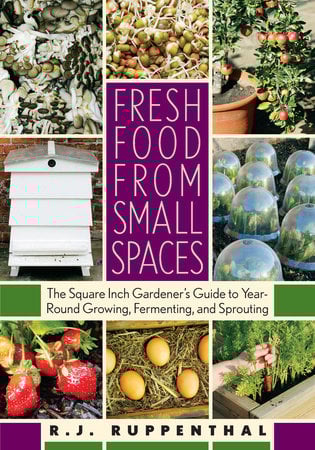
Fresh Food from Small Spaces
The Square-Inch Gardener’s Guide to Year-Round Growing, Fermenting, and Sprouting

| Pages: | 192 pages |
| Book Art: | Black and white photos |
| Size: | 7 x 10 inch |
| Publisher: | Chelsea Green Publishing |
| Pub. Date: | September 22, 2008 |
| ISBN: | 9781603580281 |
Fresh Food from Small Spaces
The Square-Inch Gardener’s Guide to Year-Round Growing, Fermenting, and Sprouting
Paperback
$27.95
Books on container gardening have been wildly popular with urban and suburban readers, but until now, there has been no comprehensive “how-to” guide for growing fresh food in the absence of open land. Fresh Food from Small Spaces fills the gap as a practical, comprehensive, and downright fun guide to growing food in small spaces. It provides readers with the knowledge and skills necessary to produce their own fresh vegetables, mushrooms, sprouts, and fermented foods as well as to raise bees and chickens—all without reliance on energy-intensive systems like indoor lighting and hydroponics.
Readers will learn how to transform their balconies and windowsills into productive vegetable gardens, their countertops and storage lockers into commercial-quality sprout and mushroom farms, and their outside nooks and crannies into whatever they can imagine, including sustainable nurseries for honeybees and chickens. Free space for the city gardener might be no more than a cramped patio, balcony, rooftop, windowsill, hanging rafter, dark cabinet, garage, or storage area, but no space is too small or too dark to raise food.
With this book as a guide, people living in apartments, condominiums, townhouses, and single-family homes will be able to grow up to 20 percent of their own fresh food using a combination of traditional gardening methods and space-saving techniques such as reflected lighting and container “terracing.” Those with access to yards can produce even more.
Author R. J. Ruppenthal worked on an organic vegetable farm in his youth, but his expertise in urban and indoor gardening has been hard-won through years of trial-and-error experience. In the small city homes where he has lived, often with no more than a balcony, windowsill, and countertop for gardening, Ruppenthal and his family have been able to eat at least some homegrown food 365 days per year. In an era of declining resources and environmental disruption, Ruppenthal shows that even urban dwellers can contribute to a rebirth of local, fresh foods.
Reviews & Praise
"This is one of the most important gardening books in years. Ruppenthal is ahead of the curve, promoting sustainability and even self-sufficiency in the burgeoning urban environment. His holistic approach to nutrition, conservation, recycling/repurposing, and composting will help redefine urban gardening. Fresh Food From Small Spaces is loaded with great ideas for urban gardeners. Ruppenthal gives great tips and background info to get beginners started. Yet, the diagrams, charts, and plant lists make it a satisfactory and intriguing reference even for experienced gardeners."Besides being a timely, progressive, intelligent reference, Fresh Food From Small Spaces is a great story and comfortable read. I enjoyed following Ruppenthal's personal struggles and ordeals. This is a fun, informative book."Ruppenthal has seen the future of city gardening and I like it! Fresh herbs on every windowsill. Pole beans on every balcony. Beehives with honey on every rooftop. And tasty shitakes in every garage."—William Moss, "Moss in the City" columnist at the National Gardening Association's Garden.org
"Every generation there is a move back to growing food close to home for various reasons: victory gardens, back-to-the-land gardens and community gardens come to mind. Now, as oil prices permanently increase, we have 'post-petroleum gardens' and Fresh Food From Small Spaces is a timely guide for a highly productive home food system, full of new and proven sustainable ways to grow and process your favorite foods in the smallest of space."—Will Raap, Founder, Gardener's Supply Company
"While the information in this book will benefit all those seeking to grow and prepare their own food at home, it is especially informative for people with only limited space. Ruppenthal covers every food I ever heard of and a whole bunch I never heard of, like water kimchi (!) that can be grown indoors or outdoors where there is not enough room for a regular garden. This is the perfect answer to the question many people are asking me: How can I take charge of my own life now that food prices are soaring when I hardly have space for a container-grown tomato or two? Reading Ruppenthal, I get a distinct feeling that one can grow enough food to survive on down in the cellar and out on the porch..”—Gene Logsdon, author of The Contrary Farmer and Living at Nature's Pace: Farming and the American Dream
"Fresh Food From Small Spaces is a passionate manifesto as well as a practical primer for urban food production. It presents clear information, innovative strategies, and enthusiastic encouragement that will motivate, inspire, and empower city dwellers seeking to grow food and build greater sustainability into their lives."—Sandor Ellix Katz, author of Wild Fermentation and The Revolution Will Not Be Microwaved
"Unfortunately, many urban-dwellers avoid gardening due to a perceived lack of space. Ruppenthal explodes these barriers by showing us in cogent hands-on detail how to cultivate meaningful quantities of healthful food from the air, sun, water, and earth available to us in our own spaces, no matter how small."—Stephen & Rebekah Hren, authors of The Carbon-Free Home
“Ruppenthal, a business professor and lifelong trial-and-error gardener, here fills a gap in gardening literature and helps readers discover techniques for sustainable food production--even on a small scale--by using every square inch of space that is available to them…It may be nearly impossible to live completely off the grid in an urban environment, but through practice, patience, and creativity, it is possible to establish such a productive urban garden that you can eat some homegrown, fresh food every day of the year.”—Library Journal

About R.J. Ruppenthal
A licensed attorney and college professor, R. J. Ruppenthal has never given up on his gardening passion, even when his day jobs led him to a more urban life. He currently teaches at Evergreen Valley College in San Jose, California, and lives and gardens in the San Francisco Bay area.
Books by R.J. Ruppenthal
You may also like...
-
 $29.95
 -
$39.95
-
$29.95


