

Buying Meat for the Holidays? Questions to Ask Your Butcher or Farmer
Getting ready to start planning for festive dinners? Before buying meat for the holidays, it’s important to research a few things about the practices involved in butchering, packaging, and distribution — which directly impact the quality of your meat.
The following is an excerpt from The Gourmet Butcher’s Guide to Meat by Cole Ward. It has been adapted for the web.
Buying Meat for the Holidays
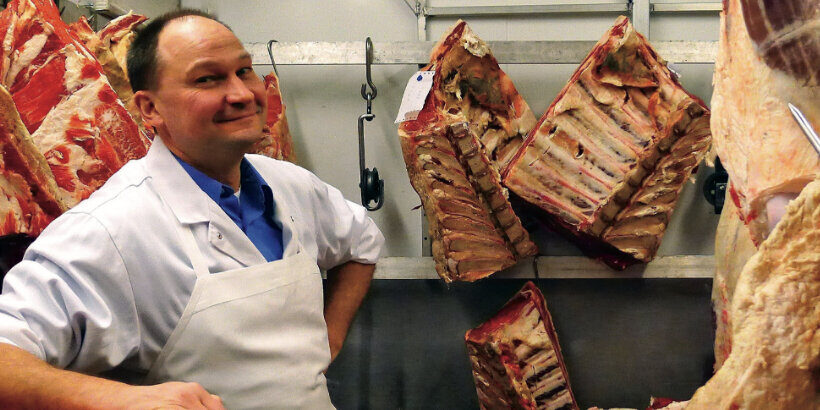
(Bertrand Makowka of Boucherie Viandal in Montréal is a master butcher who—with his brother Yves—is carrying on the family tradition of whole-animal butchery begun by his father 30 years ago.)
Get ready to read about some business practices the meat sector doesn’t want you to know about. Some of them may seem far-fetched, but I can assure you that all are true. How do I know? Because I’ve been there.
Practices in Meat Production
In my many years of working in meat departments, I’ve seen some shocking examples of very poor practices, both ethically speaking and sanitation-wise. These are things I think every shopper should be aware of, both to avoid getting ripped off and to avoid possibly getting sick.
Why some meat department managers think it’s okay to cheat their customers this way, I don’t understand. Your best defense against their kind of ripoffs is to educate yourself. Don’t allow dishonest practitioners to thrive on your ignorance.
I’m giving you the benefit of my inside knowledge here. I refuse to work for large supermarket chains any longer because of their deceptive practices and lack of quality. They survive only because of deceptive advertising and labeling and—most of all—because of customer ignorance.
What to Consider Before Buying Meat
The next time you’re wandering past the meat department of your supermarket wearing a sweater because of the Arctic chill, take a closer look at what’s being offered. Chances are you’ll see meat offerings with labels like reduced! or special today!! or manager’s special!!! What exactly does this mean? Did the manager personally endorse that “Manager’s Special”?
During my years working in large supermarkets and chain stores, I learned one important fact: The department manager’s authority is surprisingly small. A meat manager’s authority is generally limited to ordering products for his or her department, directing his or her staff or reprimanding them for infractions, sitting in on an interview of a potential employee, and making sure that the mandated policy of the company is followed.
Be Cautious With Labels
Pricing of products, weekly advertised specials, and the determination of what products will be sold are handled by the corporate office. I am very wary of any fresh food with a red label of any kind on it implying that it is a special deal. If a piece of meat is labeled manager’s special, it has nothing to do with the individual manager.
The department stocks rolls of labels for different circumstances—special today! . . . fresh turkey! . . . manager’s special! . . . I am woman, hear me roar! (no, wait, not that one)—so when a piece of meat is nearing the end of its shelf life, you can bet that it’s suddenly the Manager’s Special. ’Cause if they can’t sell it fast, they have to throw it out. Probably tomorrow.
Now, suppose you buy a package of chicken parts with one of those labels on it, intending to cook it for dinner, but then you decide not to cook tonight. That chicken might end up spoiled totally if it’s not frozen immediately.
Watch Out for “Close-Dated” Products
In the world of meatdom, the term close-dated refers to a product (typically vacuum-packed primal or subprimal cuts) shipped from the warehouse/ wholesaler to the retailer with an imminent use-by or sell-by date. This doesn’t necessarily mean the product is bad or spoiled; it simply means that it will have little or no shelf life left once it is opened, and maybe only one or two weeks left unopened.
In the case of beef, if the meat is left in the vacpacked or Cryovac package and the seal is intact, it may well be good for another week, or even two. But as soon as the vacuum pack is opened and the meat is exposed to air, it must be used or frozen right away; otherwise it will spoil rapidly.
Shelving Outdated Products

A self-service meat case. Generally, if a store has both types of meat cases, the quality of the meat in a service case is expected to be superior to that in the self-service case. Unfortunately, this isn’t always so.
I know one supermarket chain that forces its meat departments to accept close-dated or outdated products from the chain’s warehouse—even if those products haven’t been ordered.
Another chain I know of shipped pallets of close-dated or outdated meats as often as once a week to their meat departments. Great way for the company to clean out old stock that it can’t unload anywhere else.
It charged the meat department anywhere from 40 cents to one dollar per pound and instructed the meat department to double that price for retail sale.
For example, outdated or nearly outdated chicken at a cost of 40 cents a pound would be retailed for 80 cents. Rib eye or New York strip costed at a dollar per pound would sell for two bucks a pound.
Buying Meat “On Sale”
But that’s not all. Since the meat managers knew that items like rib eye, New York strip, and tenderloin sell well, they often offered these close-dated or outdated cuts to the public at $4.99 or $5.00 a pound (especially if their regular price was $8.99 or $9.99 per pound). Great deal, right? This is how some managers achieve the profit margins their head offices demand of them.
I know retail stores that buy only close-dated products and sell them as fresh. Some freeze the close-dated product, thaw it out as they need it, and sell it as fresh. Here in Vermont (as far as I last knew), such a product must be labeled previously frozen. These stores do not label it as such. It’s a practice I detest.
If the meat you’re buying is much cheaper than most of the competition in your area, if it doesn’t maintain the bright red color it has when first opened for at least 24 hours in your refrigerator, and if it has a gassy odor when it’s opened, chances are it is a close-dated meat product (near the very end of its shelf life). It is certainly old and could very well make you sick. So if you’re buying New York strip, rib-eye steak, or tenderloin and the price seems too good to be true, it is. If you smell a rat, it’s a rat.
Buying Pre-Packaged Meat
It’s not unusual to see meat items like lamb or veal shanks sliced for osso bucco and offered in vac-pak or frozen packs of two. Very convenient. What you can’t tell from the packaging is whether those shanks have been thawed and refrozen several times before packaging (it happens). Sometimes the individual packages aren’t dated . . . the correct date was on the original box in which that meat arrived at the store.
Often, items that are less popular (and thus take longer to sell) are stored in the freezer. Upon request, the butcher will grab one package, weigh it for the customer, and put the label showing the weight and date on the package. But the date shown will be that day’s sell- or use-by date—even though the package of meat may have been sitting in the freezer for six months to a year.
Ask for A Sniff Test

Cole Ward in front of the meat department in a grocery store.
Folks have told me that they’ve purchased these types of convenience packages, brought them home, opened the package, and found that they smelled to high heaven. Sometimes it’s just a little gassy smell; other times they smell really rancid—so much so that even rinsing in cold water didn’t help.
If you’re considering pre-packaged shanks, be sure to ask the butcher to open them up first so you can smell them before you buy. This may save you a trip back to the store. Remember, if you even question the freshness of meat, don’t eat it!
Beware of Marinated Meat
I worry about marinated meat products in a large supermarket, because I know that many meat markets marinate their old stuff to give it more shelf life. This is especially true of chicken. If a store is going to sell marinated items, the meat should be marinated at its freshest. And the tray should be dated.
There are two dates to look for: a sell-by date or a “when-packaged” date—this latter means it’s up to you to determine whether it’s as fresh as you’d like. Most states require stores to label meat with one of the above. Which one is the store’s call. If there’s no date, ask when the meat was marinated and make sure that the store is willing to guarantee the product.
Buying Meat from Farms
One way to identify farms that raise and slaughter humanely is to find one that has been awarded a seal of compliance from an animal welfare association. Animal Welfare Approved (AWA) is a program in which farms are annually audited for compliance with extremely stringent animal welfare standards.
Those that pass are allowed to display the AWA seal. The certification is offered to farmers free of charge, so that the process can’t be tainted by financial influence. There are other humane certification programs out there—just go online and search.
Questions to Ask the Farmer
It’s also critical to ask questions—talk to the farmer face-to-face, or by phone or email. Reading this book will give you plenty of ammunition for developing a list of questions. And I’ll help you out here, too. Here’s a checklist of things to ask a farmer before you commit to your first carcass:
- How long have you been raising animals?
- What is the breed of animal you use? Do you breed your animals yourself, or purchase young animals for raising?
- Do you use any growth hormones, feed additives, or nontherapeutic antibiotics? If so, why?
- How do you raise your animals? What do they eat?
- At what age do you slaughter them?
- Are they humanely slaughtered?
- How is your meat inspected? Federal or state? (Either is fine, by the way.)
- Is it USDA-graded? If not, how well is it usually marbled? How do you believe it grades?
- Is it aged? If so, for how long and where?
- Can you give me the names and phone numbers/ email addresses of previous purchasers? (If a farmer won’t give you references, find a different farmer.) Do you ship? How is the carcass/primal packaged?
- Do you stand behind your product? In what ways?
Recommended Reads
You may like...
-
 $24.95
 -
$35.00
-
$29.95


Recent Articles

All hail the joyful juneberry! While these berries taste wonderful when they’re fresh, you can also preserve them and create beverages with them.
Read More
Looking for something to munch on that’s both tasty and good for you? These ginger carrots are a healthy snack that are easy to make at home! The following excerpt is from The Heal Your Gut Cookbook by Hilary Boynton and Mary G. Brackett. It has been adapted for the web. Ginger Carrots Recipe…
Read More
Do you have an old, worn-out pair of jeans in your dresser? Instead of throwing them out, try to grow mushrooms on them. Follow these guidelines to get started.
Read More
Mead is one of the oldest fermented beverages and is made by fermenting honey with water, offering countless flavor possibilities. Let’s dive into the world of mead making!
Read More
Learn how to make the anti-inflammatory cocktail, Gates of Immortality! This is a vibrant, botanical twist on the classic Whiskey Smash.
Read More