

The Organic Farmer’s Business Handbook
A Complete Guide to Managing Finances, Crops, and Staff – and Making a Profit

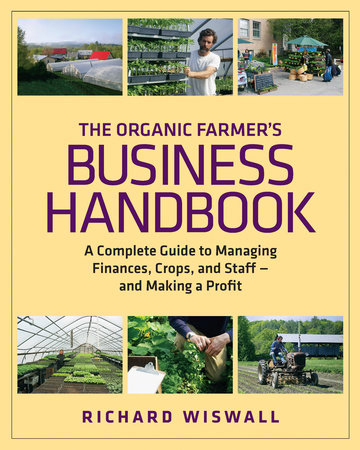
| Pages: | 224 pages |
| Book Art: | Black and white photos charts |
| Size: | 8 x 10 inch |
| Publisher: | Chelsea Green Publishing |
| Pub. Date: | September 30, 2009 |
| ISBN: | 9781603581424 |
The Organic Farmer’s Business Handbook
A Complete Guide to Managing Finances, Crops, and Staff – and Making a Profit
Contrary to popular belief, a good living can be made on an organic farm. What’s required is farming smarter, not harder.
In The Organic Farmer’s Business Handbook, Richard Wiswall shares advice on how to make your vegetable production more efficient, better manage your employees and finances, and turn a profit. From his twenty-seven years of experience at Cate Farm in Vermont, Wiswall knows firsthand the joys of starting and operating an organic farm—as well as the challenges of making a living from one. Farming offers fundamental satisfaction from producing food, working outdoors, being one’s own boss, and working intimately with nature. But, unfortunately, many farmers avoid learning about the business end of farming; because of this, they often work harder than they need to, or quit farming altogether because of frustrating—and often avoidable—losses.
In this comprehensive business kit, Wiswall covers:
- Step-by-step procedures to make your crop production more efficient
- Advice on managing employees, farm operations, and office systems
- Novel marketing strategies
- What to do with your profits: business spending, investing, and planning for retirement
A companion toolkit, available for download upon purchase of the book, offers valuable business tools, including easy-to-use spreadsheets for projecting cash flow, a payroll calculator, comprehensive crop budgets for forty different crops, and tax planners.
Reviews & Praise
"What a breath of fresh air! Richard Wiswall challenges the conventional notion that there's no real money in farming. He argues that farmers should be well-compensated, and then he shows how to make that happen. Every farmer--organic or not, beginner or experienced--should read this book."--Lynn Byczynski, editor and publisher of Growing for Market, a journal of news and ideas for local food producers
"Many people become organic farmers because they love growing crops and working the land, but truth be told that's often the easy part. Richard Wiswall's book provides practical, real-world guidance for dealing with the hard part: the business of farming."--Vern Grubinger, Vegetable and Berry Specialist, University of Vermont Extension
"Here is a call to 'wake up and smell the pencil shavings!'--that a sharp pencil (and the ability to use it) is an essential tool for every farmer's toolbox. Farmers old and new will find great practical benefit from Wiswall's book."--Andrew Brait, Full Belly Farm, Guinda, CA
"How could anyone hope to produce a business guidebook useful to one of the most diverse, independent, even contrary groups of people on earth? This essential book is overdue! While the principles have been around for some time, this is the first they have been assimilated and tested so successfully."--Ed Martsolf, Petit Jean Farm, Morrilton, Arkansas
"Richard Wiswall has given us a finely tuned handbook to run a profitable organic farm. Most farmers love the growing part but dread the business end, and suffer financially for it. This is a book that I will recommend to ANY farmer regardless of how long he or she has been in business. There are a lot of hard-learned lessons contained within that will help avoid reinventing the wheel, as so many of us have."--Mark Wheeler, Pacific Botanicals LLC, Grants Pass, OR

About Richard Wiswall
Richard Wiswall started Cate Farm in East Montpelier, Vermont, where he has farmed since 1981. Known for his work on farm profitability and appropriate business tools, Wiswall consults with other farmers, and writes and speaks frequently on organic-farm business issues. He is the author of book The Organic Farmer’s Business Handbook and Business Advice for Organic Farmers, a practical workshop available on DVD. To learn more about Wiswall and Cate Farm, visit www.catefarm.com.
Connect with Richard Wiswall
Books by Richard Wiswall
You may also like...
-
 $29.95
 -
$39.95
-
$27.00


