

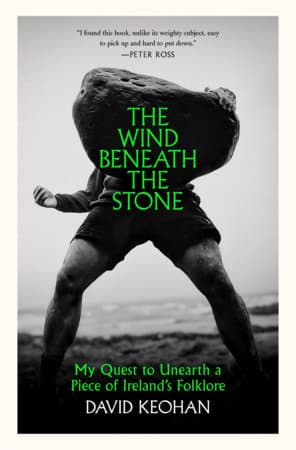
| Pages: | 240 pages |
| Size: | 6 x 9 inch |
| Publisher: | Chelsea Green Publishing |
| Pub. Date: | September 1, 2026 |
| ISBN: | 9781645024897 |
The Wind Beneath the Stone
My Quest to Unearth a Piece of Ireland’s Folklore
Hardcover
$28.00
Told through the natural beauty of the Irish landscape, The Wind Beneath the Stone is an inspirational story of hope and community that reveals how a simple challenge can take on a life of its own.
When world kettle-bell lifting champion David Keohan heard the old tales of stone-lifting, he was captivated, setting off on a quest to rediscover these famous stones and attempt the feats of heroes past by lifting them. Guided by a 1930s archive, the dúchas, in which schoolchildren shared their local folklore, Keohan began to travel the country in search of the stones. They were often to be found hidden away in quiet villages or cemeteries, their purpose almost forgotten. But, as he journeyed through Ireland, he met those who recalled the stories of the stones and the legends attached to them. Soon, others joined him as he took on the challenge of lifting these pieces of history, the heaviest of which weighed well over 450 pounds.
As Keohan’s efforts garnered more and more attention, he realized that this was more than a personal challenge. Stone-lifting had become a way for Irish people to reclaim their lost heritage, coming together to celebrate what makes their homeland special.
“[Keohan] is a scholarly Hercules who parses myth, folklore and literature . . . [and] had almost single-handedly revived the practice [of stone-lifting] in Ireland and helped stir global interest.”—The Guardian
Reviews & Praise
"Fascinating, strange, groundbreaking research in an area that intersects folklore, history, mythology and strength training."—The Blindboy Podcast
"A grand tale told with vigour and charm. I found this book, unlike its weighty subject, easy to pick up and hard to put down."—Peter Ross, author of Upon A White Horse
"A fascinating read ... This book is not just about David's ability to lift great stones. By answering the call of the stones, he has rediscovered a deep spiritual connection to the Draíocht - the magic - of the landscape, folklore, mythology, history and the language of Ireland. Through his relationship with the stones, he describes a journey of reclamation and healing, and of becoming at one with this land."—Eimear Burke, Chosen Chief of the Order of Bards, Ovates and Druids
"A gripping and glorious tale of the rediscovery of a lost Irish custom and the hunting down of the stones of strength themselves, which amazingly turn out to survive all over the country. David Keohan reveals how folklore offers profound connection to the landscape and the past - and the fine adventure there is to be had in seeking out (and in his case lifting!) storied stones."—Fiona Robertson, author of Stone Lands
"An excellent piece of literature embracing social history, folklore and storytelling with a nice literary style. A journey that enlightens and informs but also encourages us to reacquaint ourselves with what belongs to all of us: our language in its entirety and not just in its words."—Sean Ó Coisdealbha
"Strange to say, but this book about lifting heavy ancient stones is a blast of fresh air. An utterly original and joyously uplifting memoir of extreme sport and unearthing folklore."—John Lewis-Stempel, author of England: A Natural History
About David Keohan
David Keohan is an avid musician, with a degree in Fine Art and a world championship title in kettlebell sport. He has used this mix of creativity and single-minded focus to unearth and reanimate an entire lost culture of strength in Ireland, namely stone-lifting. His efforts have garnered him national and international attention, with features in GQ and Mr Porter magazines as well as TV, podcast and documentary appearances. He lives with his family in Waterford in the south-east of Ireland.
Connect with David Keohan
Books by David Keohan

You may also like...
-
 $29.95
 -
$17.95
-
$19.95


