

The Organic Grain Grower
Small-Scale, Holistic Grain Production for the Home and Market Producer

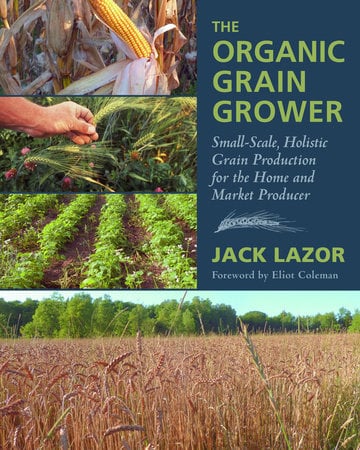
| Pages: | 448 pages |
| Size: | 8 x 10 inch |
| Publisher: | Chelsea Green Publishing |
| Pub. Date: | February 22, 2023 |
| ISBN: | 9781645022015 |
The Organic Grain Grower
Small-Scale, Holistic Grain Production for the Home and Market Producer
Paperback
$45.00
“The Organic Grain Grower is the best resource we’ve seen for small-scale grain growers everywhere. . . . [Lazor’s] passion comes alive in this fine guidebook’s depth of detail.”—Mother Earth News
The ultimate guide to growing organic grains on a small and ecological scale
The Organic Grain Grower is invaluable for both home-scale and commercial producers interested in expanding their resiliency and crop diversity through growing their own grains. Longtime farmer and organic pioneer Jack Lazor covers how to grow and store wheat, barley, oats, corn, dry beans, soybeans, pulse crops, oilseeds, grasses, nutrient-dense forages, and lesser-known cereals. In addition to detailed cultivation and processing information, Lazor argues the importance of integrating grains on the organic farm (not to mention for the local-food system) for reasons of biodiversity and whole farm management. Including extensive information on:
- The history of grain growing and consumption in North America
- The twenty-first century and the birth of the local-food movement
- Considering your farm’s scale and climate
- Understanding soil fertility and structure
- Planting your crop (including spring vs. fall cereals and preparing your soil)
- The growing and ripening process (reproductive, milk, hard-and-soft dough stages)
- The grain harvest
- Preparing grain for sale, storage, or end use (drying, cleaning seed, grain handling)
- Seed breeding and saving
- Machinery, infrastructure, and processing (both home-scale tools and larger farm equipment)
- Grinding grains for livestock rations (including how to put together a ration based on protein content) and sample rations for dairy cows, pigs, and chickens
- Processing grains for human consumption
- Additional resources and information for new grain farmers, and more…
Beginners will learn how to grow enough wheat for a year’s supply of bread flour for their homestead, and farmers will learn how to become part of a grain co-op, working alongside artisan bakers and mills. Never before has there been a guide to growing organic grains applicable both for the home-scale and professional farming scale.
This will be a classic for decades to come and a crucial addition to any farmer’s, homesteader’s, gardener’s, agronomist’s, or seed-saver’s library.
Reviews & Praise
"Jack Lazor writes about grain growing with passion and experience. With this wealth of background and insight, readers will want to do it themselves, and with the lode of detailed information Jack provides, they will be able to do so. Although his focus is on medium-scale commercial production, many of the tips he shares are applicable to the backyard grain-grower as well."—Will Bonsall, Khadighar Farm; director, Scatterseed Project
“Another outstanding offering from Chelsea Green Publishing, Lazor’s guide will doubtless plant the seeds of inspiration among beginners and old hands alike as they tackle the complexities of grain growing and organic agriculture, and will do its part to propagate more general interest in the subject."—ForeWord Reviews
“The Organic Grain Grower is quite possibly the most complete and extensive text ever written on grain production in the Northeast. Jack Lazor’s deep passion and knowledge creates an astounding story, and he shares his wisdom and experience generously. If you have ever wanted to grow grain, this is a book to own and cherish.”—Dr. Heather Darby, University of Vermont Extension Agronomist
“Jack writes from the top of a mountain—the mountain of his life. His long years of experience are longer than his very beard, and the wisdom and distillation of his farming life are written here with clarity and graceful articulation. As he says in the book, ‘people are hungry for meaning as well as food.’ In this classic book, Jack provides not only the meaning, but also the methods required to succeed as a small-scale grower of organic grains."—Jeffrey Hamelman, director, King Arthur Flour Bakery, and author of Bread: A Baker’s Book of Techniques and Recipes
"Given our industrial agriculture, most of us assume that grain can only be grown in huge monocultures devoted to producing as much as possible, unmindful of the quality. But in The Organic Grain Grower, Jack Lazor provides us with a practical and attractive alternative. As a farmer he has demonstrated that one can provide an emerging market with a diversity of superior quality grains, grown on a small scale, using heirloom varieties and modest investment. This book is (as Eliot Coleman puts it) “like acquiring hundreds of years of knowledge in one book.”—Frederick Kirschenmann, author of Cultivating an Ecological Conscience
“I believe I can safely say, without losing any money, that if you know of one fact truly necessary to growing grains organically in the United States that is not in this book, I'll pay you five bucks out of my own pocket. Plus there's a whole bunch of stuff about how to process and use grains in the barn or on the table that I have not found all in one place before.”—Gene Logsdon, author of Small-Scale Grain Growing

About Jack Lazor
Jack Lazor was co-owner of Butterworks Farm in Westfield, VT, with his wife, Anne, and cofounder of the Northern Grain Grower’s Association. Jack grew organic grains in the mountains of Vermont’s Northeast Kingdom from 1975 until his passing in 2020, both for human consumption and for feed for the family’s herd of Jersey cows. He is considered a leader in the movement for growing grains in cold climates, and was the recipient of many agricultural awards. Butterworks Farm grows corn, oats, barley, soybeans, legumes, alfalfa, and oilseeds, such as flax and sunflower. They also produce organic Jersey milk yogurt, buttermilk, sweet Jersey cream, cheddar cheese, and grain products.
Connect with Jack Lazor
Books by Jack Lazor
You may also like...
-
 $49.95
 -
$29.95
-
$29.95


