ISBN: 9781931498920 Year Added to Catalog: 2006 Book Format: Paperback Book Art: Glossary, Notes, Index Number of Pages: 6 x 9, 350 pages Book Publisher: Chelsea Green Publishing Old ISBN: 193149892X Release Date: November 30, 2006
Also By This Author
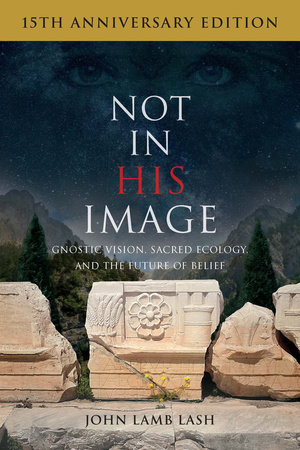
Not in His Image
Gnostic Vision, Sacred Ecology, and the Future of Belief
Not in His Image is an extraordinary and profound book. It lays bare the foundation of much of what passes for religion in this culture. In so doing it lays bare much of the foundation of the destructiveness that characterizes—that is—this culture.
That would be more than sufficient to make this book worthwhile, but Not in His Image does more: it points the way toward a religion that existed long before Christianity, toward a religion not based on control, rigid hierarchy, and separation from the earth and from the body but instead toward a religion based on ecstatic immersion in the mysterious and beautiful processes of life itself.
In other words, this book points the way home.
A few years ago I read John Lamb Lash’s book The Hero: Manhood and Power. It’s an important book, with its discussion of what it means and what it is to be a man, historically, mythologically, artistically, emotionally, physically. We corresponded.
And then he asked if I’d like to see the typescript of what became this book. I said yes. Having read his work, I thought I was prepared for this book.
I was wrong.
John told me he was sending the typescript to several colleagues, many of whom were, he said, eager to provide robust criticism. I told him I didn’t see that as my role, because I rarely find that sort of feedback helpful, or in fact anything but harmful: my job as his colleague is not to attempt to impose myself onto his book, but rather to help him say what he wants to say in the way he wants to say it.
John agreed, sent the typescript.
Before it arrived I told him also that I wasn’t sure I’d have the time to make a lot of comments anyway. I’d comment when I could, but. . . .
He understood.
I got the typescript, opened it, started reading.
When I’d told him that I wasn’t going to offer “robust criticism” I’d been right, but not for the reason I thought: I offered very few suggestions, less from a desire not to impose, but because the work was already very powerful.
When I told him I wasn’t going to comment, however, I was wrong. I did, page after page.
I found so many remarkable passages—passages that gave me gifts of understanding, clarity, courage to carry on with my own work in opposition to this deathly culture—that I stopped sending them all for fear I would bore even John.
My comments were along the lines of: “Stunning analysis. Amazing.” This was in response to this passage: “Columbus noted that the Taino Indians of the Dominican Republic were as happy as human beings can be, open to the strangers, eager to show their way of life and share it. His response was typical of the irrational violence of ‘the emotional plague,’ as Wilhelm Reich called the pathological revulsion manifested by people who are alienated from their own bodies. Columbus’ men burned the Indians alive in their huts. This reaction spread like a contagion, infecting all the following waves of invaders. Such is the mad, blind, and perverted behavior that springs from ‘a prior wounding.’”
Or “Beautiful. Unbelievably well put. This goes right to the heart of the problem.” This was my response to: “Pleasure (Greek hedonia) is an essential issue in any discussion of Paganism, but discussions of pleasure often veer away from deeper understanding of Pagan sensibility. It is rarely observed that fondness for sensual and sexual pleasure might be a spontaneous expression of the joy of living in the natural world, rather than a symptom of evil, all-consuming lust.”
And so it goes, page after extraordinary page.
I like Not in His Image for many reasons, not the least of which is that it eradicated for me the last tiny shreds of respect I had for Christianity.
Raised a fundamentalist Christian, I was a true believer as a child. Gradually, through my teens and early twenties, I sloughed off those beliefs (Why, I remember wondering, would Jesus care if I masturbated? How could something that feels good and harms no one be a sin?). Later I shed more of these beliefs as I grew to understand the central role Christianity has played in the systematic destruction of indigenous peoples, the systematic oppression of women, the systematic destruction of the natural world: the systematic expansion of a deathly empire.
For the longest time—for as long as I could—I made excuses for the religion: “Oh, that’s only how Christianity has been used, and doesn’t represent what it really is.” I said this for years despite the damning fact that what some theoretical Christianity might or might not be like is infinitely less important than what it is, and despite the far more damning evidence of Christianity’s texts themselves. I said this despite the obvious body- and earth-hatred inherent in Christianity and any other religion that posits the body and the earth as places of sin, sorrow, suffering, and shame, places which must be transcended, or escaped after death to some distant heaven. I finally came to understand that sitting in the duff beneath a redwood tree, listening to the wren-tits is heaven enough for me.
Okay, so I’d given up on Christianity, but still, I thought, Jesus—the Son of God, born through divine intervention and without recourse to messy sex—surely he had some good things to say, if only we silly, mortal humans would listen to them.
Well, Lash rid me of this belief, and for that I am thankful. He wrote: “There are just three sayings of Jesus that epitomize what is truly unique in the message of Christianity.” They are, from Matthew 5: “But I say unto you that ye resist not evil, but whosoever shall smite thee on thy right cheek, turn to him the other also,” and “Love your enemies, bless them that curse you, and do good to them that hate you,” and “Blessed are ye when men shall revile you and persecute you, and shall say all manner of evil against you falsely, for my sake.”
With the unique teachings of Jesus gathered together like this, suddenly I understood. As John writes, “The inner logic of the pathology becomes evident, as can be seen by a comprehensive paraphrase of the verses: Victims who do not resist perpetrators should even invite further harm from them, and if they love and do good to those who harm them they will be recognized in their suffering by the redeemer.”
Lash’s powerful analysis follows: “The proposition guarantees that victims will triumph spiritually, all the while allowing total liberty to those who harm, persecute, and slander them—an extremely good deal for the perpetrators, it would seem.” He says, “Upon scrutiny, redeemer ethics [that is, the teachings of Jesus] read as if they were written by the perpetrators for their own benefit.”
With that sentence I finally understood: Jesus as soft-spoken agent of the oppressors, whispering to us that we must never resist.
Lash also writes, “Jesus commands you to love your neighbor as yourself but tells you nothing about how to love yourself, so the advice is virtually useless. Self-love is the natural side of effect of loving life. Jesus does not say, ‘You shall love your own life in the same way you love another person, freely and spontaneously, asking nothing in return.’ The words attributed to Jesus do not say anything like this because the message of love they are said to contain is not what it is put up to be.”
Ninety percent of the large fish in the oceans are gone, taken by this culture. Native forests are gone, taken by this culture. Native human beings are gone, taken by this culture. A spontaneous and free love of our own bodies and our own lives is gone, taken by this culture. The culture is systematically destroying the planet, our only home. It is systematically destroying us. It is time that we put a stop to it. But before we can put a stop to it, we must see it for what it is.
John Lamb Lash’s book is a blessing, and a warning that we must cease taking the terrible advice of Christianity that we not resist evil, and that we must on the other hand reinhabit our own joyful, painful, mortal, beautiful bodies and fight for our lives and for the lives of those we love.