
Like this book? Digg it!

Book Data

ISBN: 9781890132521
Year Added to Catalog: 2001
Book Format: Paperback
Book Art: b&w illustrations, bibliography, resources, index
Number of Pages: 8 x 10, 240 pages
Book Publisher: Chelsea Green Publishing
Old ISBN: 1890132527
Release Date: April 1, 2001
Web Product ID: 210

Also in Gardening & Agriculture

Garden Seed Inventory, Sixth Edition
The Earth Care Manual

Edible Forest Gardens Vol. I
The Permaculture Way

You Can Farm
The Backyard Berry Book

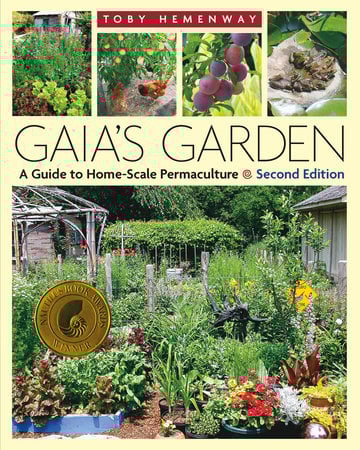
Gaia's Garden

A Guide to Home-Scale Permaculture

by Toby Hemenway

Foreword by John Todd

Excerpt 2

Preface

This book began when I visited a garden that felt unlike any I had seen.

Sometimes in a tropical forest or snorkeling in a coral reef, I have felt an aliveness, a sense of many interlocking pieces clicking together into a living and dynamic whole. These are places that naturally exude abundance. Sadly, this feeling was utterly lacking in any human-made landscape I had experienced. Natural landscapes seem so rich—they seethe with activity, they hum with life in comparison to ours. Why is it that nature can splash riotous abundance across forest or prairie with careless grace, while we humans struggle to grow a few flowers? Why do our gardens offer so little to the rest of life? Our yards seem so one-dimensional, just simple landscapes that offer a few vegetables or flowers, if that much. Yet nature can do a thousand things at once: feed insects and birds, snakes and deer, and offer them shelter; harvest, store, and purify water; renew and enrich the soil; clean the air and scent it with perfume; and on and on.

Then I visited a garden that felt the way nature does, yet hung heavy with fruit and edible greens. Soon I found a few others like it. In these places, using new techniques from permaculture and ecological design, and old ones from indigenous people and organic gardening, a few pioneers have created landscapes that feel like nature but provide a home for people as well. These are true backyard ecosystems that were designed with methods and concepts gleaned from nature, and that feel as alive as any forest. I wanted to know how to create these places, and I wanted to help others create more. Gaia’s Garden is the result of that pursuit.

These gardens represent a new type of landscape that provides for people as well as for the rest of nature. You could think of them as “edible landscaping meets wildlife gardening,” but they are more than that. These are true backyard ecosystems—not just disconnected fragments—that are as resilient, diverse, productive, and beautiful as those in nature. They are not merely flowery showplaces or ruler-straight arrays of row crops. Yet they also are not the brambly tangles that identify many wildlife gardens. They are places where conscious design has been melded with a respect and understanding of nature’s principles. The result is a living and riotously abundant landscape in which all the pieces work together to yield food, flowers, medicinal and edible herbs, even craft supplies and income for the human inhabitants, while providing diverse habitat for helpful insects, birds, and other wildlife. Places where nature does most of the work, but where people are as welcome as the other inhabitants of Earth.

Although this book is about environmentally friendly landscapes, it not an eco-fanatic’s manifesto. It’s a book on gardening, full of techniques and garden lore. But between the lines on these pages is a plea for less consumption and more self-reliance. Anyone who would pick up this book is probably familiar with the environmental destruction humans have wrought in the past few decades, so I’m not going to assault my readers with grim statistics. Suffice it to say that we have to do better. This book is an attempt to show one way to proceed. Our home landscapes consume immense amounts of resources. Providing for our needs spurs relentless conversion of wild land into factory farms and industrial forests. Yet our yards, city parks, curbsides, even parking lots and office courtyards could be lush, productive, and attractive landscapes that aid nature while yielding much for us as well, instead of being the grassy emptinesses that they are. This book shows how to do this, using techniques and examples devised by the pioneers of the sustainable-landscaping movement.

I assume that most of my readers have done a little gardening. Gaia’s Garden is not an introductory gardening book, but I do attempt to explain some new techniques and concepts well enough for novice gardeners to implement them. Many of the subjects touched on here are large enough to deserve a book of their own, so lamentably I’ve had to limit how deeply I plunge into some fascinating topics. This may be frustrating to some readers, but I’ve included an annotated bibliography and a resources section to allow further pursuit of these subjects.


Most plants mentioned in this book are identified by common name to avoid the Latinate bafflement that botanical nomenclature can inflict on many gardeners. For a few unusual species, I’ve added the botanical name. The various tables and lists of plants are also alphabetized by common name, but in those I have included the botanical name, as that is the only way to be sure we’re all talking about the same species.

With hundreds of thousands of plant species to choose from, these tables cannot hope to be comprehensive lists of all useful plants, but I hope my selections will provide readers with a broad palette from which to choose. To represent the wide variety of geographic regions on this continent, I’ve also tried to give examples from many areas and for different climates. More Americans now live west of the Mississippi than east of it, and this book reflects that bi-coastal reality.

Most of the ideas in this book aren’t mine. Many of the techniques shown here have been practiced by indigenous people for millennia, or worked out by gardeners of all stripes. They have also been compiled in the ever-broadening array of books on ecological design and permaculture. In this book, I’ve attempted to synthesize these permacultural ideas with ecologists’ growing understanding of what makes nature work. I can claim credit for few of the techniques and concepts described here, merely for the way some of them are presented. And of course, any errors are my own.

This book required the collaboration, hard work, and support of numerous people. I visited many gardens while researching these pages (one of the major perks of my subject choice). For letting me visit their sites and for their generosity with time and knowledge I thank—in alphabetical order—Earle Barnhart, Douglas Bullock, Joe Bullock, Sam Bullock, Kevin Burkhart, Doug Clayton, Joel Glanzberg, Ben Haggard, Marvin Hegge, Simon Henderson, Alan Kapuler, Brad Lancaster, Penny Livingston, Art Ludwig, Anne Nelson, Jerome Osentowski, John Patterson, Barbara Rose, Julia Russell, James Stark, Roxanne Swentzell, Tom Ward, and Mary Zemach. For support and fruitful ideas I thank Peter Bane, Bill Burton, Brock Dolman, Ianto Evans, Jude Hobbs, Keith Johnson, Michael Lockman, Bill Mollison, Scott Pittman, Bill Roley, Michael Smith, and Rick Valley. For telling me that books were not as hard to write as I feared, a special thanks to Stuart Cowan. To my agent, Natasha Kern, I owe a huge debt for her perseverance, her ideas, and her confidence. Thanks also to my very skillful editor, Rachael Cohen, who has smoothed the text considerably and tidied up my grammatical excesses. The staff at Chelsea Green have been a pleasure to collaborate with. And for a thousand graces, large and small, while I disappeared into this book, I am grateful to my wife, Carolyn.

Toby Hemenway


$24.95
On Sale: $19.96!
Format: Paperback
Status: Available to Ship
Ships: Next day