
Like this book? Digg it!

Book Data

ISBN: 9781890132521
Year Added to Catalog: 2001
Book Format: Paperback
Book Art: b&w illustrations, bibliography, resources, index
Number of Pages: 8 x 10, 240 pages
Book Publisher: Chelsea Green Publishing
Old ISBN: 1890132527
Release Date: April 1, 2001
Web Product ID: 210

Also in Gardening & Agriculture

The Basics of Permaculture Design
Getting Started in Permaculture

Salad Bar Beef
Sharing the Harvest, Revised and Expanded

The Woodland Way
Worms Eat Our Garbage

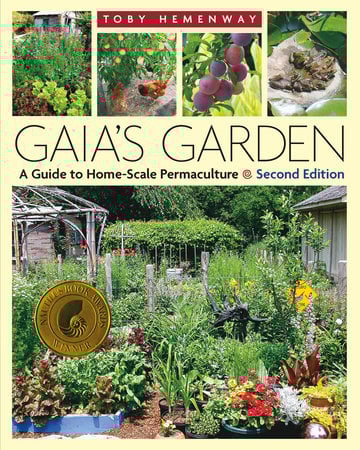
Gaia's Garden

A Guide to Home-Scale Permaculture

by Toby Hemenway

Foreword by John Todd

Excerpt

Foreword

by John Todd

As the readers of Gaia’s Garden will discover, Nature is an extraordinary designer. I teach ecological design to university students and one of my favorite teaching tools is a simple one. My students collect samples from at least three aquatic habitats, such as a wet pool in the woods, an animal wallow on a farm, and a pond or lake, and mix them together in a glass jar. With lids screwed on tightly, the students turn their jars upside down and place them in sunny windows to watch and record the unfolding drama within. I myself have kept such a jar near my desk for several years.

In the presence of sunlight, a microcosm, or miniature world, begins to organize itself. Tiny bubbles of oxygen congregate under small aquatic plants and on the surface film of the water. Within days, an internal physical structure or architecture starts to evolve, complete with biological zones of activity. Life burrows on the bottom in the sediment zone. Aquatic weeds, fragments at first, grow into miniature “forests” that reach up into the water column. The water itself teems with a diversity of microscopic life. With magnifying glasses the students discover creatures reminiscent of shrimp and other minute creatures resembling monsters from one’s imagination. The water/air interface is another zone with its own activity, where tiny insects skate across the surface film. The air column above plays its own role, exchanging gases with the water below. At night, when the air column cools, water droplets condense at the top of jar. Tap it with a pencil and it rains inside.

Within the first few weeks an observer can notice grazing and predatory cycles. Swimming animals, called zooplankton, appear seemingly out of nowhere, then disappear to be replaced by other species. Snails lay egg clusters on the walls. The aquatic plants grow into complex shapes to gather light and nutrients. Some plants penetrate the water/air interface and grow up into the air. Algae on the walls create a green carpet that consumes carbon dioxide and saturates the jar with oxygen gas during the day. The snails graze the algal carpets, leaving winding and spiraling paths that let light through to the rooted plants within.

The communities that adapt within are unique, part forest pool, part farm wallow, and part pond. All the life forms in the jars are familiar to biologists, but the combinations of species are unlike anything in the ecosystems from which they have been derived. Ecologically they are new. And each of the students’ microcosms develops differently from the others. The water and sediment samples that seed the jars vary for each student and these differences will affect the life within the jar. Even where the jars are placed on the window will determine their fate.

What is perhaps most fascinating and relevant to my tale here is that despite their differences, all the glass jar communities have four basic attributes in common. First, they have the ability to self-organize in the presence of sunlight. (In darkness or dim light, they do not. Waste products accumulate and most of the organisms die.) Sunlight generates nutrient cycling, gas exchanges, growth, grazing, predation, death, and decay: an ecological dance.

Secondly, self-organization leads to self-design. A living “architecture” is formed where light, space, and the limits of the jar interact with all the life within. The jar’s inhabitants occupy the space optimally. Self-design leads to a beauty and a deep aesthetic within the jar that an observer immediately senses.

Thirdly, these microcosms can repair themselves. If a window blind is left closed and the sunlight blocked for several days the ecosystem within will collapse. But if the jar is returned to the light soon enough, the living systems will begin to reorganize itself. The self-repair process generates a new system, usually different than the one from which it was derived. The attribute of self-repair is essential to the sustainability of the system. Perturbations, whether they be hurricanes, drought, or toxic assault, happen in all systems, but life-in-concert has the mechanisms to adapt.

A final characteristic of the microcosm is the ability to self-perpetuate. The microbial life within the jar reproduces over time periods measured by minutes for bacteria and hours for algae. Higher forms perpetuate their species in days or weeks. Cycles wax and wane with the season, but with any luck the system will persevere. In the jar on my office desk, a microcosm has been unfolding for years. Over time some of the original life forms have gone extinct, for the small size of the jar tests the limits of life working in concert. Yet as a whole, the system is amazingly persistent. The miniature ecosystem that I am looking into now as I write may well outlive me.

The Lilliputian world within the jar has a real power: it reveals Nature as designer. Ecologists have begun to decode the language of natural systems on a larger scale than in my jar. From the rain forests, coral reefs, mangrove swamps, prairies, deserts, lakes, and northern forests, they are deciphering principles of natural design. This knowledge embodies the genius of evolutionary time and the collective experience of all life as a whole system. Like the title of this book, it is Gaian knowledge.

Seeing the world as an ongoing process of ecological design transforms how one approaches the basic problem of supporting humanity. Ecological knowledge is now being used to develop new living technologies that can repair damaged environments and recycle wastes into beneficial new products. These eco-technologies are beginning to influence the design of infrastructures for human communities. In Gaia’s Garden, author Toby Hemenway takes this thinking a powerful step forward by bringing living systems’ intelligence to the household. The book sets forth the radical notion that ecological design, applied at the level of the home, can utterly transform how landscapes are sustained and humans fed. This book provides a genuine alternative to the contemporary industrial/global machine, which extracts resources and exploits humans and landscapes for its own ends and means. If the ideas presented here are widely adapted, then we have the possibility of forging a culture based upon Earth stewardship. In my opinion, ecological design as developed in Gaia’s Garden represents the only long-term hope for humanity.

Gaia’s Garden owes its heritage to the Permaculture teachings pioneered by Bill Mollison and David Holmgren over the last quarter century. In its quiet and wise way, this book outlines a radical redesign for the future of gardening and agriculture, organized around the basic premise that in the growing of foods and the crafting of landscapes, it is possible to substitute ecological information and human stewardship for today’s dependence on capital, hardware, chemicals, machines, genetically engineered organisms, and destructive technologies. Hemenway shows us that the task of restoring the Earth begins in our own gardens.

One of my favorite tales from the book embodies the worldview of the ecological designer in practical ways—through what Hemenway terms “polyculture,” and what I shall call “gardening in the image of a meadow.” Instead of the often back-breaking labor that goes into tilling, sowing, weeding, and chemically controlling a conventional vegetable garden, Toby Hemenway’s meadow-inspired food garden works on totally different principles. It provides its own fertilization, has internal weed suppression and pest-control mechanisms, and manages its internal moisture levels through dry times and wet, functioning as a self-organizing ecology. The cycle begins about one month before the last frost, when the gardener prepares the garden bed with sheet composting or mulching. After the last frost, the gardener broadcasts seeds of radish, dill, parsnip, calendula, and many varieties of lettuce over the garden and spreads one-quarter inch of compost over the seeds. That’s it. Then Nature goes to work. After four weeks, the radishes are ready for harvesting. Cabbage seedlings can fill the holes they leave. By week six, the dense lettuce crop begins yielding mesclun, leaving other lettuce varieties to grow to full size over the next several months. When the soil warms up in late spring and early summer, bush beans and buckwheat take the space formerly occupied by the lettuce. Dill and calendula, whose flowers are edible, are harvested next. The cabbage varieties mature over an extended period, and by fall the parsnips are ready to harvest. The gardener pokes garlic cloves and fava beans into these newest openings, to be harvested the following year. The polyculture provides enough botanical diversity to control pests and disease as well as to protect the plants from excess rain and drought.

Variations on this polyculture theme throughout the book expand the meaning of gardening from the traditional battle to control Nature to a conscious and conscientious attempt to imitate and re-create natural systems in the backyard. Gaia’s Garden shows how ideas and patterns from Nature can be blended and integrated to create larger systems. These larger systems in turn connect with each other to create a self-tending and co-evolving garden landscape.

Ecological design is predicated upon place. Each garden, each valley and each region is different. These differences, in the hands of an Earth steward, can be honored and used toward creative and diverse ends. Each garden is a reflection of the potential of place and the intimacy with which the gardener can connect with the needs and latent forces of the land. Earth wisdom becomes an expanding universe for the seeker, until the garden becomes an Eden where the gardener and garden exist in true harmony. The world we dream of, sustainable and beautiful, takes shape in the ecological garden. Gaia’s Garden is a fine place to begin.


$24.95
On Sale: $19.96!
Format: Paperback
Status: Available to Ship
Ships: Next day