

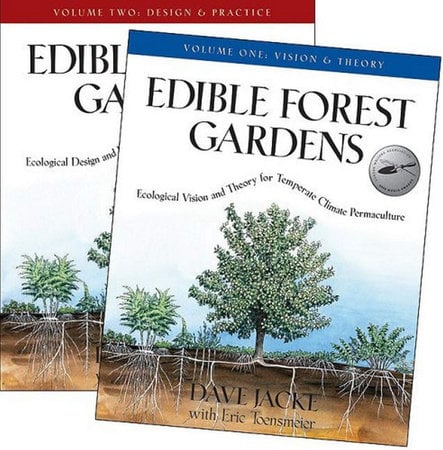
| Pages: | 1068 pages |
| Book Art: | Volume I has full-color illustrations and charts throughout; Volume II has black-and-white illustrations and charts throughout |
| Size: | 17 x 10-1/4 inch |
| Publisher: | Chelsea Green Publishing |
| Pub. Date: | November 15, 2005 |
| ISBN: | 9781890132606 |
The Edible Forest Gardens: 2 Volume Set
Boxed Set
$150.00
Edible Forest Gardens is a groundbreaking two-volume work that spells out and explores the key concepts of forest ecology and applies them to the needs of natural gardeners in temperate climates.
Volume I lays out the vision of the forest garden and explains the basic ecological principles that make it work. In Volume II, Dave Jacke and Eric Toensmeier move on to practical considerations: concrete ways to design, establish, and maintain your own forest garden. Along the way they present case studies and examples, as well as tables, illustrations, and a uniquely valuable “plant matrix” that lists hundreds of the best edible and useful species.
Taken together, the two volumes of Edible Forest Gardens offer an advanced course in ecological gardening-one that will forever change the way you look at plants and your environment.
What is an edible forest garden?
An edible forest garden is a perennial polyculture of multipurpose plants. Most plants regrow every year without replanting: perennials. Many species grow together: a polyculture. Each plant contributes to the success of the whole by fulfilling many functions: multipurpose. In other words, a forest garden is an edible ecosystem, a consciously designed community of mutually beneficial plants and animals intended for human food production. Edible forest gardens provide more than just a variety of foods. The seven F’s apply here: food, fuel, fiber, fodder, fertilizer, and “farmaceuticals,” as well as fun. A beautiful, lush environment can be a conscious focus of your garden design, or a side benefit you enjoy.
“These will be the benchmark works in the field for many years. The level of scholarship and meticulous footnoting is unsurpassed by anything I’ve seen in permaculture literature.”—Toby Hemenway, author of Gaia’s Garden
Reviews & Praise

About Eric Toensmeier
Steve Gabriel, author of Farming the Woods (with Ken Mudge), is an ecologist, educator, and a forest farmer who has lived most of his life in the Finger Lakes region of New York. His personal mission is to reconnect people of all ages with the natural world and to provide the tools for good management of forests and other landscapes. He currently splits his time between working for the Cornell Small Farms Program, and developing the farm he runs with wife Elizabeth, Wellspring Forest Farm, which produces shiitake mushrooms, duck eggs, pastured lamb, nursery trees, and maple syrup.
Books by Eric Toensmeier


About Dave Jacke
Dave Jacke has been a student of ecology and design since the 1970s, and has run his own ecological design firm—Dynamics Ecological Design Associates—since 1984. Dave is an engaging and passionate teacher of ecological design and permaculture, and a meticulous designer. He has consulted on, designed, built, and planted landscapes, homes, farms, and communities in the many parts of the United States, as well as overseas, but mainly in the Northeast. A cofounder of Land Trust at Gap Mountain in Jaffrey, NH, he homesteaded there for a number of years. He holds a B.A. in Environmental Studies from Simon’s Rock College (1980) and a M.A. in Landscape Design from the Conway School of Landscape Design (1984). You can learn more about his work at edibleforestgardens.com. He lives in Keene, New Hampshire.
Eric Toensmeier is the award-winning author of Paradise Lot and Perennial Vegetables, and the co-author of Edible Forest Gardens. Eric is an appointed lecturer at Yale University, a Senior Fellow with Project Drawdown, and an international trainer. He presents in English and Spanish throughout the United States, Canada, Mexico, Guatemala, and the Caribbean. Eric has studied useful perennial plants and their roles in agroforestry systems for over two decades, and cultivates about 300 species in his urban garden. His writing can be viewed online at perennialsolutions.org.
Books by Dave Jacke
You may also like...
-
 $39.95
 -
$39.95
-
$45.00


