

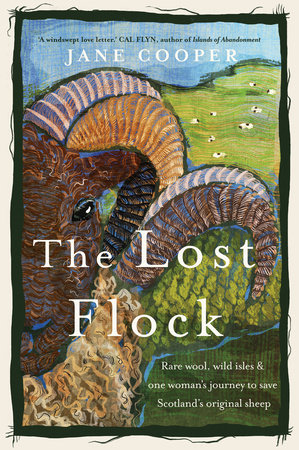
The Lost Flock
Rare Wool, Wild Isles and One Woman’s Journey to Save Scotland’s Original Sheep

| Pages: | 224 pages |
| Book Art: | 30 color photos 8-page color insert |
| Size: | 6 x 9 inch |
| Publisher: | Chelsea Green Publishing UK |
| Pub. Date: | September 14, 2023 |
| ISBN: | 9781915294395 |
The Lost Flock
Rare Wool, Wild Isles and One Woman’s Journey to Save Scotland’s Original Sheep
“A windswept love letter”—Cal Flyn, author of Islands of Abandonment
From Viking times to pastoral Highland crofts to odious research experiments, this is the untold, real-life detective story of the remarkable little horned sheep known as the Orkney Boreray and the determined woman who moved to one of Scotland’s wildest islands to save them.
It was Jane Cooper’s passion for knitting that led her to search for rare-breed sheep and their distinctive wool. When she found a ‘lost flock’ of Boreray sheep—the UK’s rarest breed of sheep—it ignited a quest that would ultimately change her life. Uprooting her suburban existence in Newcastle, she embarked on a new adventure as a farmer and shepherd in the faraway Orkney Islands.
There, to her astonishment, Jane realized that she was the sole custodian of the last remnants of a unique group of Boreray sheep, what then became her Orkney Boreray flock. She began investigating its mysterious and ancient history, tracking down the origins of the breed, its significance to Scotland’s natural heritage, and the importance of protecting the Orkney Boreray from extinction.
“Jane Cooper combines intelligence, heart and passion to create a life of integrity not only for herself but for one of the rarest breeds of sheep on the planet. . . . Her trials and triumphs offer a stellar example for others to follow in their own ways. Bravo!”—Deborah Robson, author of The Fleece and Fiber Sourcebook
Reviews & Praise
“Rare-breed sheep, Scotland’s most dramatic landscapes and a woman on a mission. All the perfect ingredients for an ovine true-life adventure.”—Sally Coulthard, author of A Short History of the World According to Sheep
“A delightful tale about one woman’s passionate commitment to save a unique breed of sheep. Small, with hairy neck ruffs of black and tan, her chosen wards are not just any sheep; obscure and ignored by the commercial sheep farming community, Jane’s flock in Orkney were in danger of dying out. The story of their enchanting history, promotion and salvation is a tribute to how individual dedication can avert the very worst of outcomes.”—Derek Gow, author of Bringing Back the Beaver
“Starting with the history of the Boreray, one of our rarest sheep breeds, The Lost Flock tells the fascinating and rather romantic story of the so-called Lost Flock, a group within the breed that got left behind when the rest were added to the official register. An extremely useful and very well-written addition to the library of books on our native livestock breeds.”—Christopher Price, CEO of the Rare Breeds Survival Trust
“Beautifully written and impeccably researched, Jane Cooper is deeply committed to her flock of Borerays. Cooper proves to be the ultimate ovine detective, solving the three-thousand-year mystery of the Lost Flock while simultaneously securing the future of smallhold farming in Orkney. She is a treasure to the industry and a hero to the breed.”—Linda Cortright, founder of Wild Fibers magazine and author of Twisted Tales
“Jane Cooper combines intelligence, heart and passion to create a life of integrity not only for herself but for one of the rarest breeds of sheep on the planet – and, ultimately, to build a community that promotes the well-being of all its members, two-foot and four-foot, and of the earth. Her trials and triumphs offer a stellar example for others to follow in their own ways. Bravo!”—Deborah Robson, coauthor of The Fleece and Fiber Sourcebook
“I fell in love with this craft, these sheep, their islands, this determined woman and her story: how a knitter and spinner of wool became a shepherd and changed the fortunes of a rare and ancient breed of sheep; how, if you are bold and passionate enough to pursue, pull and ‘roo’ the threads of a craft, it will take you to the wildest heart of things.”—Nicola Chester, author of On Gallows Down
“The Lost Flock is a hugely readable ode to obsession and how one woman’s knitting project led her to fall in love with the rarest of rare breeds and follow her passion to the ends of the earth. Part history lesson, part life lesson, Jane Cooper extols the virtues of preindustrial farming and cultivating a deeper connection with food, land and biosphere. The lost flock shows the power of one committed individual to enact positive change and save part of our shared natural heritage from extinction.”—Ross Barnett, author of The Missing Lynx
“There’s so much interesting historical information threaded through Jane Cooper’s book about her adventures to preserve the Lost Flock of Boreray.”—Suzanna Crampton, author of Bodacious: The Shepherd Cat
"Cooper’s account combines beautiful descriptions of the landscape of Orkney with a meticulously researched history of shepherding and wool in the Highlands. The result enchants."—Publisher's Weekly

About Jane Cooper
Jane Cooper grew up in North Warwickshire and learned to knit when she was very young. In 2010, Jane met the late Sue Blacker of the Natural Fibre Company, who wanted to get British Wool into the 2012 Olympic and Paralympic Games, so Woolsack (woolsack.org.uk) was born, which they ran together. In 2013 Jane and her husband Paul moved to Orkney and got their first Boreray sheep and in 2017, Jane discovered that she was the custodian of the last remnants of the ‘Lost Flock’ of Boreray sheep. To secure the long-term future of the Orkney Boreray, Jane established flocks with more (younger!) Orkney crofters and farmers, to develop products and markets and make them a profitable enterprise for everyone involved. In September 2021 Orkney Boreray mutton became Scotland’s second Slow Food International Presidium. There are now eight flocks of Boreray sheep in Orkney.
Books by Jane Cooper
You may also like...
-
 $19.95
 -
$25.00
-
$28.00


