

Make Your Own Shoes: When Technology Fails
Matthew Stein’s book, When Technology Fails: A Manual for Self-Reliance, Sustainability, and Surviving the Long Emergency, offers this quick guide to making your own shoes. The book is packed with useful tips for saving money, living a sustainable lifestyle, and surviving in a savage, Road Warrior-like dystopia.
We hope that will never happen, but if it does, at least your toes will be stylin’ and safe.
The following article was adapted for the web from When Technology Fails: A Manual for Self-Reliance, Sustainability, and Surviving the Long Emergency.
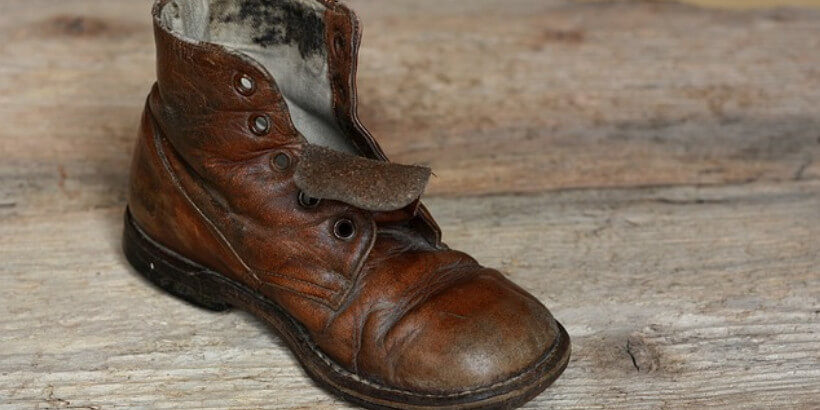
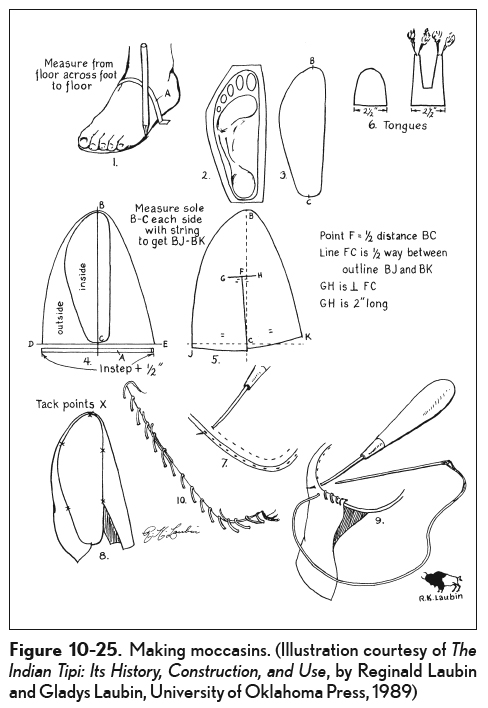 In pioneering days, a good-fitting pair of shoes was a truly valuable possession. Often, when shoemakers passed through a village, they would make several pairs of shoes for each person who could afford them, as it might be years before they had the opportunity to purchase another pair of good-fitting shoes. Making your own traditional boots is not easy, but sandals and moccasins are easy and rewarding leathercraft projects for the beginner.
Soles can be attached with stitching, primitive hide glues, more modern glues such as Barge Cement, or nailed in place (cobbling). McNett Corporation makes an excellent urethane shoe-repair cement, called Freesole, which can be used to repair holes in shoes and worn soles or glue new soles in place. Freesole is available through backcountry suppliers and shoe-repair shops. It is reportedly much stronger than Barge Cement and withstands much higher temperatures, but I have not tried it yet for gluing soles in place. See Chapter 14 for instructions on how to make your own glues.
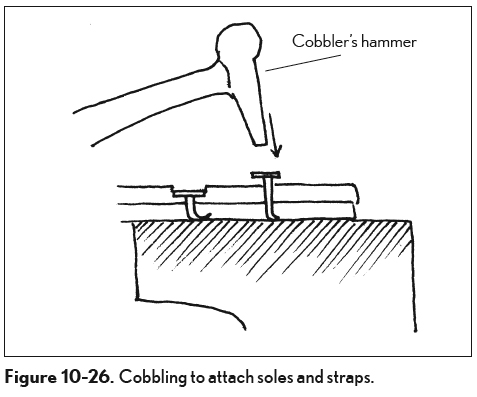 Sinews, heavy waxed nylon thread, or multistrand wire are all good, strong materials for stitching together footwear. If you scavenge wire for thread, make sure that the strands are fine or else constant flexing will cause the metal to fatigue and the wire to break. Shoe soles and straps can be nailed together by a process called “cobbling.” Shoe soles that were attached by simply nailing short nails through the soles into the midsole would soon work loose and fall off. Traditional cobblers use nails with slender, tapering tips that are nailed through the straps and soles against a metal anvil, bending the nail tips backward so that they form a hook shape. By bending the nail tips, the sole or strap is captured in such a way that the nails can’t easily work their way back out.
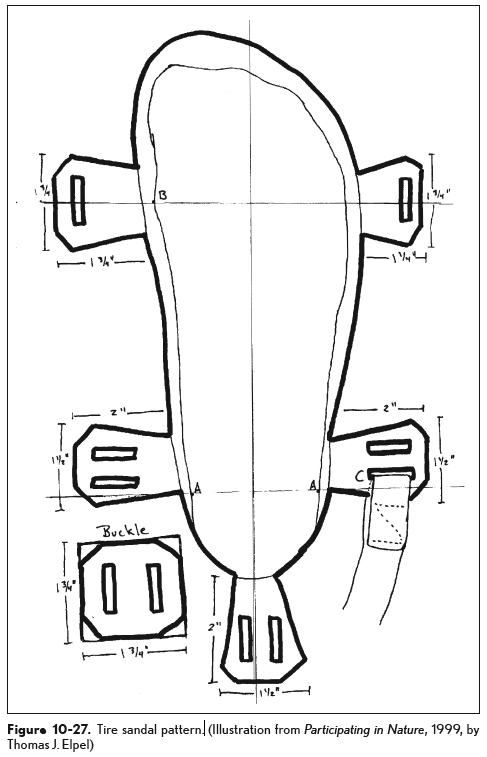 Cast-off rubber tires make great sandals and soles. Thomas J. Elpel, author of Participating in Nature1, believes that the best all-around homemade footgear is a tire sandal worn over a moccasin. You can wear holes in a pair of moccasins in less than a day of rough travel, and tire sandals can wear a hole in your feet (blisters) in a few hours. When you wear the two together, you get the comfort of moccasins combined with the durability of tire sandals. Around camp you can wear just the moccasins. When fording rivers, wear just the sandals. Using a band saw, sharp knife, chisel, hacksaw, or coping saw, cut tire sandals and buckles from older-style tires that don’t have steel belts.
Use the pattern shown in Figure 10-27 as a rough guide. Start by tracing the outline of your foot on a piece of paper. Add about 3/8 inch to the front and sides, but not the heel area. Make two marks at the centers of your anklebones (A) and a mark at the side of the ball of your foot, directly behind your big toe (B). Draw lines through these points, as shown in the pattern, to help you locate the strap loops. The strap loops are designed for 3/4-inch-wide webbing. If you use a different size of strap material, adjust and customize your pattern as necessary to fit your foot. Cut out your pattern as you would a paper doll, and lay it on the tire to mark the outline for cutting the rubber (Elpel 1999, 134).
Click here to listen to the story of the shoe cobbler on NPR.
Notes
1. Elpel, Thomas J. Participating in Nature: Thomas J. Elpel’s Guide to
Primitive Living Skills. Pony, MT: HOPS Press, 1999.
Recommended Reads
Read The Book

When Technology Fails
A Manual for Self-Reliance, Sustainability, and Surviving the Long Emergency, 2nd Edition
$35
You may like...
-
 $28.00
 -
$35.00
-
$32.95


Recent Articles

Looking to get started with a family cow? Here are the must-have tools and the safety precautions worth considering to ensure a healthy, happy cow!
Read More
The gut plays a significant role in overall health. Here’s a juice recipe to help improve, gut health, digestion and boost immunity. Cheers to a healthier you!
Read More
Thyme is easy to grow and harvest in almost any condition. Follow these tips to get started growing, harvesting (and drying) thyme in your home or backyard!
Read More
Whether foraging or gardening, it’s vital to know the proper techniques for harvesting. Read on for how to harvest herbs, roots, flowers, bark, fruit, and more!
Read More
No summer day is complete without ice cream. Try out these dairy-free ice cream recipes to indulge in this frozen treat while still being kind to your gut.
Read More