

The Scoop on Spoon Carving
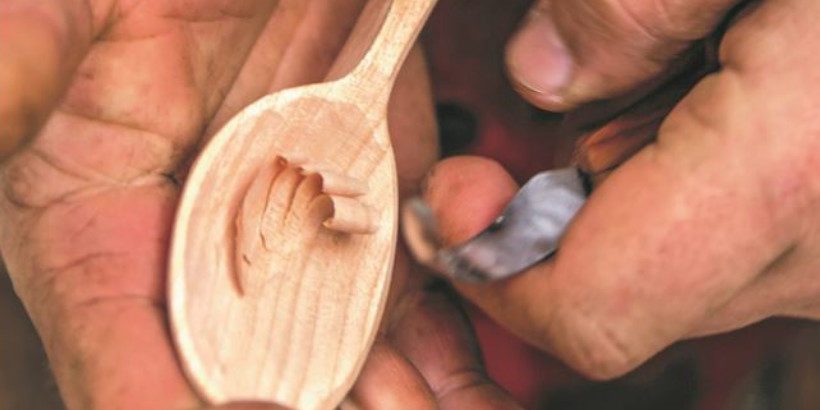
There’s no better time than the present to pick up a new hobby! And with the new year just starting, sticking to a new hobby can be an easy and achievable resolution. One possible new hobby you could try out? Spoon carving.
The following is an excerpt from Carving Out a Living on the Land by Emmet Van Driesche. It has been adapted for the web.
(Spoon Carving. Photo by Meghan Hoagland.)
Another new skill I developed on the farm has given me options on a far greater scale, eventually becoming the biggest part of my professional identity, what I do with most of my time, and what I am known for around the world.
I am talking, oddly enough, about spoon carving. Spoon carving is one of those strange activities that seems so niche that you couldn’t possibly make any money doing it.

Spoon Blanks. Photo by Emmet Van Driesche.
On the face of it, that would be correct. However, by leveraging my life and journey through Instagram I have been able to build a business that currently accounts for a quarter of my yearly income, separate from the farm revenue. By next year it will exceed revenue from the farm. Spoon carving allows me to add value to the deciduous trees on the farm, turning them into a resource that I can sustainably harvest indefinitely.
I started carving wooden spatulas during the fall when my daughter was a year and a half old. It was something I could do while keeping a watchful eye on her as she toddled around the yard. I scoured the winter firewood stacked on our porch for straight-grained pieces, split them open, and carved something quickly.
My designs were simple because they had to be. I never knew how much time I had before I needed to change a diaper or tend to a banged-up knee. The wood was dry and hard, my knife was not the greatest, and I leaned heavily on sandpaper to cover up my lack of skill.
The spatulas sold, however, first at the fall festival in town and later at the grove during the tree season. I sold them for $10 each, not a great hourly rate but not awful either, and the money reinforced my desire to do something concretely productive during the mornings or afternoons I had with her.
I didn’t carve the entire time, but if I made just one thing I could point to and tell myself I had contributed something concrete to the day, something creative, it alleviated some of the exhaustion that comes from being the parent of very young children.
When I look back at those spatulas now I cringe because I knew so little about carving, but I also feel pride, because I recognize that I treated carving like part of the farm business right from the start. Over the years, my skill as a carver has increased dramatically, but that same attitude prevails, as does the desire to make objects that are both functional and beautiful.
Recommended Reads
Read The Book

Carving Out a Living on the Land
Lessons in Resourcefulness and Craft from an Unusual Christmas Tree Farm
$28
You may like...
-
 $17.95
 -
$30.00


Recent Articles

All hail the mighty garlic clove! Become a master at garlic growing with these simple tips for growing no-till garlic from seed to harvest.
Read More
Try your hand at preserving veggies by freezing them! Freezing vegetables is a quick, simple way to preserve them for winter meals.
Read More
If you keep your hens in a stationary coop, you’re missing out on their soil building talents. Un-coop that poop by putting your flock in chicken tractors!
Read More
Growing mushrooms on logs is an easy way to cultiavte your own fungi! Work in tandem with nature to grow many varieties of mushrooms.
Read More
As your favorite variety of home grown tomatoes start ripening on the vine this summer, be sure to save those seeds for next year’s planting.
Read More