

How to Preserve Olive Fruit Leather in 5 Easy Steps
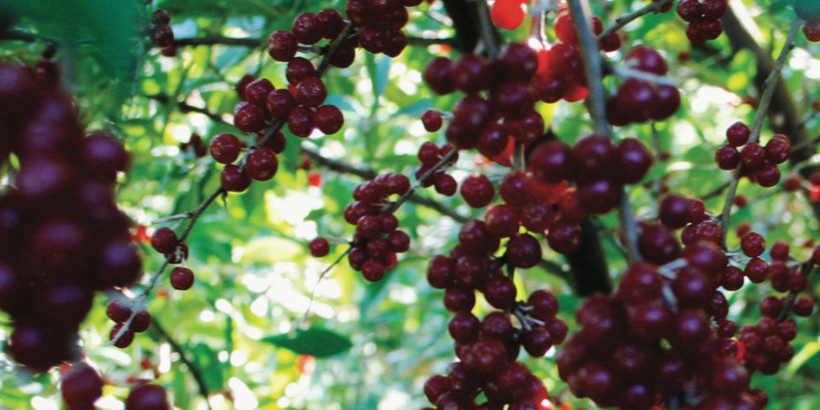
Autumn olives are quite the berry. No added sugar is required! Give it a try and keep some delicious and nourishing olive fruit leather on hand for whenever you get the craving.
The following excerpt is from Wild Flavors: One Chef’s Transformative Year Cooking from Eva’s Farm by Didi Emmons. It has been adapted for the web.
Russ Cohen’s Autumn Olive Fruit Leather
Forager, environmentalist, and teacher Russ Cohen doles out a little fruit leather to his students before they begin a foraging tour. Everyone marvels at the sweet flavor, including me! To make this leather it’s helpful to have a dehydrator, but you can also make it on top of a woodstove or in an oven warmed by the pilot light. (Traditionally, of course, fruit is dehydrated by the sun.)
Russ sees this leather as the best way to use autumn olive berries, which are quite tart when fresh, because the drying process concentrates the sugars, so much so that he need not add sugar. Which is unusual, Russ says, since he’s found that he generally needs to add at least a little sugar to all leathers, even wild grape leather.
INGREDIENTS
1 gallon or more autumn olives
PROCESS
- Place the berries in a large, heavy-bottomed pot. Add water to a depth of approximately J inch in the pot, to prevent the fruit from scorching. Heat to a low simmer, and let simmer (no boiling) for 30 minutes, stirring occasionally.
- Run the cooked fruit through a food mill. Then pass it through a sieve to get a very thick, tomato-sauce-like consistency. The pulp that’s left behind in the sieve is not a waste product—save it and add it to your morning cereal!
- Line the trays of a dehydrator with the fruit roll sheet accessory or parchment paper. Pour the fruit puree into a gravy boat or an old soy milk carton. Drizzle the puree onto the prepared trays in the thinnest layer possible.
- Dry the fruit leather at 135 degrees F, or according to the dehydrator manufacturer’s instructions, for 12 hours. Rotate the trays and dry for another 12 hours.
- Cut the leather into strips and store in ziplock bags; they’ll keep indefinitely.
Recommended Reads
The Radiant Raspberry: Foraging For and Cooking With Wild Raspberries
You may like...
-
 $29.95
 -
$25.00
-
$40.00


Recent Articles

Want an on-the-go snack without having to go to the grocery store? Whip up this homemade applesauce for a fresh fall snack whenever you get the craving!
Read More
The possibilities are pretty much endless with wild ingredients — use almost any fresh fruit or juice and a sweetener to create your own custom jam or syrup!
Read More
Fermenting mead is an ancient practice. With step-by-step instructions, learn how to brew fruit-based and flower meads, from foraging to fermenting.
Read More
Small But Mighty! Crab Apples are easy to find, simple to store, and incredibly flavorful. Keep reading to learn more about the unsung heroes of the apple family.
Read More
Try your hand at preserving veggies by freezing them! Freezing vegetables is a quick, simple way to preserve them for winter meals.
Read More