
Holistic Healing: All About Medicinal Reishi Mushrooms
Reishi mushrooms are outstanding fungi that rightfully earn the title “The Mushroom of Immortality.”
The medicinal properties are fascinating and far-reaching, from tumor suppression to blood pressure modulation. Discover the wide breadth of the reishi mushroom and how to integrate them into your own healing practices.
The following excerpt is from The Mycelial Healer by Christopher Parker and Katherine Parker. It has been adapted for the web.
Holistic Healing with Reishi Mushrooms
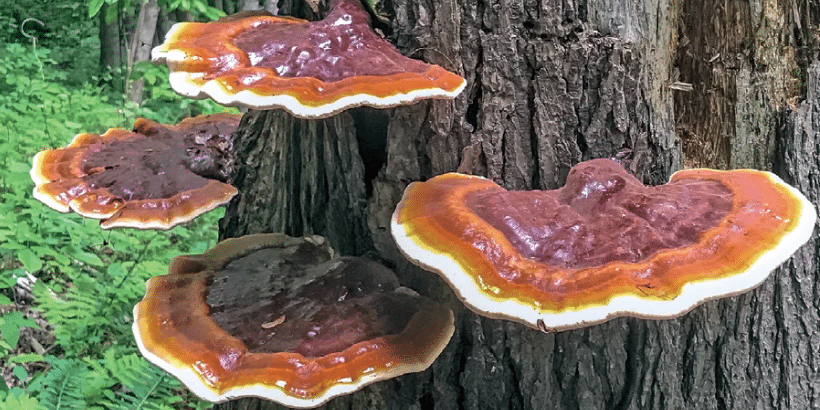
Reishi mushrooms in a variety of shapes and sizes are in the genus Ganoderma. The Latin root of this genus name means “shiny skin.” This quality is apparent to anyone who has seen this mushroom growing in the wild. The caps of these shelf fungi are so shiny they sometimes look artificial, as if a forest nymph had applied a layer of shellac all the way out to the margins. For this reason, they are also called Varnish Shelf.
Reishi mushrooms produce rusty brown spores that are ejected out of the hymenium under forceful hydraulic pressure, which causes the microscopic spores to rise upward, and most end up landing on the mushroom caps. The cap becomes layered in a thick dusting of millions of spores. These spores have a very low germination rate (approximately 50 percent).

Figure 7.10. Ganoderma tsugae (Hemlock Reishi) on dead Hemlock (Tsuga
canadensis).
Reishi are a white rot fungus. This simply means they tend to consume mostly lignin and leave the white fluffy cellulose behind. There are about eighty species in the Ganoderma genus. They occupy many forests worldwide and are both saprotrophic and parasitic fungi. Some are considered pathogens and others simply decomposers that recycle woody material back to the forest floor as fertile soils. Just like all mushrooms, Reishi occupy vital niches in ecosystems.
Several Reishi species occur in the eastern woodlands of North America. Most of these are saprotrophic. Further south and along southern coastal areas, Ganoderma zonatum parasitizes palm trees; once a tree is infected, there is no treatment.
Worldwide, Ganoderma species tally up to nearly three hundred. The overwhelming majority of these species have medicinal qualities; some are more widely recognized than others as medicinal. Reishi is one of the most cultivated and popular groups of mushrooms on the planet. Evidence for its powerful medicinal properties is mounting each year as more research is published. Reishi is also a mushroom that can be cultivated and utilized with ease.
The Chinese name Lingzhi means “The Mushroom of Immortality,” or “The Divine Mushroom.” The most widely used common name for G. lingzhi is Reishi; another common Japanese name is Mannetake.
Reishi thrives in hot, humid environments. Most species are found in tropical or subtropical forests. G. tsugae, Hemlock Reishi, is an exception. It often occurs in rich coves in the Southern Appalachians where nighttime temperatures will dip into the 40s (°F) during May and June. It is not uncommon for Hemlock Reishi fruiting bodies to grow up to 24 inches in diameter. But in the Appalachian woodlands, Golden Reishi never grow as big as the Hemlock Reishi. This is likely due to the ability of the Hemlock Reishi mycelium to break down its host tree more quickly than the Golden Reishi can consume its preferred host, which tends to be oak. (Hemlock is a much softer wood than oak.)
The Reishi worldwide market was $4.27 billion in 2023. According to the Business Research Company, Reishi mushrooms and supplements will see strong growth within the next several years driven by the awareness of natural products and health and wellness. Functional foods and dietary supplements are expected to boost the growth of the Reishi market. It is estimated that by the year 2028 the Reishi market will be a $6.69 billion industry.

Figure 7.11. Ganoderma curtisii (Golden Reishi) growing off substrate block covered in spores.
Traditional Uses
In Chinese medicine, and throughout Asia, Reishi mushroom has been utilized for at least two thousand years and possibly much longer. This medicinal powerhouse was mentioned in texts as far back as 100 BCE. Lingzhi has been documented in ancient texts as an effective medicine for a number of ailments, as well as a tonic for strengthening the human body. Sheng-Nong’s herbal classic, The Divine Farmer’s Materia Medica, was composed during the Han Dynasty (25–220 CE), and we can speculate that the knowledge was much older, having been being passed down orally. Information typically stays in a culture to stand the test of time before it is documented, and then the line between information and wisdom begins to blur.
Reishi mushrooms started appearing as a subject in artwork centuries ago. One of my favorite depictions of Reishi is in a soapstone carving of Guanyin from eighteenth-century China, currently held at the Metropolitan Museum of Art in New York City. We also saw the mushroom wall paintings in the drawing room of Sir Walter Scott’s nineteenth-century home in southern Scotland. The Divine Farmer’s Materia Medica shows clearly the importance of various types of Reishi mushroom to Chinese medicine. In these texts, Ganoderma species are divided into six categories according to color, and healing properties are assigned to the color of the mushroom dovetailing to the organ or ailment.
Research on Human Health Effects
Reishi continues to be an important mushroom in Chinese medicine and is gaining popularity in the West as more and more scientific research confirms its health-promoting benefits. Reishi mushrooms influenced the way of life for ancient humans and cultures, and they continue to affect modern humans in the same ways they did our ancestors.
New research tools are leading to discoveries that deepen our understanding of species that fall under the umbrella of the Ganoderma genus. Laboratory and preclinical studies with Reishi mushroom have found them to have anticancer, antiviral, antibacterial, and anti-inflammatory activity in addition to being of benefit to heart health and in the management of diabetes. Here we summarize a few of the strongest, as well as some more recent, human clinical trials.
CANCER
Western researchers generally agree that Reishi is an effective adjunct therapy for cancer. Use of Reishi can slow tumor growth and improve quality of life, but there is not yet evidence for Reishi to be used as a standalone treatment to cure cancer. We note that all studies published at the time of this writing had worked with people who already had a cancer diagnosis.
There are no trials following healthy people over multiple years to gather data on whether use of Reishi prevents, or slows the onset, of cancers. One international, highly controlled clinical trial with polysaccharides extracted from G. lucidum treated advanced lung cancer patients with 600 mg of Reishi three times a day for twelve weeks. The patients who took Reishi showed slower growth of lung cancer, improved quality of life, and increased blood biomarkers indicating a more active and healthy immune system.
Use of Reishi was also associated with a reduction in associated issues such as fever, coughing, and insomnia. A hot-water extract of G. lucidum has also been found to suppress the growth of precancerous lesions of the large bowel after twelve months of treatment. G. lucidum spore powder is commonly used in Traditional Chinese Medicine (TCM). In one study, breast cancer patients given 1,000 mg of spore powder extract three times a day for four weeks experienced drastic, and statistically significant, reductions in fatigue, anxiety, and depression and increased physical well-being and quality of life.
INFECTION AND IMMUNE-BOOSTING EFFECTS
In an effort to reduce colds in preschool children in Colombia, a yogurt supplemented with Reishi-derived β-glucans was given daily to 167 children for 12 weeks. Blood samples and physical examinations indicated these children had significantly healthier immune systems and suffered fewer colds than children who did not receive the Reishi yogurt. This method is being investigated as a possible way to reduce the spread of infections in young children. Similar work looked at the effect of Reishi-derived β-glucans (200 mg daily) on healthy adults over a twelve-week period. Researchers found increased biomarkers for a healthy immune system.
CARDIOVASCULAR EFFECTS
Reishi’s cardioprotective effects seem to be due primarily to its beneficial effects on levels of blood glucose and blood fat, blood pressure, and the liver. Reishi has been shown to reduce inflammation in the heart and blood vessels, which has a protective effect against heart disease. A daily dose of 540 mg Reishi-derived β-glucan for people diagnosed with atrial fibrillation (irregular heartbeat) over ninety days resulted in significant improvements in systolic blood pressure, heart rate, anti-inflammatory markers, compounds that reduce tumors, energy, and quality of life, as well as reduced fatigue, pain, and physical limitations.

Figure 7.14. Reishi antlers.
In patients with coronary heart disease, a twelve-week treatment of daily Reishi extracts reduced various heart-related symptoms and resulted in a higher likelihood of a normal ECG reading, all while reducing blood pressure and serum cholesterol levels.
One study looked at Reishi as a possible preventative medicine for heart disease by studying people who had mildly elevated blood pressure and cholesterol levels. The participants took 1.44 g Reishi for twelve weeks. Researchers saw improvements in levels of beneficial cholesterol but no significant change in blood pressure. They did, however, find improvements in blood plasma insulin levels, suggesting a possible antidiabetic effect.51 These results are promising, but more research needs to be done.
DIABETES
Two tightly controlled studies have looked at the effects of Reishi in people with type 2 diabetes. The first study found a significant beneficial effect, but the second study found no effect. Two possible factors might explain this disparity of results: the studies may have used different extraction methods, and patients were given different dosage levels. The study that found a significant result used Ganopoly, which is a patented commercial Reishi-extraction product.
The study results don’t state exactly what is in Ganopoly nor how it is produced. The study that found no effect used “Ganoderma lucidum extract and spores.” This is also not a precise description, but it is clearly different from the content of Ganopoly. The study that showed significant results used a much higher dose (5,400 mg per day) than the study that didn’t find an effect (3,000 mg). The studies were conducted in different countries, and thus different dietary habits or other cultural differences could have impacted results as well. More research is needed.
ANTI-INFLAMMATORY EFFECTS
Chronic inflammation may underlie many diseases, including cancer. Reishi has been shown in lab studies to reduce inflammation. A handful of human clinical trials have tested Reishi’s effects on inflammation in a few disease states. Results are mixed, but one promising example is fibromyalgia, which is characterized by chronic and widespread pain throughout the body without a clear cause. Understandably, secondary impacts include depression, anxiety, and reduced quality of life. A study of female patients who received 6,000 mg of micro-milled Reishi antler daily for six weeks showed a distinct trend toward greater happiness and life satisfaction and reduced body pain and depression compared to baseline.
Role in Holistic Healing
This mushroom is on my top-three list of mushrooms to never be without. With good reason, more people are looking to this medicinal heavy hitter for holistic support in their modern day lives. As both an immune system and blood pressure modulator, Reishi seems a natural candidate to be a cornerstone medicinal mushroom for helping people cope with stress-filled lives. Using Reishi can help restore balance by counteracting stress hormones that increase inflammation in the body.

Figure 7.15. Outdoor-cultivated Reishi. The black protuberances near the Reishi are Dead Man’s Fingers (Xylaria polymorpha).
We need the medicine of such powerful mushrooms to help regulate heightened states of stress and anxiety. Research studies now support the benefits of grounding, simply having our skin in direct contact with the earth, to increase blood viscosity. One study showed that just two hours of grounding had dramatic effects on red blood cell aggregation. As described in “Cardiovascular Effects,” Reishi provides some of the same benefits to cardiovascular health as grounding does.
Reishi has a deep untapped potential to change the lives of people in communities lacking medical infrastructure close at hand. Underserved populations in the United States, and worldwide, can start to improve the quality of their lives by growing their own medicine and creating supportive, mycelial-like connections with neighbors and those in need. Will you be a node in the web to connect your community?
Cultivation Notes
The patience required to grow Reishi has lessons for us mushroom cultivators. If you haven’t started cultivating this mushroom yet, I encourage you to try it! The joy it brings, the grounding that comes from being in contact with your medicine, the empowerment that arises from knowing you can take charge of your health—these are feelings that no amount of money can buy. Reishi is easily cultivated on sawdust substrate in controlled environments. This can allow the grower to manipulate carbon dioxide levels, which can facilitate the formation of antlers. Outdoor cultivation is possible by partially burying small-diameter logs horizontally. Larger- diameter logs should be buried vertically.
Ethical Wild Harvesting
Wild Reishi can be a rare find, seeming to show up on only one dead tree out of hundreds. Yet at times, we find a hillside where almost every dead oak tree has Reishi fruitbodies. Some species of Reishi are plentiful only because of the demise of their host trees. G. tsugae is the best example in Appalachia. This species is endemic on Hemlock trees that are dying due to infestation by the Hemlock Woolly Adelgid (Adelges tsugae).
This will often result in huge flushes of Reishi in parts of forests that had groves of hemlocks. It is easy to imagine these hundreds of pounds of mushrooms as a never-ending supply. But in order to continue flourishing, this species will need to make a leap onto other tree species as a host once all the hemlocks have died out. (We and other mushroom hunters have occasionally found it on White Pine.)
A lot of bad advice is circulating about harvesting Hemlock Reishi—to harvest too early, or to harvest all you can get, predicated on greed. We must find a balance between harvesting the current bounty and conserving enough to allow the fungus to adapt and change over time. Other Ganoderma species are much less plentiful.
For example, we may find only a few Golden Reishi (G. curtisii) while on a five- to ten-mile trek through the forest. If they are this scarce in your region, the recommendation is to pick a small percentage of what you find and leave the rest intact. Along the coastal regions in the southeast, we find Golden Reishi to be pretty common among live oaks and even Cabbage Palms. The fact is that if harvesting is not done correctly, then the population dwindles and the medicine is no longer available. Culturing and growing naturally on logs on your own property is the best and most consistent way to obtain Reishi.
Recommended Reads
Mushrooms as Food & Medicine: Ancient Medicine for Modern Times
Read The Book
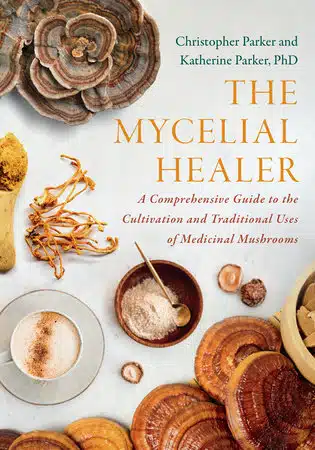
The Mycelial Healer
A Comprehensive Guide to the Cultivation and Traditional Uses of Medicinal Mushrooms
$34.95
You may like...
-
 $39.95
-
$42.95
-
$44.95


Recent Articles

From tumor suppression to blood pressure modulation, discover the medicinal properties of reishi mushrooms and how to integrate them into your healing practice.
Read More
These small fruits are a delicious source of nutrients that you can find almost anywhere. Get started on acorn harvesting with help from these simple tips!
Read More
The gut plays a significant role in overall health. Here’s a juice recipe to help improve, gut health, digestion and boost immunity. Cheers to a healthier you!
Read More
Thyme is easy to grow and harvest in almost any condition. Follow these tips to get started growing, harvesting (and drying) thyme in your home or backyard!
Read More
Whether foraging or gardening, it’s vital to know the proper techniques for harvesting. Read on for how to harvest herbs, roots, flowers, bark, fruit, and more!
Read More