

The Spirit of Hitching
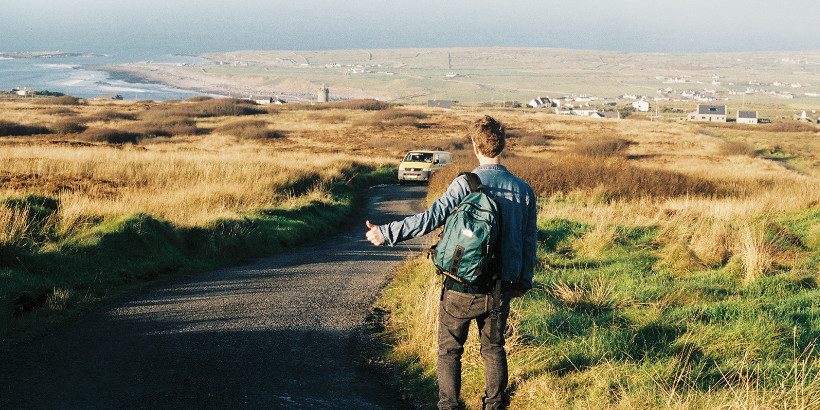
Gone are the days where you can stick out your thumb to catch a carefree ride. For a long time though, hitchhiking was considered normal and even reasonably safe. Even more, it gave people a chance to connect with strangers, share stories, and spend a bit of time in someone else’s shoes. While the days of carefree hitching have faded away, the hope, understanding, and interconnectivity it fostered are needed now more than ever.
The following is an excerpt from Hitching for Hope by Ruairí McKiernan. It has been adapted for the web.
One afternoon when I was 13 years old, I attracted the attention of some bullies as I rode the bus home from school. The older guys sneakily tied the cords of my coat to the seat so that when I tried to stand to get up, I found myself stuck and missed my stop. I was raging, and it seemed as if everyone was laughing at me; just what I needed on top of the vulnerability I already felt, being new to the area.
However, what was then a humiliating experience soon opened the door to a new world of possibility.
From that day on, with a cautious blessing from my parents, hitching became my primary mode of school transport until my family eventually moved closer to town.

Community spirit was a prominent feature of life in decades past, in part out of necessity: people either stuck together or perished alone.
Neighbours often helped each other through the meitheal, the old Irish term for work sharing. My grandmother used to tell us stories about the neighbours who helped build her family’s house. Offering the same kindness in return, my gran’s family would pitch in with farm work, and so the wheel of reciprocity and interdependence kept turning.
Hitchhiking always felt to me like a natural part of this web of interconnectedness. It exemplifies that sense that we’re all in it together – that we can pick someone up when they need help, as it might be us or someone we know who needs help tomorrow. I experienced this each Saturday morning during my teens when I would hitch 24 kilometres from Cootehill to Cavan town to play rugby.
I’d usually end up walking and waiting for half an hour or more before getting a lift, and the same on the way back, but I thought nothing of it. In an era before smartphones or the internet, it was as if I had all the time in the world. In later years, hitching opened up the world to me when I travelled in Scotland, Canada, Australia, New Zealand and West Africa. I gained insight into other people and cultures, and developed confidence, conversational skills and the capacity for trust.
Times changed, though. As the years passed, hitching slowly disappeared from my life and, seemingly, from the world around me. The more money I earned, the lazier I became, opting for comfort and convenience over the occasional hardships of thumbs-out travel. As the Irish economy blossomed, people bought cars and public transport improved somewhat. Urbanisation, individualism and the pressures of modern life also set in, and with these, hitchhiking faded into the past.
The demise of hitching was aided by movies and news reports that pushed a particular narrative, suggesting hitchhikers might be dangerous people, or that they themselves stood a good chance of being attacked by opportunistic drivers.

When I first told people of my plans to hitch around Ireland, common responses included ‘Aren’t you afraid of being murdered?’ and ‘Nobody hitches anymore.’ Whether hitchhiking was dead or not was a valid question, and one that I was keen to investigate. I didn’t doubt that dangers existed, but I also wasn’t fully convinced that people were now too busy, mistrustful or selfish to bother giving lifts. I liked the idea of challenging conventional wisdom – of putting my thumb out to the nation to see what it stood for.
In doing so, I would be reconnecting with my youthful openness, healing old wounds, and inviting my country to reveal itself.
Recommended Reads
Read The Book

Hitching for Hope
A Journey into the Heart and Soul of Ireland
$17.95
You may like...
-
 $19.95
 -
$29.95
-
$34.95


Recent Articles

Looking to get started with a family cow? Here are the must-have tools and the safety precautions worth considering to ensure a healthy, happy cow!
Read More
Whether foraging or gardening, it’s vital to know the proper techniques for harvesting. Read on for how to harvest herbs, roots, flowers, bark, fruit, and more!
Read More
How and why can some plants live to such a great age? Delve into the lifespan of plants and discover the incredible longevity and resilience of these remarkable living beings.
Read More
We’ve been told to kill a lanternfly because they’re “invasive.” In reality, they are living like any other insect would. So why are they under attack?
Read More
Dig into the many varieties of grass seeds, learn about toxicity, and review a list of edible grass seeds. Happy foraging!
Read More