

Speaking for the Bees
“Having a relationship with the rest of nature is knowing that we can, if we wish, rekindle our lost connections, because somewhere deep inside us all, there lives a little spark of ‘wild’ just waiting to be ignited.” —Brigit Strawbridge Howard
Our planet is home to at least 20,000 species of bees—a statistic most of us would be content to take note of briefly before carrying on with our lives. Not Brigit Strawbridge Howard. Her sudden realization of the teeming diversity a just a few steps out her backdoor stopped her in her tracks. She has since become an avid observer of our most prevalent pollinators and a passionate architect of their habitat. Amateur naturalist turned native wild insect champion, Howard truly speaks for the bees, as is evident in this excerpt from her book, Dancing with Bees from the Winter 2019 Seasonal Journal.
The following is an excerpt from Dancing with Bees by Brigit Strawbridge Howard. It has been adapted for the web.
Bees. Where to begin? For the past decade or so, they have filled me with ever-increasing wonder and delight, as I have immersed myself in watching, listening, and tuning in to them, alongside all the other wild and wonderful creatures and plants I have come across in my travels.
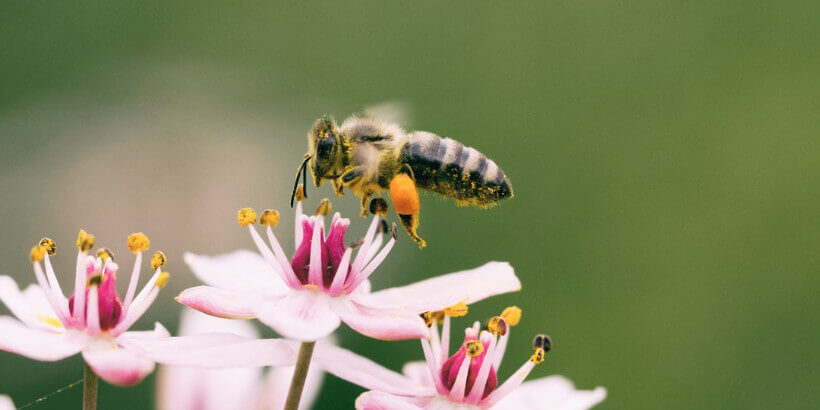
Given the enormity of our reliance upon bees as pollinators of our crops, it beggars belief that most of us know so little about them. Mention the word “bee” to most people, and images of hives, beekeepers, and honey are the most likely things that will spring to mind. However, if you were to give the same people a sheet of paper and a box of colored pencils, and ask them to draw you a bee, most would draw something shaped a little like a rugby ball with striped yellow, white, and black bands, to which they might attach a head, six legs, two antennae, and a pair or two of wings – something that looks, essentially, like a bumblebee rather than a honeybee.
But in actual fact, Planet Earth is home to at least 20,000 different species of bee. 
This is quite a staggering figure, one which surprises most people when they first hear it (it certainly surprised me), especially if they have previously only been aware of the existence of honeybees and bumblebees. Even more surprising is the fact that of all these different species, only 9 are honeybees and around 250 are bumblebees. There are also around 500 so-called stingless bees. The rest are ‘solitary’ bees, and it is amongst these species that I have found many new friends…
Most of us are aware that bees are important pollinators, but far from being in awe of the fact that something so tiny is capable of achieving something so extraordinary as pollination, we tend instead to take this gift—or “service”, as it is so sadly referred to these days by economists – very much for granted. I use the word “gift” with consideration and awareness of the fact that a gift is usually something that has been given with intent to a recipient.
As bees and other pollinators go about their daily business of foraging for pollen and nectar, their aim is of course to collect as much as possible to take back to their nest to feed, or provide for, the next generation of their species. Bees are no more setting out to “gift” us than they are setting out to pollinate the plants they visit, but the result, in my eyes, is one of the most wonderful gifts that nature bestows upon the human race, and one without which we simply would not survive.
Recommended Reads
Read The Book

Dancing with Bees
A Journey Back to Nature
$17.95
You may like...
-
$19.95
-
$25.00
-
$19.95


Recent Articles

Whether foraging or gardening, it’s vital to know the proper techniques for harvesting. Read on for how to harvest herbs, roots, flowers, bark, fruit, and more!
Read More
How and why can some plants live to such a great age? Delve into the lifespan of plants and discover the incredible longevity and resilience of these remarkable living beings.
Read More
We’ve been told to kill a lanternfly because they’re “invasive.” In reality, they are living like any other insect would. So why are they under attack?
Read More
Dig into the many varieties of grass seeds, learn about toxicity, and review a list of edible grass seeds. Happy foraging!
Read More
A forest garden provides a beautiful, bountiful edible landscape at any scale—whether there’s only a few dozen square feet or you have over an acre to spare.
Read More