
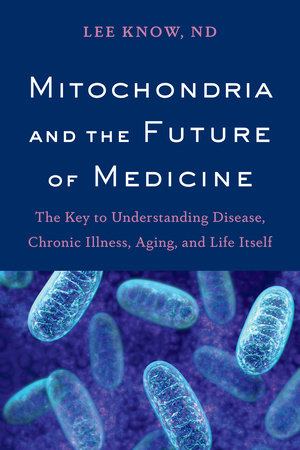
Mitochondria and the Future of Medicine
The Key to Understanding Disease, Chronic Illness, Aging, and Life Itself

| Pages: | 272 pages |
| Book Art: | Black-and-white illustrations |
| Size: | 6 x 9 inch |
| Publisher: | Chelsea Green Publishing |
| Pub. Date: | February 13, 2018 |
| ISBN: | 9781603587679 |
Mitochondria and the Future of Medicine
The Key to Understanding Disease, Chronic Illness, Aging, and Life Itself
Paperback
$24.95
“From infertility to aging to cancer and neurological disease, Dr. Lee Know will teach you that mitochondria play a central role in much that we care about in health and disease.”—Stephanie Seneff, senior research scientist, MIT and author of Toxic Legacy
With information for patients and practitioners on optimizing mitochondrial function for greater health and longevity
Why do we age? Why does cancer develop? What’s the connection between heart failure and Alzheimer’s disease, or infertility and hearing loss? Can we extend lifespan, and if so, how? What is the Exercise Paradox? Why do antioxidant supplements sometimes do more harm than good? Many will be amazed to learn that all these questions, and many more, can be answered by a single point of discussion: mitochondria and bioenergetics.
In Mitochondria and the Future of Medicine, Naturopathic Doctor Lee Know tells the epic story of mitochondria, the widely misunderstood and often-overlooked powerhouses of our cells. The legendary saga began over two billion years ago, when one bacterium entered another without being digested, which would evolve to create the first mitochondrion. Since then, for life to exist beyond single-celled bacteria, it’s the mitochondria that have been responsible for this life-giving energy. By understanding how our mitochondria work, in fact, it is possible to add years to our lives, and life to our years.
Current research, however, has revealed a dark side: many seemingly disconnected degenerative diseases have tangled roots in dysfunctional mitochondria. However, modern research has also endowed us with the knowledge on how to optimize its function, which is of critical importance to our health and longevity.
Dr. Know offers cutting-edge information on supplementation and lifestyle changes for mitochondrial optimization and how to implement their use successfully, including:
- CoQ10
- D-Ribose
- Cannabinoids
- Ketogenic dietary therapy
- and more!
Mitochondria and the Future of Medicine is an invaluable resource for practitioners interested in mitochondrial medicine and the true roots of chronic illness and disease, as well as anyone interested in optimizing their health.
“Dr. Lee Know does a brilliant job shedding light on this once ignored organelle and shows us how to care for our most important metabolic system.”—Dr. Nasha Winters, co-author of The Metabolic Approach to Cancer
Reviews & Praise
“In 1991, when faced with my own health challenges, mitochondria became front and center in my quest for health. Over the last two and a half decades, more and more researchers and clinicians are finding themselves interested in these little powerhouses and proclaiming themselves ‘mitochondriacs.’ Dr. Lee Know does a brilliant job shedding light on this once ignored organelle and shows us how to care for our most important metabolic system.”—Dr. Nasha Winters, co-author of The Metabolic Approach to Cancer
“Mitochondria and the Future of Medicine is a tour de force of mitochondria and human health. When it comes to curing chronic disease and extending longevity, it’s not an understatement to say that the content of this book will be shaping the future of medicine.”—Ari Whitten, best-selling author and creator of The Energy Blueprint
“In Mitochondria and the Future of Medicine, Dr. Lee Know takes the mystery out of the evolving science surrounding mitochondria. Here, he clearly and concisely describes mitochondrial structure and function while presenting us with multiple examples of why healthy mitochondria are so crucial to our overall health. Without conjecture or overreach, Dr. Know also provides the rationale behind nutritional strategies that have great potential to improve the status of our mitochondria, a central tenet of healthy aging.”—Miriam Kalamian, author of Keto for Cancer

About Lee Know
Lee Know, ND, is a licensed naturopathic doctor based out of Canada, and the recipient of several awards. Known by his peers to be a strategic and forward-thinking entrepreneur and researcher, he has held positions as medical advisor, scientific evaluator, and director of research and development for major organizations. Besides managing Scientific Affairs for his own company, he also currently serves as a consultant to the natural-health-products and dietary-supplements industries, and serves on the editorial advisory board for Canada’s most-read natural health magazine. He calls the Greater Toronto Area home, where he lives with his common-law partner and their two sons, and has a particular interest in promoting natural health and environmental stewardship.
Connect with Lee Know
Books by Lee Know
You may also like...
-
 $20.00
 -
$29.95
-
$29.95


