

Living Mulch: A Better Way to Cover Ground
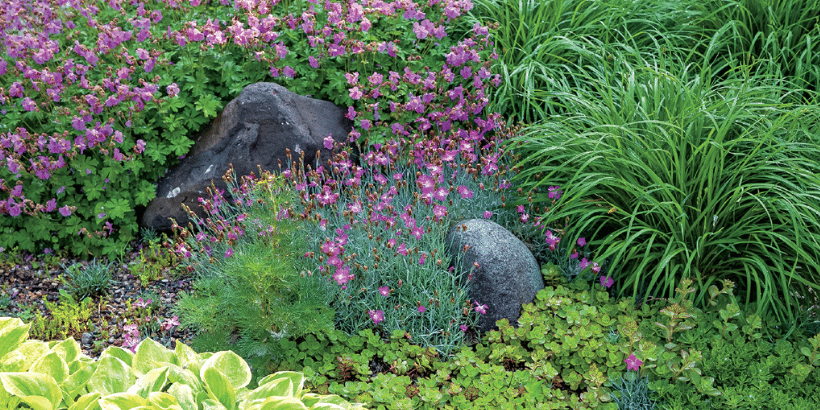
Conventional mulch—sometimes called dead mulch—can give a tidy appearance. But you’d be surprised by the time-saving, ecological benefits of using a living mulch as ground cover in your garden!
Like conventional mulch, living mulch suppresses weeds, cools soil, and prevents erosion. Beyond that, it’s sustainable and visually interesting, and it saves work.
The following is an excerpt from Garden for Life by Rhonda Fleming Hayes. It has been adapted for the web.
Needed: Resilient Plants
No matter where they live, older gardeners want to keep going, but their gardens might start to look different. In reimagining future gardens, resilience will be a key factor. With less energy and patience to give, older gardeners should look to tough, trouble-free plants that can withstand erratic weather; plants with grit, plants that can bounce back, much like they themselves have been doing as they go through life.
In many cases these will be native plants, species that have historically occurred in a particular region or habitat, without human introduction or influence. These plants have coevolved with wildlife over millennia and adapted to the local climate, soil, and ecological conditions of their region. They are crucial for supporting local ecosystems, providing food and habitat for native wildlife, insects, and pollinators.
At other times they might be selected cultivars bred for more than visual appeal, including exceptional cold-hardiness, heat-tolerance, disease- and pest-resistance, strong growth habit, and adaptability to other environmental stresses. Nativars—cultivars of native species bred for specific traits like larger flowers and more compact growth habits—will become more attractive to home gardeners. Stalwart plants typically considered ordinary might deserve another look. As one of my favorite garden columnists, Ann Treneman, an American but longtime UK resident, suggests in The Times, “Instead of trying to grow the impossible, it pays to love those that thrive.”
Living Mulch: A Better Way to Cover Ground
To talk about living mulch, sometimes called green mulch, first we need to talk about conventional mulch. Should we call it dead mulch or just mulch? Gardening experts tout the benefits of mulch all the time, and they’re not wrong. It does a number of things to help our gardens: retains moisture, suppresses weeds, reduces erosion, insulates plants while cooling the soil, and even repels some insects. However, I suspect its most endearing quality is giving gardens a tidy appearance.

Mulch materials vary by region or climate.
Pine straw is commonly used in southern states, oyster shells are found in mulch around homes along the Gulf and in New England, and people in the rice-producing state of Arkansas use rice hulls. Gravel and rock are used everywhere, and especially in arid climates. But the most common overall is some form of wood mulch. Each material has its pros and cons, and you should know these if you’re planning to use nonliving mulch.
Here’s what has convinced me to move away from conventional material (in my case, wood mulch) and toward living mulch
My urban lot isn’t large, but it still took a lot of bagged mulch to cover the bare spots. Even as the plants filled in over the years there was still that need to “fluff up” the mulch as it thinned (wood mulch, being organic, slowly but steadily breaks down into soil). Buying, loading, unloading, hauling, and spreading all those bags of mulch is too much time, money, and effort. As we grow older, we’ve got better things to do.
I began a quest to cover as much of that area as possible with plant life, with the ultimate goal of eventually losing the mulch altogether. I quickly learned that groundcover is the best friend you didn’t know you needed. Something I brushed past at the garden center on my way to attention – seeking perennials suddenly fascinated me. So many colors and textures, like that quiet person at a dinner party you have to draw out only to find they can tell a captivating story.

Sampling of options for living mulch
Low-Growers
- Bugleweed (Ajuga reptans): Zones 3–10
- Canadian wild ginger (Asarum canadense): Zones 4–6
- Cheddar pink (Dianthus gratianopolitanus): Zones 4–8
- Creeping phlox (Phlox subulata): Zones 3–9
- Creeping thyme (Thymus serpyllum): Zones 4–8
- Maiden pink (Dianthus deltoides): Zones 3–8
- Sedges (Carex spp.): Zones vary by species
- Sedum (low-growing varieties) Spotted dead nettle (Lamium maculatum): Zones 3–8
- Sweet woodruff (Galium odoratum): Zones 4–8
- Woodland phlox (Phlox divaricata): Zones 3–8
Taller, but Attractive in Mass Plantings
- Coral bells (Heuchera spp.): Zones 3–9, depending upon variety
- Cranesbill (Geranium spp.): Zones 3–8, depending upon variety
- Dwarf goat’s beard (Aruncus aethusifolius): Zones 3–9
- Lady’s mantle (Alchemilla mollis): Zones 3–8
- Lamb’s ear (Stachys byzantina): Zones 4–8
- Siberian bugloss (Brunnera macrophylla): Zones 3–8
Plants have different levels of sociability.
In nature you won’t find “polka dot” or “meatball” plants growing in isolation like islands among mulch. Yes, you’ll see some leaf litter that looks like mulch, but still, plants tend to grow next to one another; they touch and interact. When choosing your groundcovers it helps to mimic that in your design.
Understanding plant sociability—how they interact with one another according to their growth habits—can help gardeners create more natural and sustainable landscapes by imitating the way plants naturally group together in their native habitats. Some grow in colonies, eventually spreading to form a mat, while others grow in individual clumps (but can be spaced closely together to form a a layer of groundcover). That can inform your choice of plants for this first layer of your landscape. Consider bloom time and how they complement the larger plants they grow beneath.
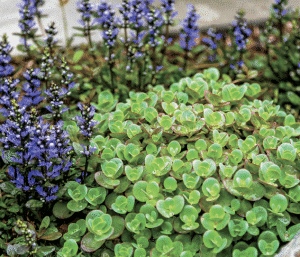

Be aware that some groundcovers can be too aggressive for your needs, so do your homework.
Groundcovers sold at informal plant sales (often plants dug from yards) are known to spread quickly—that’s why people have a lot to spare. These may be perfect for large areas but maybe not for smaller gardens. The tendency to spread is what makes groundcovers successful at what they do. Once I have a patch established, I don’t need to buy more; I just “divide and multiply.” I dig up small pieces, poke them in the ground, and water well to keep enlarging the area of living mulch.
Living mulch goes beyond groundcovers
You can select matt-forming plants, or plant shorter plants en masse (mass planting). Low-profile grasses and sedges are perfect for creating a cohesive design. I like to think of them as sautéed onions in a savory dish: They act to bind together all the flavors to make something more complex. I love it when the plants that make up my living mulch meet and mingle, forming a living tapestry beneath my feet. I’m not there yet, but I’m well on my way to having living mulch throughout my entire garden.
It turns out that living mulch can do all the good things that dead mulch can do, plus a few more.
Like conventional mulch, living mulch suppresses weeds, cools soil, and prevents erosion. Beyond that, it’s sustainable and visually interesting, and it saves work. Once established, it’s also economical because you don’t have to replace it periodically like you do with wood and other organic mulches. In addition, I think it gives landscapes a mature, settled look; I call it “plant patina.”
Living mulch also provides an all-important “soft landing” for insects. This term was coined by pollinator conservationist Heather Holm. It refers to diverse native plantings beneath keystone trees, like oak, willow, cherry, poplar, pine, and other natives trees that “provide habitat and shelter for various life stages of insects, especially caterpillars, moths, butterflies, and other beneficial insects like bumblebees and fireflies.”
Recommended Reads
Weed Suppression: Choosing The Right Cover Crops & Living Mulches
Read The Book

Garden for Life
Strategies for Easier, Greener, More Joyful Gardening as We Age
$29.95
You may like...
-
 $44.95
 -
$34.95
-
$34.95


Recent Articles

All hail the mighty garlic clove! Become a master at garlic growing with these simple tips for growing no-till garlic from seed to harvest.
Read More
Try your hand at preserving veggies by freezing them! Freezing vegetables is a quick, simple way to preserve them for winter meals.
Read More
As your favorite variety of home grown tomatoes start ripening on the vine this summer, be sure to save those seeds for next year’s planting.
Read More
Curious about carrots? Before you get started on cultivating, check out these insights on growing & harvesting carrots from gardening expert Will Bonsall.
Read More
Squash newbies, this one’s for you! Learn how to harvest, cure, and store squash with these tried-and-true techniques from gardening expert Carol Deppe.
Read More