

How to Become a Shiitake Mushroom Farmer
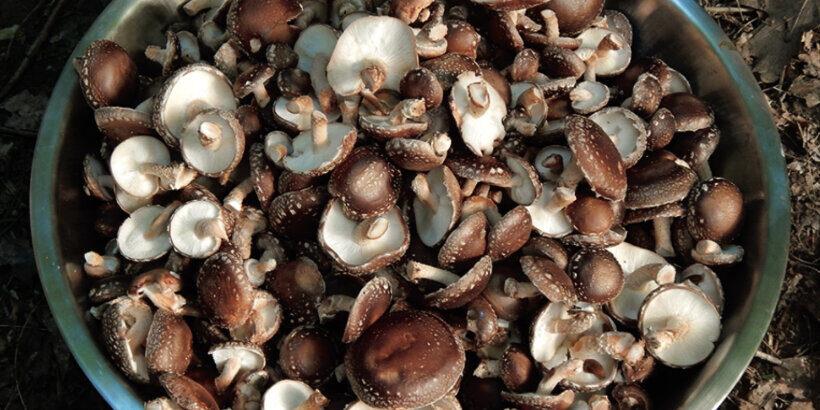
Interested in becoming a mushroom farmer? Shiitake mushrooms are one of the easiest and most profitable places to start.
The following is an excerpt from Farming the Woods by Steve Gabriel and Ken Mudge. It has been adapted for the web.
(Photographs courtesy of Steve Gabriel and Ken Mudge unless otherwise noted.)

A beech log that has been “forced” to produce a uniform flush of shiitake mushrooms.
The Stunning Shiitake Mushroom
Shiitake (Lentinula edodes) is the third most common cultivated mushroom in the world and certainly the best-known forest-grown mushroom in North America.
It is a bit ironic that shiitake mushrooms, one of the most important nontimber forest crops used in North American forest farming, is not native to the continent.
It is indigenous to Asia and has been cultivated in China since about AD 1100 and later in Japan, where the value has primarily been placed on its medicinal properties.
The Rise of the Shiitake Mushroom
A paper published in 1982 by Gary Leatham1 was instrumental in popularizing shiitake cultivation in the United States. Today a half dozen spawn producers exist, but the number of growers is quickly on the rise.
In addition to their delicious taste, shiitake boast a number of positive nutritional and medicinal qualities.2,3
Health Benefits of the Shiitake Mushroom
The proteins contained in shiitake have an amino acid profile similar to the “ideal protein” for humans. These mushrooms are one of the best sources of protein, especially for vegetarians/vegans looking to eliminate animal proteins in their diet.
Multiple studies conducted over the last ten years have demonstrated that an active component in shiitake called eritadenine “significantly decreased the plasma total cholesterol concentration, irrespective of dietary fat sources . . .”
Shiitake mushrooms are considered a good source of three B vitamins (B2, B5, and B6); a very good source of six trace minerals (manganese, phosphorus, potassium, selenium, copper, and zinc); and a notable source of magnesium and vitamin D.
Another documented health benefit of shiitake mushrooms is as a supporter of the immune system. Shiitake also contains the polysaccharide lentinan, a (1-3) ß-D-glucan, which is associated with cancer prevention properties of this mushroom.
Shiitake Mushroom Production
Producers of forest-cultivated shiitake mushrooms range in size from “hobby” scale (<200 logs), part-time commercial (500 to 1,000 logs), all the way up to fulltime commercial (>5,000 logs).
Few of these producers bother to produce their own spawn for log inoculation; instead they rely on companies that specialize in spawn production and also sell a wide range of mushroom-related supplies.
According to the USDA National Agricultural Statistics Service (NASS, 2013), in 2011–2012 there were 151,000 natural wood logs in outdoor shiitake production, whereas in 2012–2013 the number of logs dropped to 137,000.
It should also be noted that several experienced growers, and a major supplier of spawn to mushroom growers all over the United States, regard these shiitake-related NASS statistics to be unreliable because they believe most growers do not fill out the annual surveys sent to them by NASS, which may be the reason for the drop in the numbers.
By all indications “on the ground” (attendance at Extension events, sales at spawn producers, involvement in grower groups), log-base shiitake production is well on the rise.
Beginning Shiitake Mushroom Farming

Shiitake mushrooms grown indoors on artificial sawdust “logs.”
For beginning farmers shiitake is perhaps one of the best candidates as a niche crop, at least in the northeastern United States.
The markets are more or less wide open, with consumers and chefs eager to get their hands on this tasty and nutritious food.
Shiitake can be easily sold at farmers’ markets, to restaurants, and through CSA models for $11 (wholesale) to $16 (retail) a pound.
A beginner can start with 300 logs, which yield roughly 10 pounds a week, or $120 to $160 of sales, and add more logs until he is satisfied.
The cost to inoculate each log is $1.50 to $3.00, which pales in comparison to the $50 to $60 of sales per log that will be gained over its lifetime.
And other than drying out, the crop is forgiving of changing weather conditions, floods and droughts, and even the farmer’s desire to take a vacation.
Notes
- Leatham, G.F. 1982. Cultivation of shiitake, the Japanese forest mushroom on logs: A potential industry for the United States. Forest Products Journal. 32:29–35.
- Hobbs, C. 1995. Medicinal mushrooms: an exploration of tradition, healing & culture. No. Ed. 2. Botanica Press, Santa Cruz, Calif.
- USDA SR-21. Conde Nast, 2014 Nutrition facts and analysis for mushrooms, shiitake, cooked, without salt. 5 January 2014. http://nutritiondata.self.com/facts /vegetables-and-vegetable-products/2488/2.
Recommended Reads
Read The Book

Farming the Woods
An Integrated Permaculture Approach to Growing Food and Medicinals in Temperate Forests
$42.95
You may like...
-
 $40.00
 -
$24.95
-
$39.95


Recent Articles

All hail the joyful juneberry! While these berries taste wonderful when they’re fresh, you can also preserve them and create beverages with them.
Read More
Do you have an old, worn-out pair of jeans in your dresser? Instead of throwing them out, try to grow mushrooms on them. Follow these guidelines to get started.
Read More
If you’re planning out a forest garden, or are just looking for a plant to use as ground cover, garden strawberries are a great option.
Read More
Discover the magic of oyster mushrooms! They can grow almost anywhere. Straw is a surprisingly simple way to cultivate the ever-popular oyster mushrooms.
Read More
Known for their tall stature and distinctive flower heads, cattails thrive near lakes and marshes. From edible shoots and nutrient-rich roots to pollen used in baking, cattails offer a wealth of uses.
Read More