
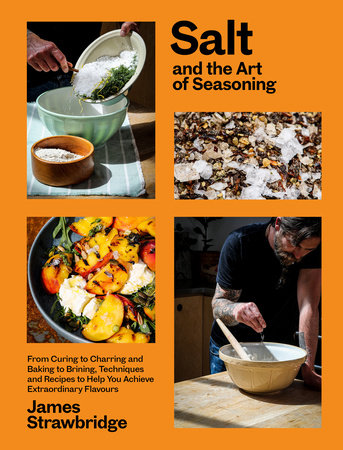
Salt and the Art of Seasoning
From Curing to Charring and Baking to Brining, Techniques and Recipes to Help You Achieve Extraordinary Flavours

| Pages: | 288 pages |
| Book Art: | 120 color photos |
| Size: | 7 x 10 inch |
| Publisher: | Chelsea Green Publishing UK |
| Pub. Date: | May 17, 2023 |
| ISBN: | 9781915294036 |
Salt and the Art of Seasoning
From Curing to Charring and Baking to Brining, Techniques and Recipes to Help You Achieve Extraordinary Flavours
“[The] recipe book that will make all your other recipe books taste better.”—The Telegraph
“A paean to the transformative effects of natural salts.”—The Observer
Understanding how to use salt can make or break a dish. Salt and the Art of Seasoning will not only help you master your use of seasoning, but it will allow you to reimagine how you cook, cure, and work with salt in your kitchen—elevating your flavors to a whole new level.
Includes over 100 salt-inspired recipes!
Salt is extraordinary. A fundamental, ancient resource used for thousands of years around the world, it is the one essential ingredient that transforms all cooking: elevating flavors from good to great, to unforgettable. In this stunning new cookbook, chef, TV presenter, food photographer, and sustainable living expert James Strawbridge shares with you the fundamentals of this artisan ingredient: from distinctive flavor notes and profiles of different salts found around the world, to brilliantly useful techniques—such as brining, baking, charring, fermenting, and preserving.
Inside, you’ll also find:
• The Science of Taste
• A Salt Sommelier’s Guide
• How to measure “to taste” and season correctly
• Salt Craft—from curing to blocking to baking
• Over 100 recipes—from drinks to desserts
Salt and the Art of Seasoning will show you how to choose the right type of salt for the right type of dish, how to add it at the right time and in the right amount. James shares techniques such as using salt to pickle, cure and ferment as well as making your own flavored or smoked salts to bring out all sorts of previously hidden flavors. James has also crafted salt-inspired recipes to help you use salt in more creative, healthy and delicious ways.
Recipes include:
• Brined chicken
• Cornish salted sardines
• European-style sour pickles
• Native American cured fish
• Kimchi fried rice
• 8 essential flavoured salts
• Smoked salted butter
• Focaccia
• Smoked toddy
• And more!
Salt and the Art of Seasoning takes you on an unforgettable journey exploring salt’s long role in food throughout the world and human history—while teaching you how to best use this fundamental spice tonight to make your meal sing.
Reviews & Praise
“[The] recipe book that will make all your other recipe books taste better.”—The Telegraph
“Concise and crisp, Salt and the Art of Seasoning’s well-written pages are likely useful, be it for a reason, a season or a lifetime. You’ll return to it like a horse to a salt lick!”—Valentine Warner, cook, broadcaster and author of The Consolation of Food
“James has taken on writing a book about the most singularly important ingredient in the kitchen. Salt gives life. Our bodies cannot perform without salt, but that’s not what I mean. I am always asked by friends and customers why my food tastes so much better than theirs. I give two answers. The first: “I have been a chef for 30 years so I’m not surprised!” The second is merely one word, “salt”. Salt gives life to ingredients like no other spice. When you cook with enough salt it brings out the natural flavour so that there is no need to season it afterwards. Cooking without salt would be cooking without soul!”—Mark Sargeant, chef patron of The Brasserie MS and author of My Kind of Cooking
“This is an inspiring, informative and imaginative study of the most essential of seasonings in which James writes with passion and enthusiasm about this sometimes unfairly vilified ingredient in all its glory. He demonstrates salt's versatility, importance and beauty in a book brimming with recipes and projects that I can’t wait to try.”—George Egg, comedian and cook
“There’s so much more to salt than… salt. James Strawbridge delves into the myriad types, tastes, uses and history of salt – a seasoning that has the power to transform the flavour of even the humblest ingredient.”—Karen Barnes, Editorial Director of delicious
“This book is a feast for the eyes as well as the taste buds. Stunning photography, mouth-wateringly delicious recipes, peppered throughout with fascinating insights and information about the world of salt, written in a wonderfully readable and imaginative style. Never again will salt be an afterthought in our household.”—Brigit Strawbridge Howard, author of Dancing with Bees
“I’m loving Salt and the Art of Seasoning and James’s in-depth knowledge of this amazing ingredient. As a chef, salt is a massive part of my cooking, so this is a book that sits firmly on my shelf. Get yourself a salt block and try the scallop ceviche. Salt is extraordinary and so is this book.”—Andrew Tuck, chef at St Kew Inn
“I have always known how creative and artistic James is but Salt and the Art of Seasoning shows his technical side and understanding of the science of seasoning, and salt. Who thought I would enjoy understanding lacto-fermentation – I never stopped to think about how sauerkraut was made during my many years living in Germany. You simply have to do the tomato test and explore the concept of merroir, then your eyes will be truly opened. I’m not saying that I will be trying to perfect the two-finger grind but my cupboard suddenly contains a diversity of salt hitherto unknown, and I have a greater understanding of why salt deserves its place in our history, from a means of payment to being the go-to condiment.”—Dick Strawbridge, author and presenter of Channel 4’s Escape to the Chateau
“Salt and the Art of Seasoning is a worthy and inspirational homage to the most essential ingredient in our pantry. James teaches us how salt is the ultimate way to harness flavour, transform textures, ferment, preserve and improve our cooking.”—Eco-Chef Tom Hunt, author of Eating for Pleasure, People & Planet
“I’m obsessed with salts; I collect them, write about them, cook with them, and even grow them. Just when I thought I knew all that I could about salt, Chef Strawbridge drops some delicious knowledge with Salt and the Art of Seasoning. Anyone who pickles, ferments, makes charcuterie, or enjoys other culinary techniques that are salt focused needs this book in their workspace.”—Jeremy Umansky, co-author of Koji Alchemy
“Knowing how and when to use different salts is one of the most important parts of cooking, but navigating the different types and when they should be used can be confusing. James has put together a great manual on how to use what’s probably the most important seasoning in the kitchen.”—Alan Bergo, author of The Forager Chef’s Book of Flora
“A paean to the transformative effects of natural salts”—The Observer

About James Strawbridge
James Strawbridge is an award-winning Cornish chef, photographer and sustainable living expert as well as the author of several cookbooks including The Complete Vegetable Cookbook, The Artisan Kitchen and Practical Self Sufficiency with Dick Strawbridge. Recent television presenting and appearances include Escape to the Chateau (Channel 4), Strawbridge over the Drawbridge (BBC) and The Hungry Sailors (ITV).
Connect with James Strawbridge
Books by James Strawbridge
You may also like...
-
 $34.95
 -
$34.95
-
$35.00


