

Grass-Fed Beef for a Post-Pandemic World
How Regenerative Grazing Can Restore Soils and Stabilize the Climate

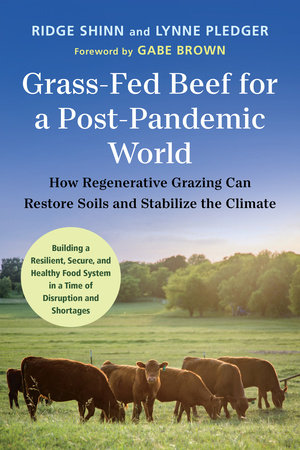
| Pages: | 224 pages |
| Size: | 6 x 9 inch |
| Publisher: | Chelsea Green Publishing |
| Pub. Date: | October 24, 2022 |
| ISBN: | 9781645021247 |
Grass-Fed Beef for a Post-Pandemic World
How Regenerative Grazing Can Restore Soils and Stabilize the Climate
*With a foreword by Gabe Brown, bestselling author of Dirt to Soil
How can we learn from our mistakes and pave a way for sustainable, nutritious, local meat?
The COVID-19 pandemic exposed the vulnerabilities of our globalized food system and highlighted the desperate need for local and regional supplies of healthy meat. We must replace corn-based feedlots, which are responsible for significant climate emissions, nitrogen pollution, and animal suffering. Grass-Fed Beef for a Post-Pandemic World outlines a hopeful path out of our broken food system via regional networks of regeneratively produced meat.
In 2017, Ridge Shinn and Lynne Pledger went to market with Big Picture Beef, a company that partners with farmers across the Northeast to increase access to wholesale markets while promoting holistic grazing management techniques. The result? Increased health benefits for consumers, the environment, and livestock.
In Grass Fed-Beef for a Post-Pandemic World, you’ll find information assembled from the fields of ecology, climate science, nutrition, and animal welfare, along with on-the-farm stories from Ridge’s travels as a consultant all over the United States and abroad.
You’ll discover how regenerative grazing can:
- restore degraded farmland
- protect against droughts and floods
- increase biodiversity
- combat climate change by reducing emissions and sequestering carbon
- contribute to regional economic development
- produce nutrient-dense, healthy meat for consumers
Grass-Fed Beef for a Post-Pandemic World is not just for beef producers, but for anyone wondering how our farmers and ranchers can raise cattle while also caring for the local and global environment.
“The next time someone argues that cows are disastrous for the planet, hand them a copy of Grass-Fed Beef for a Post-Pandemic World. Equal parts manifesto and how-to guide, Shinn and Pledger will show you that the solution to our human and planetary health crisis begins with a cow eating grass and ends with the most delicious steak you’ve ever had.”—Dan Barber, author of The Third Plate
Reviews & Praise
“The next time someone argues that cows are disastrous for the planet, hand them a copy of Grass-Fed Beef for a Post-Pandemic World. Equal parts manifesto and how-to guide, Shinn and Pledger will show you that the solution to our human and planetary health crisis begins with a cow eating grass and ends with the most delicious steak you’ve ever had.”—Dan Barber, author of The Third Plate
“This comprehensive and engaging account offers a path forward from industrial to regenerative agricultural practices, one that is urgently needed in the face of diminishing availability and increasing costs of the fossil fuels largely responsible for a precipitously warming global climate. This book is a must-read for people worldwide interested in how managed grazing can enhance the health of soil, plants, domesticated and wild animals, and humans and can help cool a warming planet as increasing temperatures make large swathes of the globe, including many parts of the United States, uninhabitable during the next fifty years.”—Fred Provenza, professor emeritus, Department of Wildland Resources, Utah State University; author of Nourishment
“Lynne Pledger and Ridge Shinn have created a readable, usable guide to grass-fed beef—full of both the hows and whys. An essential addition to the libraries of everyone involved in the raising and selling of beef.”—Nicolette Hahn Niman, author of Defending Beef
"Whether you eat beef or not, this book reveals what what everyone needs to know—why grass-fed beef is better not just for the health of cows but for people and the planet as well."—Anne Biklé, coauthor of What Your Food Ate
“Challenging the entrenched wisdom that cows are bad for us and the environment, Grass-fed Beef for a Post-Pandemic World offers a well-seasoned perspective that the real problem is how we raise them.”—David R. Montgomery, author of Dirt and Growing a Revolution
“Anchored in the science, history, and first-hand practice of regenerative grazing, Ridge Shinn and Lynne Pledger make a deeply informed and unromanticized case for incorporating the ‘work with nature’ principles of nineteenth century agriculture to, among other things, restore soils, promote rural economies, mitigate climate disruption, and support overall well-being—system-wide and at scale.”—Jock Herron, design critic focused on food systems and health, Harvard Graduate School of Design
“Grass-Fed Beef for a Post-Pandemic World is a well-researched and timely contribution to a much-needed conversation about what we eat and where it comes from. Fascinating for anyone interested in finding ways they can personally help mitigate climate change and ‘eat better’ for the planet, for animal welfare, and for their own health. Essential reading for farmers wanting to restore their land, feel good about what they do, and turn a profit.”—Libby Henson, codirector and cofounder, Grassroots Systems
“As we increasingly recognize the vital role of regenerative grazing in human, ecological, and planetary health, the question invariably asked is, how quickly can it be scaled up? Informed by decades of industry experience and market success, the authors of Grass-Fed Beef for a Post-Pandemic World lay out a brilliant strategy for transforming beef production from a conventional, extractive, fossil fuel-intensive model to an approach that heals degraded soil, improves wildlife habitat, rejuvenates rural economies, and sequesters carbon. Best of all, their vision is adaptable to all regions.”—Karl Thidemann, cofounder, Soil4Climate
“This book gives me hope. In it, soil and climate heroes Ridge Shinn and Lynne Pledger bring us a giant step closer to the regenerative future. Buy it. Absorb it. Cherish it. Share it.”—Seth J. Itzkan, cofounder, Soil4Climate
“This timely book by Ridge Shinn and Lynne Pledger masterfully covers how a transition to regenerative grazing can restore ecosystem function to deliver vital ecosystem services to provide ecological and economic resilience required for a secure and healthy food system base. They outline the steps necessary to transition from the current food system organization to systems that facilitate decision making on the land and educate the population on the benefits of managing to restore ecosystems.”—Richard Teague, professor, Texas A&M AgriLife Research

About Lynne Pledger
Lynne Pledger is a writer and environmental advocate. She has worked with Ridge Shinn since the early 1980s to preserve heritage livestock breeds and increase regenerative grazing in the northeastern United States. She has also worked in affiliation with NPOs—including Clean Water Action, Sierra Club, and Upstream—on public policy issues such as waste reduction, climate change, and energy. She has been a guest lecturer on sustainability issues at UMass Amherst, Smith College, Leslie University, and the Harvard School of Public Health. In addition, she homeschooled her two children and one grandchild. Now living in western Massachusetts, she is writing a book of poetry.
Books by Lynne Pledger

About Ridge Shinn
Ridge Shinn is the founding CEO of Grazier LLC, a.k.a. Big Picture Beef, a 100% grass-fed beef company partnering with farmers throughout the northeastern United States. Early in his career he became interested in heritage breeds of livestock and cofounded the group now known as The Livestock Conservancy. He was also the founding director of the New England Livestock Alliance, which helped farmers find markets for their meat. In addition to managing his Devon herd in central Massachusetts, Ridge has consulted all over North America, in New Zealand, England, Uruguay, and Argentina, and for the Lakota of the Cheyenne River Reservation. His work has been recognized in Smithsonian, the Atlantic, the New York Times, and TIME magazine, which dubbed him a “carbon cowboy.”
Books by Ridge Shinn

About Gabe Brown
Gabe Brown is a pioneer of the soil-health movement and has been named one of the twenty-five most influential agricultural leaders in the United States. Brown, his wife, Shelly, and son, Paul, own Brown’s Ranch, a holistic, diversified 5,000-acre farm and ranch near Bismarck, North Dakota. The Browns integrate their grazing and no-till cropping systems, which include cash crops and multi-species cover crops along with all-natural, grass-finished beef and lamb, pastured pork, and laying hens. The Brown family has received a Growing Green Award from the Natural Resources Defense Council, an Environmental Stewardship Award from the National Cattlemen’s Beef Association, and the USA Zero-Till Farmer of the Year Award.
Books by Gabe Brown

You may also like...
-
 $17.95
 -
$19.95
-
$39.95

