

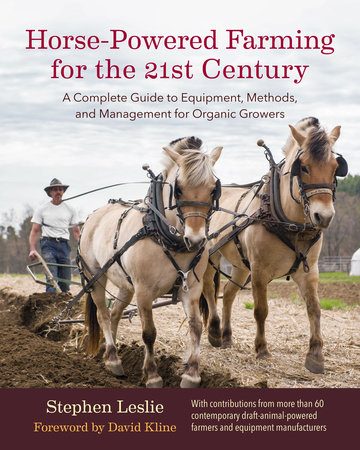
Horse-Powered Farming for the 21st Century
A Complete Guide to Equipment, Methods, and Management for Organic Growers

EXCERPTS
| Pages: | 416 pages |
| Book Art: | Color photos color illustrations throughout |
| Size: | 8 x 10 inch |
| Publisher: | Chelsea Green Publishing |
| Pub. Date: | December 3, 2015 |
| ISBN: | 9781603586139 |
Horse-Powered Farming for the 21st Century
A Complete Guide to Equipment, Methods, and Management for Organic Growers
With contributions from more than 60 contemporary draft-animal-powered farmers and equipment manufacturers
Now is a time of exciting new developments for live animal power. As the numbers of adherents to this way of life grow, ecologically minded farmers in their fields are developing efficient horse-drawn systems, and equipment manufacturers in small shops all across North America and Europe are coming forth with new innovations in ground-drive technology that have us poised on the cusp of another agricultural revolution—with working horses, mules, donkeys, and oxen at the heart of it.
Stephen Leslie’s first book, The New Horse-Powered Farm, presented an overview of the many facets of running a small, diversified farm with live horse power. Horse-Powered Farming for the 21st Century is focused entirely on the tools and methods required to successfully manage the horse-powered market garden with draft animal power. However, this is not a step-by-step how-to guide outlining one single system, but rather a manual that presents a range of options and approaches. Leslie examines the function and use of all the implements typically employed on a contemporary draft-animal-powered market garden and illustrates these points with insightful reports from the field, farm profiles, and home-built solutions contributed by over sixty draft animal-powered farmers from across North America and Europe.
Each teamster’s story represents a patch in a quilt that is woven together with a narrative thread to guide the reader through the whole fabric of the growing season, from soil preparation to harvest. The book structure follows the seasonal progression of implements, beginning with several examples of contemporary draft-animal-powered produce farms; next an examination of the versatile utility of forecarts; then taking an in-depth look at fertility management on the farm; moving on through primary and secondary tillage, seeding and transplanting; then on to the multifold options for cultivators, tool carriers, and multipurpose implements, with technical harnessing and hitching details for the best use of the implements. For experienced teamsters and beginning market growers farming with horses, this is an invaluable and one-of-a-kind guide, sure to last forever in the agricultural canon.
Reviews & Praise
“In his first book, The New Horse-Powered Farm, Stephen Leslie presented a formidable mass of expert guidance and helpful information gleaned from his own experience horse farming and that of others similarly engaged. In Horse-Powered Farming for the 21st Century, Leslie piles on insightful wisdom that delves deeper into the subtle complexities of managing a horse-powered farm. The first book furnished plans for constructing a fully equipped horse farming toolbox. Horse-Powered Farming for the 21st Century bolsters that information with clear explanations of how to make the best use of the instruments found inside.”—Joe Mischka, Rural Heritage Magazine
“Stephen Leslie has compiled an encyclopedia of horse-farming knowledge with excellent diagrams and photos to illustrate the various applications of draft-animal work. It is a luxury to be able to hold this vast accumulation of knowledge and experience offered by contributors across the United States and other countries. Stephen’s writing reminds us that horse farming is our hope for the future because it is not dependent on fossil fuels or large acreages. Horse-Powered Farming for the 21st Century is a great book, not only for its practical tips for farmers but also as a statement about what matters on this planet.”—Heather Smith Thomas, author of Storey’s Guide to Training Horses

About Stephen Leslie
Stephen Leslie is the author of The New Horse-Powered Farm, published by Chelsea Green in 2013. He began his farming career in 1992 at Hawthorne Valley, a biodynamic farm in upstate New York, where he worked for three years as an apprentice. Since then, in partnership with his wife, Kerry Gawalt, he has made his living farming and gardening with draft horses. Currently, Stephen and Kerry and their daughter, Maeve, own and operate Cedar Mountain Farm, a Fjord-horse-powered CSA and Jersey-cow dairy at the Cobb Hill Cohousing in Hartland, Vermont. Stephen is a regular contributor to the Small Farmer’s Journal and Rural Heritage magazine.
Connect with Stephen Leslie
Books by Stephen Leslie
You may also like...
-
 $24.95
 -
$39.95
-
$10.00


