How do mushrooms grow? How do they eat, reproduce, or spread? What exactly is a mushroom?All of these answers and more can be found in the intricate, web-like fiber found underneath these fungi: the mycelium.
Understanding this “vegetative” part of the fungus is key to understanding the whole system.
Whether you’ve tripped on them or over them or just enjoy them on your pizza, most encounters with fungi involve mushrooms. The utterly common supermarket “button” variety may spring to mind, or perhaps the pale little parasols common to fields and suburban lawns.
But mushrooms are a universe unto themselves, expressing every imaginable (or, as one soon discovers, often unimaginable) form and texture.
Types of Mushrooms
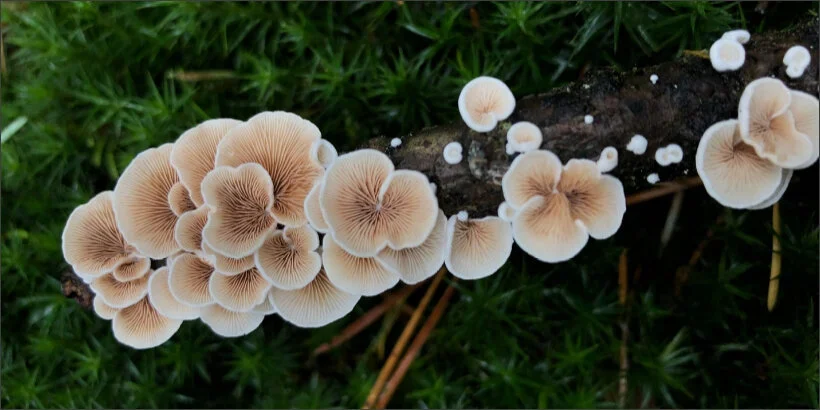
Toadstools peek up from the duff; striated hooves of polypore “shelf ” fungi bestud tree trunks; smut and rust fungus appear as dust across vast croplands; pungent, scarlet claws of stinkhorns erupt and unfurl in slow-motion ecstasy before becoming engulfed in flies, or form geometric cages and veils worthy of Buckminster Fuller’s fevered dreams.
Some look like living icicles or a surrealist’s vision of bloody teeth; many appear as tiny cups barnacled upon a twig or blotchy spots on a leaf, never to be noticed by human eyes.
Certain varieties bruise in coruscating rainbows when sliced or deliquesce into inky puddles after a few hours aboveground. Many mushrooms might seem soft and squishy, but they can grow with enough force to break through pavement or lift rocks.
Common Names for Mushrooms
Their common names—pheasant’s back, witches’-butter, wood ear, elfin saddle—are often so apt that they’re impossible to forget once learned. They also comprise a seemingly endless variety of meanings.
Depending on whom you ask, mushrooms inspire thoughts of delight, disgust, delicacy, divinity, or death. When encountered in nature, they can seem to vibrate with an inexplicable sense of presence, even selfhood; many mycophiles speak of “meeting” mushrooms in the woods.
But mushrooms are just the tips of a fluffy iceberg, indicating a dense tangle of living fibers below: the mycelium.
The Mycelium and Its Secrets
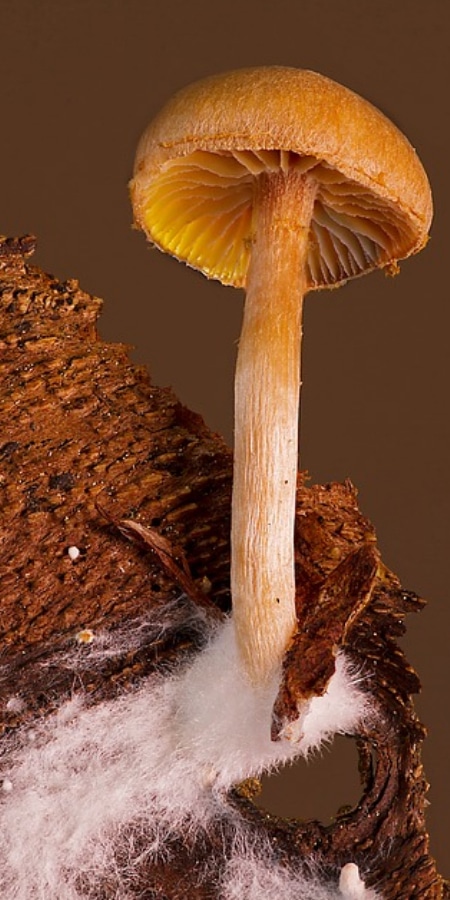
This is the wispy white patch one sees when lifting a log from putrescent leaves on the wet forest floor or examining the side of a fallen tree. Called the “vegetative” part of the fungus—seemingly a holdover from its inclusion in the plant kingdom—the mycelial mat within which its entire life cycle plays out is often very small, no bigger than an ant or a handful of leaf cells.
Others can straddle several acres and live for hundreds, even thousands of years. Upon becoming interested in mushrooms, one often hears about the Humongous Fungus high in Oregon’s Blue Mountains; the web of its mycelial “body” extends upward of three square miles, earning it the title of the largest living thing on earth, as well as one of the oldest.1
What Is the Mycelium?
The mycelium amounts to a complex network of cellular strands called hyphae. As the mycelium grows, its hyphae constantly branch and fuse in various directions, searching for food and mates while infusing their environment with a fungal undergirding. Every hyphal tip grows and divides, and those tips do the same again.2
Viewed up close, and best seen with a microscope or a time-lapse camera, hyphae resemble ice crystals in their constantly expanding search for sustenance, be it from wood, leaves, insects, rocks, bacteria, bone, or symbiosis with another organism.
Functions of the Mycelium
Along every part of its surface, enzymes ooze out to digest food that is then absorbed back through the walls of the hyphal cells; rather than chew, swallow, and digest their food, fungi flip that script, growing through, dissolving, and absorbing their sustenance. Fungi excrete diverse varieties of exudates, including those that serve to fight off other microbes or attract potential mates as the network of its body expands its reach and negotiates its environment.3
Since individual hyphae are so thin—down to a few thousandths of a millimeter—the mycelium folds a huge amount of surface area into a small space.4 As the mycelial web grows from nearly every leading edge, it may add more than half a mile of hyphal length every day. As much as eight miles can be found in a cubic inch of rich, undisturbed soil; under harsher conditions, that length can shrink closer to one hundred centimeters.5The incredible fineness of hyphae allows them to wend intricately among and within plant roots, between microscopic cracks in stone, even inside a host’s individual cells.
What Is Mycelium Made Of?
The mycelium is made of millions of hyphal cells, with no distinct center. Split it in half, and the two sections will carry on with their day. Break it into tens of thousands of microscopic pieces, and each fragment will independently resume the search for food and mates, relinking wherever they meet another part of their former, larger self.
From tip to hyphal tip, the fungus regulates the flow of energy and information throughout the various zones of its distributed form: Where there’s nutrition, energy goes into consuming and distributing it throughout the mycelium; where there are threats, it can marshal an armory of adaptive defenses.
And there are always threats. A fungus in nature lives in constant, deadly competition with bacteria, insects, and other fungi that seek to eat them or seize their resources.6
If pickings seem slim or local conditions take a turn, the mycelium may decide—insofar one is comfortable calling it a “decision”—to retreat, explore new opportunities, or start making mushrooms.
When you look at the forest floor and see mushrooms (lucky you), it’s because the mycelium underneath has determined that it’s time to cast fate to the wind.
Literally, in the form of spores. Mushrooms are also commonly called fruiting bodies, another linguistic relic of their long-standing inclusion among the ranks of plants.
Not to be outdone by their botanical namesake, mushrooms take all kinds of curious and colorful shapes that can rival flowers in their beauty and complexity, but their unifying purpose is reproduction, and if we’re being honest, that’s often pretty obvious just by looking at them.7
Notes:
By comparing the fungus’s size to its rate of spread—about one to three feet a year—scientists estimated it to be between 1,900 and 8,650 years old; see Craig L. Schmitt and Michael L. Tatum, “The Malheur National Forest Location of the World’s Largest Living Organism [The Humongous Fungus],” United States Department of Agriculture, Forest Service, Pacific Northwest Region (2008), 4, https://www.fs.usda.gov/Internet/FSE_DOCUMENTS/fsbdev3_033146.pdf.
Gero Steinberg, “Hyphal Growth: A Tale of Motors, Lipids, and the Spitzen- körper,” Eukaryotic Cell 6, no. 3 (March 2007): 351–60, https://doi.org /10.1128/ec.00381-06.
Cotter, Organic Mushroom Farming, 7–8.
McCoy, Radical Mycology, 14.
Phillips, Mycorrhizal Planet, 6.
Fungi can also parasitize other fungi. Perhaps the most often cited example is the delectable lobster mushroom, which develops a signature red “shell”on its surface when Hypomyces lactifluorum parasitizes a species of Russula or Lactarius, turning it from bland or overly spicy to crunchy and tasty; see Tom Volk, “This Month’s Fungus Is Hypomyces lactifluorum, the Lobster Mushroom,” Tom Volk’s Fungus of the Month for August, 2001, accessed August 6, 2020, https://botit.botany.wisc.edu/toms_fungi/aug2001.html.
Phallus impudicus, for example, is a slender, pale, sometimes slightly curved mushroom with a dark, rounded tip that bears an undeniable resemblance to, well, you get the idea.
Do you have an old, worn-out pair of jeans in your dresser? Instead of throwing them out, try to grow mushrooms on them. Follow these guidelines to get started.
Discover the magic of oyster mushrooms! They can grow almost anywhere. Straw is a surprisingly simple way to cultivate the ever-popular oyster mushrooms.
Known for their tall stature and distinctive flower heads, cattails thrive near lakes and marshes. From edible shoots and nutrient-rich roots to pollen used in baking, cattails offer a wealth of uses.
These much-loved titles are the perfect books for Mother’s Day! Gardening books, cookbooks, memoirs and more — there’s a book for every mom on this list.