

Lessons From An Unusual Christmas Tree Farm: Resourcefulness and Craft
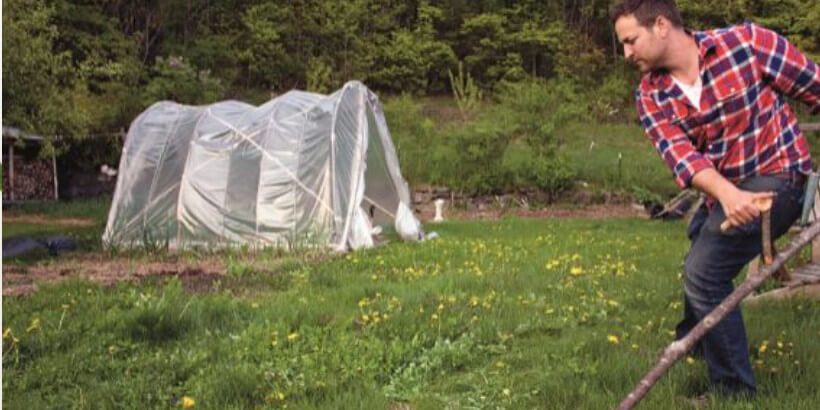
Emmet Van Driesche and his wife, Cecilia, operate the Pieropan Christmas Tree Farm in Western Massachusetts. When he’s not working on the tree farm or editing scientific manuscripts, he spends his time carving wooden spoons and teaching others to do the same. You can learn more about him at www.emmetvandriesche.com.
The following is an interview with Emmet Van Driesche. It has been adapted for the web.
You are both a Christmas tree farmer and a spoon carver. What is it about carving and working with trees that you find interesting?
One aspect I enjoy is the actual process of making something. With the spoons, it’s the combination of aesthetics and design and skill. With the trees, it’s much more—it goes back to my farming roots. How do you maintain a landscape? What’s your relationship to that landscape, historically? How is your relationship to the landscape dependent on that of the people who came before you? These are all questions that have interested me, even before I came to this farm.
What I discovered through taking this opportunity is an interesting new way of thinking about work. One of the most important things about why this work is good for me is that it suits me temperamentally. I love the physical work, and I love the way that it’s just a series of decisions that need to be made quickly and are inconsequential in and of themselves.
The most important thing is that you just keep making them and making them and don’t get bogged down.
And I think that really suits my temperament. I didn’t know that going into this.
How long had you been selling trees and wreaths when you started carving and selling spoons? What was the genesis of that activity for you?
I had this moment where I was watching my one-year-old daughter crawl around the yard. I was standing on the porch next to all the firewood, and I thought, I feel like making something right now, and I could sell it. We were poor, we needed money, and I had already made these spatulas for our kitchen. I thought, I bet I could make some of those and sell them. And so I did.
I just started making them, and that first year I sold them for $10 a piece and they all sold, so that was about $300. At the time we were paying around $625 in rent, so that was half a month’s rent—that’s what the mentality was through the first bunch of years. At that point I wasn’t looking at the landscape and thinking, Here’s this thing I could get from the land. It hadn’t even occurred to me to think that holistically yet.
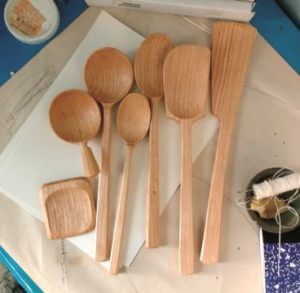 And then the spoon carving built over a couple of years. I came across enough resources online, even though I wasn’t on social media and didn’t have a cell phone and we had barely any internet at the house. I remember I would put my daughter to sleep and just sit on the floor with my laptop, out of sight, and read this blog and stalk people’s Instagram accounts. I fell down that rabbit hole and became more and more excited about it.
Even though there are disparate parts to what you do—from Christmas trees, to wreaths, to scythes, to spoons, to lessons—they all seem to be connected through wood or trees. Is this how you see it?
For a long time I felt like I didn’t have a job I could easily explain to people. It was always so strangely mixed together—I didn’t know how to articulate it, or even how to think about it.
But as I did it more, and it started to work, I came to realize that all the things I was doing were supporting each other in a way where they didn’t have to be so obviously aligned.
For example, for common woodworkers, they make one woodworking product, and the way they diversify is by making another product—first you do cutting boards, then you do rolling pins, then you do bowls, right? But from the beginning I’ve always found myself pulling together the different things that interest me and then figuring out how they can be cross-marketed, rather than sticking within a genre. And the interesting thing for me has always been how disparate things can support each other in ways you didn’t necessarily anticipate.
I was a multidisciplinary major in college because I was a sailor and just wanted to learn about the ocean, so I made up a major that I could twist in such a way that allowed me to think about the ocean. I take the same approach now: I’m taking whatever my situation is and twisting it around so that I can work for myself. And that’s the thread that ties it all together.
Recommended Reads
Wild Apples, Real Cider, and the Complicated Art of Making a Living
Read The Book

Carving Out a Living on the Land
Lessons in Resourcefulness and Craft from an Unusual Christmas Tree Farm
$28
You may like...
-
 $34.95
 -
$20.00
-
$34.95


Recent Articles

Do you have an old, worn-out pair of jeans in your dresser? Instead of throwing them out, try to grow mushrooms on them. Follow these guidelines to get started.
Read More
If you’re planning out a forest garden, or are just looking for a plant to use as ground cover, garden strawberries are a great option.
Read More
Discover the magic of oyster mushrooms! They can grow almost anywhere. Straw is a surprisingly simple way to cultivate the ever-popular oyster mushrooms.
Read More
Wondering how to get your goats to stay in one place? The secret is all in choosing the right fences and gates to keep them safe, happy, and healthy.
Read More
Beets can be grown year-round and are a perfect, flavorful addition to meals. Get started on growing your own no-till beets with help from these tips!
Read More