

Small-Scale Grain Raising
An Organic Guide to Growing, Processing, and Using Nutritious Whole Grains for Home Gardeners and Local Farmers, 2nd Edition

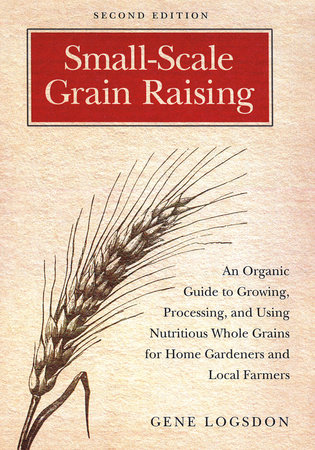
| Pages: | 320 pages |
| Book Art: | Black and white drawings |
| Size: | 7 x 10 inch |
| Publisher: | Chelsea Green Publishing |
| Pub. Date: | April 14, 2009 |
| ISBN: | 9781603580779 |
Small-Scale Grain Raising
An Organic Guide to Growing, Processing, and Using Nutritious Whole Grains for Home Gardeners and Local Farmers, 2nd Edition
Paperback
$29.95
First published in 1977, this book—from one of America’s most famous and prolific agricultural writers—became an almost instant classic among homestead gardeners and small farmers. Now fully updated!
Small-Scale Grain Raising offers a entirely new generation of readers the best introduction to a wide range of both common and lesser-known specialty grains and related field crops, from corn, wheat, and rye to buckwheat, millet, rice, spelt, flax, and even beans and sunflowers.
More and more Americans are seeking out locally grown foods, yet one of the real stumbling blocks to their efforts has been finding local sources for grains, which are grown mainly on large, distant corporate farms. At the same time, commodity prices for grains—and the products made from them—have skyrocketed due to rising energy costs and increased demand. In this book, Gene Logsdon proves that anyone who has access to a large garden or small farm can (and should) think outside the agribusiness box and learn to grow healthy whole grains or beans—the base of our culinary food pyramid—alongside their fruits and vegetables.
Starting from the simple but revolutionary concept of the garden “pancake patch,” Logsdon opens up our eyes to a whole world of plants that we wrongly assume only the agricultural “big boys” can grow. He succinctly covers all the basics, from planting and dealing with pests, weeds, and diseases to harvesting, processing, storing, and using whole grains. There are even a few recipes sprinkled throughout, along with more than a little wit and wisdom.
Never has there been a better time, or a more receptive audience, for this book. Localvores, serious home gardeners, CSA farmers, and whole-foods advocates—in fact, all people who value fresh, high-quality foods—will find a field full of information and ideas in this once and future classic.
“Home bakers rejoice! Gene’s book is back just in time to help you grow those flavorful, old, heirloom grain varieties you have always wanted to try. Bon appétit!”—Eliot Coleman, author of The Winter Harvest Handbook and The New Organic Grower
Reviews & Praise

About Gene Logsdon
Over the course of his long life and career as a writer, farmer, and journalist, Gene Logsdon published more than two dozen books, both practical and philosophical, on all aspects of rural life and affairs. His nonfiction works include Gene Everlasting, A Sanctuary of Trees, and Living at Nature’s Pace. He wrote a popular blog, The Contrary Farmer, as well as an award-winning column for the Carey, Ohio, Progressor Times. Gene was also a contributor to Farming Magazine and The Draft Horse Journal. He lived and farmed in Upper Sandusky, Ohio, where he died in 2016, a few weeks after finishing his final book, Letter to a Young Farmer.
Connect with Gene Logsdon
Books by Gene Logsdon


You may also like...
-
 $34.95
 -
$40.00
-
$34.95


