

| Pages: | 256 pages |
| Book Art: | Color photos throughout |
| Size: | 8 x 10 inch |
| Publisher: | Permanent Publications |
| Pub. Date: | June 23, 2015 |
| ISBN: | 9781856232166 |
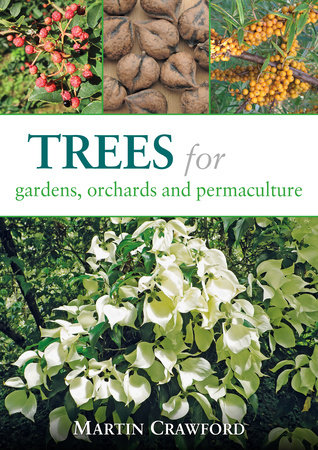
Trees for Gardens, Orchards, and Permaculture
Are you wondering which productive trees to plant in your garden? Or are you planning a forest garden? Perhaps you are planting an orchard but want a greater diversity of useful trees than is typical? Or you’d like to know what unusual fruit trees you can use? The answers to all these questions can be found in master forest gardener Martin Crawford’s new book.
Crawford has researched and experimented with tree crops for twenty-five years and has selected over one hundred of the best trees producing fruits, nuts, edible leaves, and other useful products that can be grown in Europe and North America. Each of the trees or tree groups includes details of:
• Origin and history
• Description and uses
• Varieties/cultivars
• Cultivation, pests, and diseases
• Related species
• European and North American suppliers
• Color photos with every entry
The appendices make choosing trees for your situation easy, with lists of suitable trees for specific situations, plus flowcharts to guide you. If you want to know about and make use of the large diversity of tree crops that are available in temperate and continental climates, then this book—by an internationally acknowledged expert—is both fascinating and essential reading.

About Martin Crawford
After several years working in organic agriculture and horticulture, Martin Crawford founded the Agroforestry Research Trust in 1992. Since then he has focused on researching and growing perennial food systems including forest gardens and orchards of nut trees and uncommon fruits. He runs the nursery at ART which propagates and sells many different tree and perennial plants and is the author of Creating a Forest Garden; Trees for Gardens, Orchards, and Permaculture; and other books on ecological gardening.
Connect with Martin Crawford
Books by Martin Crawford


You may also like...
-
 $25.95
 -
$75.00
-
$31.95


