

| Pages: | 672 pages |
| Book Art: | 8-page color insert |
| Size: | 6 x 9 inch |
| Publisher: | Chelsea Green Publishing |
| Pub. Date: | January 20, 2020 |
| ISBN: | 9781603589789 |
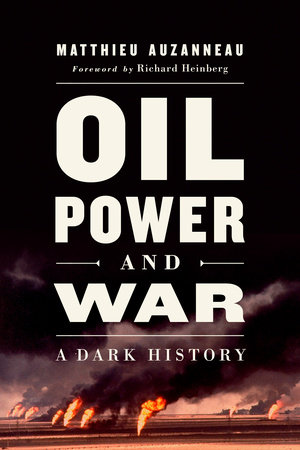
Oil, Power, and War
A Dark History
Paperback
$34.95
Catholic Herald Book Awards 2019 Finalist, Current Affairs
“Auzanneau has created a towering telling of a dark and dangerous addiction.”—Nature
The story of oil is one of hubris, fortune, betrayal, and destruction. It is the story of a resource that has been undeniably central to the creation of our modern culture, and ever-present during the darkest exploits of empire the world over. For the past 150 years, oil has become the most essential ingredient for economic, military, and political power. And it has brought us to our present moment in which political leaders and the fossil-fuel industry consider extraordinary, and extraordinarily dangerous, policy on a world stage marked by shifting power bases.
Upending the conventional wisdom by crafting a “people’s history,” award-winning journalist Matthieu Auzanneau deftly traces how oil became a national and then global addiction, outlines the enormous consequences of that addiction, sheds new light on major historical and contemporary figures, and raises new questions about stories we thought we knew well: What really sparked the oil crises in the 1970s, the shift away from the gold standard at Bretton Woods, or even the financial crash of 2008? How has oil shaped the events that have defined our times: two world wars, the Cold War, the Great Depression, ongoing wars in the Middle East, the advent of neoliberalism, and the Great Recession, among them?
With brutal clarity, Oil, Power, and War exposes the heavy hand oil has had in all of our lives—and illustrates how much heavier that hand could get during the increasingly desperate race to control the last of the world’s easily and cheaply extractable reserves.
Reviews & Praise

About Matthieu Auzanneau
Matthieu Auzanneau is the director of The Shift Project, a European think tank focusing on energy transition and the resources required to make the shift to an economy free from fossil fuel dependence, and also from greenhouse gas emissions. Previously he was a journalist, based in France, and mostly writing for Le Monde. He continues to write his Le Monde blog, Oil Man, which he describes as “a chronicle of the beginning of the end of petroleum.” The original French edition of this book, Or Noir: La grande histoire du pétrole, was awarded the Special Prize of the French Association of Energy Economists in 2016.
Connect with Matthieu Auzanneau
Books by Matthieu Auzanneau

You may also like...
-
 $10.00
 -
$17.95
-
$22.95


