

How to Plan the Best Garden Ever
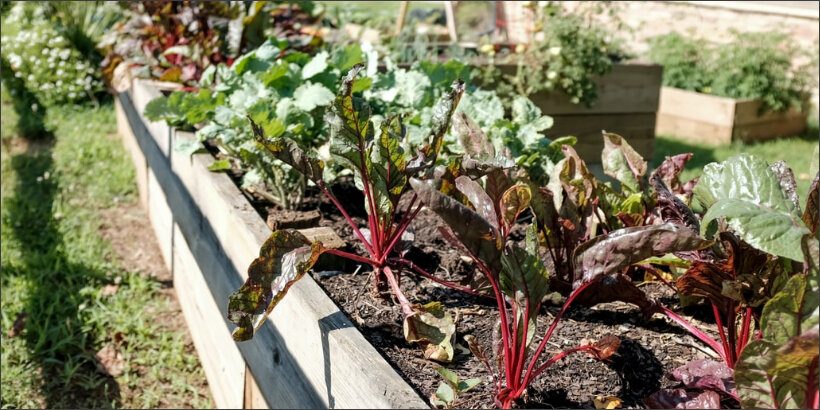
Garden goals ahead! When you plan out how you want your garden to look and operate, you’re setting yourself up for long-term success. Here are helpful tips for creating the best garden this growing season!
The following excerpt is from The Resilient Gardener: Food Production and Self-Reliance in Uncertain Times by Carol Deppe. It has been adapted for the web.
Plan Your Garden: Rows or Beds?
Rows might be great for tractors, but beds can be easier to water, and can help you to space your plantings throughout the growing season.
How many gardens start thus? First, we haul out the rototiller (or hire the tractor guy) and till up the entire garden.
We let the buried thatch decompose for three weeks and hire the tractor guy or rototill again. Then we try to plant the whole thing all at once, preferably before it rains. Rain will compact the soil and make it harder to create furrows for planting.
In addition, if a couple of weeks go by before we plant, weeds will have such a head start that we really should rototill again or hoe the entire area before planting. So after the second plowing or tilling, we tend to want to plant everything all at once.
Planting becomes a bottleneck.
Needing to plant everything all at once creates an emergency. Once we have successfully planted everything all at once, it will all need to be weeded all at once. And the entire garden is in seedlings needing maximum watering care all at once.
Many a garden fails because, once planting has been turned into an all-at-once emergency, the gardener collapses (exhausted but happy) and forgets the garden for a while, during which time the seedlings fail to germinate or die from lack of water, or weeds get too far ahead.
Planning Your Garden: Building Beds

“Here I am wielding the long-handled peasant hoe, my favorite gardening tool. I hoe off to the side and sway from side to side (from the legs) as I work. It is the lift stroke (using arm, not back muscles) that is the power stroke. I merely guide the tool as it drops, with gravity doing the work on the downstroke. Note how I grip the handle, with both palms face down and all fingers as well as the thumb wrapped over the handle. This grip allows me to use the tool with a straight back and straight wrists.” – Carol Deppe. Photo courtesy of Carol Deppe.
We usually create or rejuvenate beds by digging. Someone, of course, has to do the digging. But you don’t have to dig all the beds at once.
Gardening in beds particularly lends itself to areas with long growing seasons, mild winters, and year-round gardening, with different beds being planted at various times throughout the year.
Gardening in beds is also typical for perennial or ornamental plantings. For small gardens, there is much to be said for beds. In many situations they are the only option.
Why Build Planting Beds?
A garden bed is a soft place where you don’t walk. You don’t walk on beds even when weeding, harvesting, or digging to renovate them.
This means the width must be limited to what you can comfortably reach across from the sides—a maximum of about 5 feet, generally.
Beds may be any length, however.
I had no choice about gardening in beds when vegetable gardening in my backyard.
Various concrete walls and fences and property lines made it impossible to drive a tractor into the yard. So there was no option of hiring the tractor guy.
Also, there were so many septic easements and shady areas that the space available for gardening was limited to small areas here and there.
Even rototilling with a walk-behind tiller isn’t practical with tiny dispersed beds.
Customizing Your Gardening Bed
When we garden in beds in the backyard, it is often automatically in raised beds.
When we start with poor soil or the subsoil typical of many backyards, we usually add bulky organic materials (leaves, compost, etc.) to help create a decent garden soil.
These added materials plus any dug soil translate into a raised bed. Raised beds have special advantages and liabilities.
Raised Beds: Pros and Cons
They dry out and warm up faster in the spring than planting areas that are level with the ground around them. This is a big advantage for early plantings in areas that experience cold, wet springs (such as Oregon).
In addition, if the water table is high or the soil is shallow you may need raised beds to provide deep enough soil for plant roots. However, when there is little or no rain (such as in Oregon in summer), the fact that raised beds dry out faster means they need more frequent watering.
Beds don’t need to be raised, though. They can be level with the rest of the ground.
Temporary Beds
You can, for example, start by tilling a garden area, then just designate certain areas as beds and others as paths. Beds also do not have to be permanent.
Temporary beds are not walked on throughout the growing season but are tilled up at the end of the season; and next year’s beds may not be in the exact same places. Even raised beds need not be permanent. You can till up the entire garden area first, then hoe or till the soil up into beds.
Then you plant and tend the beds as beds (and avoid walking on them) for just the one growing season. Several large organic farms around here operate largely or completely with a style of temporary raised beds. They till a field, then shape it into raised beds with a tractor-drawn bed-forming implement.
Then they treat the beds as beds (and don’t walk on them) for a season before tilling the entire field again.
Choosing What & When To Plant
For many years, I used a mixed strategy. I grew the crops that needed to be harvested almost daily for summer meals in permanent raised beds in the backyard. Then I had a larger tilled garden elsewhere for field corn, dry beans, and winter squash.
In my backyard I planted about one bed every three weeks as the breaks in the weather permitted.
I planted the bed for first-early peas in February; greens in March and April; tomatoes, summer squash, and green beans in May and June; overwintering brassicas in July and August; and garlic, fava beans, and overwintering peas in October.
My plantings of corn, dry beans, and winter squash were too large for me to be able to deal with as hand-dug beds.
They also needed to be planted approximately all at once in May, fitting perfectly with the pattern of just calling the tractor guy to till up a field. These crops also did not require tending or harvesting daily. So these are the crops I grew in the tilled field away from home.
Gardening in intensively planted beds is the way to get the most yield from small spaces.
In order to obtain those high yields, however, you must have very fertile soil, must water regularly, and must plant intensively.
You really crowd the plants compared to traditional plantings in rows. I found that such intensive plantings did not work for me.
The crowded plantings must be watered almost every day it doesn’t rain. Here in maritime Oregon, that is every day starting in June and going right through the entire summer.

Photo of the author, Carol Deppe. Courtesy of Carol Deppe.
Making Your Garden Resilient
Nevertheless, I still lost entire beds here and there whenever an emergency in my mother’s medical situation took me totally out of the garden for a while.
I learned to minimize the impact of these emergencies on my gardening by not planting more than one bed every three weeks.
That way I had only one bed at a time at its most vulnerable stage with respect to either watering or weeding.
Whenever the unforeseen deprived the garden of my labor for a while, if I lost something, it was usually only one bed, not all of them.I am not the sort of person who, given my druthers, wants to water or do any other chore every single day, even in the best of times.
During the period I was caring for my mother, absolutely all of my ability to do those kinds of tasks was taken up with the caregiving situation.
Garden beds do not have to be planted intensively, however.
If I planted my beds with about 50 percent more space than typical for intensive beds, I didn’t have quite the watering pressure. I found I could water every other day or even skip two days without much problem.
These days Nate and I garden entirely in a tilled garden arranged in traditional rows, and our spacings within the rows are on the generous side.
We space things so as to allow ourselves to water only the most moisture-dependent plants (tomatoes, full-season sweet corn, melons, and kale) once per week and the least water-needy plants (potatoes) not at all. This cuts down on the total amount of water needed as well as watering labor.
This garden can survive and thrive when left completely alone for a week, even during the worst heat waves in summer, and considerably longer the rest of the time. Nate doesn’t like must-do-every-day chores any more than I do.
Until I had expanded to a much bigger leased garden elsewhere (and a collaborator), however, garden beds in the backyard were an essential part of my strategy. And I simply did not have the room to give the plants as much space as they needed for once-per-week watering and greater water resilience.
Gardening, like the rest of life, is full of trade-offs.
Recommended Reads
Read The Book

The Resilient Gardener
Food Production and Self-Reliance in Uncertain Times
$35
You may like...
-
 $29.95
 -
$39.95
-
$32.95


Recent Articles

Raised garden beds are a great way to utilize small space to create a bountiful garden. Discover how to create beautiful, easy-to-maintain raised garden beds!
Read More
Do you have an old, worn-out pair of jeans in your dresser? Instead of throwing them out, try to grow mushrooms on them. Follow these guidelines to get started.
Read More
If you’re planning out a forest garden, or are just looking for a plant to use as ground cover, garden strawberries are a great option.
Read More
Hot sauce fans, this one’s for you! This easy recipe for fermented hot sauce with wild greens is sure to add an extra punch of flavor to your favorite meal.
Read More
Discover the magic of oyster mushrooms! They can grow almost anywhere. Straw is a surprisingly simple way to cultivate the ever-popular oyster mushrooms.
Read More