
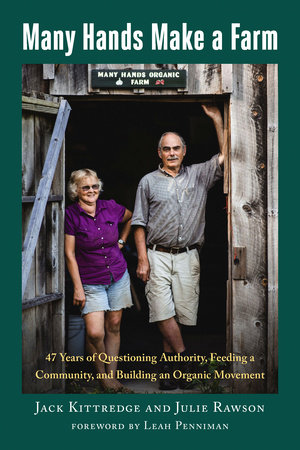
Many Hands Make a Farm
47 Years of Questioning Authority, Feeding a Community, and Building an Organic Movement

| Pages: | 208 pages |
| Book Art: | 8-page color insert |
| Size: | 6 x 9 inch |
| Publisher: | Chelsea Green Publishing |
| Pub. Date: | November 16, 2023 |
| ISBN: | 9781645021971 |
Many Hands Make a Farm
47 Years of Questioning Authority, Feeding a Community, and Building an Organic Movement
From Northeast Organic Farmers Lifetime Achievement Award: Jack Kittredge and Julie Rawson
In this heartfelt and unflinching memoir, two activists recount the nearly half century they’ve spent questioning authority while raising a family, building a self-reliant community, starting an organic farm, leading a farming organization, and experiencing the struggles and joys of living a purposeful life.
Many Hands Make a Farm traces the journey of organic farming pioneers Julie Rawson and Jack Kittredge from their early years of bright-eyed excitement, through the long slog for economic stability, to the formation of a thriving community and a growing natural farming movement. Along the way, they established relationships with farming leaders across the country during the creation of the National Organic Program.
Julie and Jack met while working as community organizers in Boston. After falling in love and starting a family, they decided to use Jack’s irregular earnings as a board game designer to support a move to a rural area where they could grow healthy food and earn their living at home, so they could be present for their four children. What began as a family homestead soon grew into the small, diversified Many Hands Organic Farm.
Julie and Jack have intentionally chosen to live their lives differently than the mainstream, prioritizing minimizing energy use, raising food organically, not relying on credit, favoring natural health care, participating in the arts, working creatively, and instilling the values of hard work and responsibility in their children.
In a time when society at large was “going along to get along,” Julie and Jack stood out as leaders and iconoclasts. They believe that taking risks and making bold decisions can unlock one’s potential and lead to actions that enrich the spirit, the family, and the community.
Many Hands Make a Farm will resonate with fans of original thinkers from Henry David Thoreau and Wendell Berry to Lynn Margulis and Adelle Davis. The book strongly conveys the message of finding roots in a community, respecting the Earth, and combining social justice work with the joys and challenges of raising a family. These themes shine through on every page, making this memoir a must-read for anyone seeking inspiration and guidance on finding meaning in their life.
“Told in complementary, alternating narratives between husband and wife, this informative and heartfelt memoir is uplifting from start to finish.”—Booklist
Reviews & Praise

About Jack Kittredge
Jack Kittredge worked for 17 years opposing the Vietnam War and organizing low-income communities. In partnership with three friends, he designed board games including Cosmic Encounter and DUNE. Jack met Julie Rawson in 1976, and they began a family and bought farmland in central Massachusetts, where Jack designed the passive-solar house and timber-frame barn that they then built themselves with help from a cast of family and friends. The couple runs an organic CSA farm that serves 150 families and has raised four active children. Jack edited The Natural Farmer, the newspaper of the Northeast Organic Farming Association, and served as policy director for NOFA/Mass for over 30 years. He wrote and published “Soil Carbon Restoration: Can Biology Do the Job?” in 2015.
Books by Jack Kittredge

About Julie Rawson
Julie Rawson is a lifelong farmer minus a 10-year stint in Chicago and Boston as a community organizer. Mother of four and grandmother to eight, active local musician, and ever the organizer and envelope-pusher, she loves to work with others on the farm and in the community to accomplish great things each day. She had a 35-year career as the lead staff for the Northeast Organic Farming Association/Mass Chapter. She feels blessed to be chief farmer at Many Hands Organic Farm and 47-year wife of Jack Kittredge.
Books by Julie Rawson

About Leah Penniman
Leah Penniman, the 2019 recipient of the James Beard Foundation Leadership Award, is a Black Kreyol farmer who has been organizing for an anti-racist food system for over fifteen years. She began with the Food Project in Boston, Massachusetts, and went on to work at Farm School in Athol, Massachusetts, and Many Hands Organic Farm in Barre, Massachusetts. She cofounded Youth Grow urban farm in Worcester, Massachusetts. She currently serves as founding co-executive director of Soul Fire Farm in Grafton, New York, a people-of-color led project that works to dismantle racism in the food system through a low cost fresh food delivery service for people living under food apartheid, training programs for Black, Latinx, and Indigenous aspiring farmer-activists, Uprooting Racism training for food justice leaders, and regional-national-international coalition building between farmers of color advocating for policy shifts and reparations. She has dedicated her life’s work to racial justice in the food system and has been recognized by the Soros Equality Fellowship, NYSHealth Emerging Innovator Awards, The Andrew Goodman Foundation Hidden Heroes Award, Fulbright Distinguished Awards in Teaching Program, New Tech Network National Teaching Award, Presidential Award for Excellence in Teaching (New York finalist), among others. She has contributed to two published volumes, authored numerous online articles, and given dozens of public talks on the subject.
Connect with Leah Penniman
Books by Leah Penniman

You may also like...
-
 $29.95
 -
$19.95
-
$22.95


