

| Pages: | 240 pages |
| Book Art: | Black and white illustrations |
| Size: | 6 x 9 inch |
| Publisher: | Chelsea Green Publishing |
| Pub. Date: | March 17, 2009 |
| ISBN: | 9781603581028 |
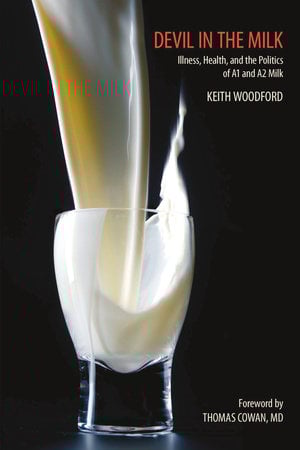
Devil in the Milk
Illness, Health and the Politics of A1 and A2 Milk
Paperback
$29.95
This groundbreaking work is the first internationally published book to examine the link between a protein in the milk we drink and a range of serious illnesses, including heart disease, Type 1 diabetes, autism, and schizophrenia.
Certain health problems are linked to a tiny protein fragment that is formed when we digest A1 beta-casein, a milk protein produced by many cows in the United States and northern European countries. Milk that contains A1 beta-casein is commonly known as A1 milk; milk that does not is called A2. All milk was once A2, until a genetic mutation occurred some thousands of years ago in some European cattle. A2 milk remains high in herds in much of Asia, Africa, and parts of Southern Europe. A1 milk is common in the United States, New Zealand, Australia, and Europe.
In Devil in the Milk, Keith Woodford brings together the evidence published in more than 100 scientific papers. He examines the population studies that look at the link between consumption of A1 milk and the incidence of heart disease and Type 1 diabetes; he explains the science that underpins the A1/A2 hypothesis; and he examines the research undertaken with animals and humans. The evidence is compelling: We should be switching to A2 milk.
A2 milk from selected cows is now marketed in parts of the U.S., and it is possible to convert a herd of cows producing A1 milk to cows producing A2 milk.
This is an amazing story, one that is not just about the health issues surrounding A1 milk, but also about how scientific evidence can be molded and withheld by vested interests, and how consumer choices are influenced by the interests of corporate business.
“Devil in the Milk is potentially as significant as Carson’s Silent Spring or Nader’s Unsafe at Any Speed.”—Alan Robb, The New Zealand Farmers Weekly
Reviews & Praise

About Keith Woodford
Keith Woodford is Professor of Farm Management and Agribusiness at Lincoln University in New Zealand. A regular commentator in the news media, he was previously at the University of Queensland (Australia) for 20 years. He lives with his family in Christchurch, New Zealand.
Books by Keith Woodford


About Thomas Cowan
Thomas Cowan, MD, has studied and written about many subjects in medicine, including nutrition, homeopathy, anthroposophical medicine, and herbal medicine. He is the author of Cancer and the New Biology of Water; Vaccines, Autoimmunity, and the Changing Nature of Childhood Illness; and Human Heart, Cosmic HeartThe Fourfold Path to HealingThe Nourishing Traditions Book of Baby and Child Care. Dr. Cowan has served as vice president of the Physicians’ Association for Anthroposophic Medicine and is a founding board member of the Weston A. Price Foundation. He also writes the “Ask the Doctor” column in Wise Traditions in Food, Farming, and the Healing Arts (the Weston A. Price Foundation’s quarterly magazine), has lectured throughout the United States and Canada, and is the cofounder of two family businesses, Dr. Cowan’s Garden (drcowansgarden.com) and Human Heart, Cosmic Heart (humanheartcosmicheart.com). He has three grown children and currently resides in San Francisco with his wife, Lynda Smith.
Connect with Thomas Cowan
Books by Thomas Cowan


You may also like...
-
 $34.95
 -
$29.95
-
$20.00


