

| Pages: | 192 pages |
| Size: | 6 x 9 inch |
| Publisher: | Chelsea Green Publishing |
| Pub. Date: | September 16, 2025 |
| ISBN: | 9781915294517 |
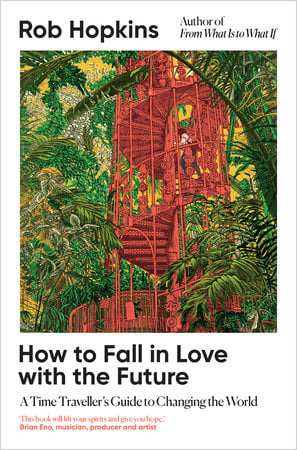
How to Fall in Love with the Future
A Time Traveller’s Guide to Changing the World
2025 Foreword Reviews INDIES Award Honorable Mention for Ecology & Environment
There are an infinite number of possible futures that lie ahead of us—like threads stretching out into the distance. Rob Hopkins, cofounder of the international Transition Network movement, invites us to travel to future worlds we would actually want to live in.
“No one makes environmental optimism more credible or compelling than Rob Hopkins. Read this and don’t weep.”
—Hugh Fearnley-Whittingstall, chef and campaigner
In 2020, when the COVID-19 pandemic disrupted every aspect of daily life, climate activist and Transition Network cofounder Rob Hopkins responded the way a lot of people did: by starting a podcast. But it wasn’t any ordinary podcast. In each episode, Hopkins and his guests would “time travel” together to the year 2030—walking down imagined future streets, talking with imagined future neighbors, visiting imagined future local businesses. While Hopkins’s guests came from all walks of life—economists, politicians, bakers, comedians, novelists and more—they all shared a willingness to suspend their worries about the future long enough to mentally inhabit and then describe a world they were thrilled to be a part of.
What Hopkins discovered was no less profound: this simple exercise of visiting a positive future forced him to rethink the work he’d been doing as a climate activist for decades.
How to Fall in Love with the Future is the result of that radical disruption—and Hopkins’s deep dive into the people and movements throughout history who have used visions of the future to inspire positive change on a large and dramatic scale. From the life and writings of musician Sun Ra and the history of Black utopian movements to the latest neuroscience on what goes on in our minds—and hearts—when we “time travel,” Hopkins brings essential new thinking to anyone overwhelmed with dread and anxiety for the future. He asks us to consider: what would the world look like if we all got to work imagining—and then building—a world we were deeply in love with?
“Rob Hopkins is one of the world’s great optimists. He really believes that things can get better, and, when he’s around, they usually do. This book will lift your spirits and give you hope.”
—Brian Eno, musician, producer and artist
“Rob Hopkins puts imagination back at the heart of future-dreaming, offering us an irresistible invitation to dream bigger and then make those dreams a reality.”—Kate Raworth, author of Doughnut Economics
Reviews & Praise
“Rob Hopkins is one of the world’s great optimists. He really believes that things can get better, and, when he’s around, they usually do. This book will lift your spirits and give you hope.”—Brian Eno, musician, producer and artist
“This is exactly the book we need: it barges despair aside and reveals the many different and wonderful ways we could be.”—George Monbiot, Guardian columnist; author of Regenesis
“It’s easy to know what we’re fighting against: climate breakdown, social inequality and the destruction of nature. What’s harder, and arguably more important, is to get clear on what we’re fighting for. Rob has a gift of illuminating the better future that is possible and, critically, showing us where pockets of that future already live in the present. I shall carry around his latest book to ward off doom and despair and to remind myself of just what is possible when we allow ourselves to imagine.”—Clover Hogan, climate activist; founder, Force of Nature
"What a joyous book to read! Through inspiring stories of practice, Rob Hopkins shows us how playful imagination can unleash profound insight – and then generously invites us to make his tools our own. This is a rich and irresistible resource for hopeful hearts. Dive in!"—Kate Raworth, author of Doughnut Economics
“All successful movements for change have to have both light and shade, but the climate and nature movements have often focused much more on the shade – what we are losing and how painful that is. Without denying this reality, Rob Hopkins chooses to instead focus on the light – the compelling, intoxicating vision of what we can do if we get this right. This is a book that will regenerate your sense of possibility and purpose. An essential read.”—Tom Rivett-Carnac, political strategist, author and podcaster
“In this extraordinary work of imagination and storytelling, Rob Hopkins stunningly reveals the centrality of both creative acts for inventing utopian horizons. To arrive at the future in our dark times requires skilled guides who give us the space to think and feel what we never thought possible. No one is better at this task than Rob Hopkins. And this little book fires up the imagination in startling ways. You must read it.”—Alex Zamalin, Rutgers University; author of Black Utopia: The History of an Idea from Black Nationalism to Afrofuturism
“Rob Hopkins invites us to fall in love with the future and demonstrates what a radical, transformative act this can be. At once visionary and deeply practical, Hopkins’s new book sets out a route map to inspire change, unlock new possibilities and reignite activism.
Urgent, powerful and exhilarating, How to Fall in Love with the Future shows us that the act of imagining a better future is the necessary first step towards achieving it – and that stories of real change happening right now provide compelling grounds for hope.”—Caroline Lucas, former Green Party MP for Brighton Pavilion
“Playful and profound. This book brilliantly reveals how the imagination is our most underused resource for redesigning the future.”—Roman Krznaric, author of The Good Ancestor and History for Tomorrow
“I was a guest of Rob’s on his podcast, talking about the power of sport in climate action, so I knew that Rob was a bit of a visionary; he just thinks differently and expresses himself wonderfully. This book is another fantastic example of that, enthusing his readers with the possibilities of a better tomorrow.”—David Garrido, sports broadcaster and sustainability champion
“Rob Hopkins is a shining star in the firmament of generative thinking that will bring us all forward to a future we’d be proud to leave to the generations that come after us. If (when) we embrace the possibility of a flourishing world, Rob’s way markers will have been key to us getting there. This is a clever, thoughtful, inspiring and beautiful book, and every single living human should read it.”—Manda Scott, author of Any Human Power; co-creator, Thrutopia Masterclass
“Citizens everywhere are already creating a future worth falling in love with – it’s just that the media radar is pointed in the wrong direction to see it. Rob doesn’t just celebrate this very possibility – he helps us experience it through every sense we have. A vital contribution.”—Jon Alexander, co-founder, New Citizen Project; author of Citizens: Why the Key to Fixing Everything is All of Us
“If I say this book is delightful, do not think I mean frivolous. It is a stirring tribute to the potential of the imagination as a collective force for remaking the future. Lose yourself in these inspiring stories of activists, artists and educators worldwide who are tenderly cultivating new tomorrows and then look around you; you will see a more vivid, hopeful today. Hopkins not only makes complex ideas and difficult histories accessible and compelling; he also offers a rich bounty of examples and exercises for kindling the light of the radical imagination in these dark times.”—Max Haiven, PhD, Canada Research Chair in the Radical Imagination and associate professor, Lakehead University
“Imagine one of the kindest and brightest people in the world telling you how to shape the future into what you always dreamed of. That’s what this book is about.”—Cyril Dion, writer, filmmaker and activist
“In a time when dark and self-serving forces are working to capture the future, we need a coordinated, global resistance of the imagination. Imagination – especially when practiced together – is not a whimsical escape from reality but a vital force for reshaping it. As well as fighting the old, we must place our energy and attention on the futures we long for and tell stories about them as if they are already here. Rob’s powerful and passionate book shares practical strategies on how to help people fall in love with these futures – and fight to make them real. Bold, hopeful, and beautifully written, How to Fall in Love with the Future leaves you seeing the world through fresh eyes – and, most importantly, with your imagination fired up to create the world we’d be proud to leave for future generations.”—Phoebe Tickell, systems thinker and imagination activist; founder, Moral Imaginations

About Rob Hopkins
Rob Hopkins is the cofounder of Transition Network and Transition Town Totnes. He is the author of several books, including The Transition Handbook and, most recently, From What Is to What If: Unleashing the Power of Imagination to Create the Future We Want. An Ashoka Fellow, Hopkins has spoken at TED Global and several TEDx events, and he appeared in the French film phenomenon Demain. He holds a PhD from the University of Plymouth, as well as 2 honoris causas. Hopkins is a director of Totnes Community Development Society, and he runs ‘Imagination Catalyst’ trainings for a wide range of organisations, including Balenciaga and Patagonia. He hosted the podcast From What If to What Next and has collaborated with musician Mr Kit on a music project called Field Recordings from the Future, due out in 2025. In November 2022, he was made an Honorary Citizen of Liège, Belgium, by the mayor of the city. His website is robhopkins.net.
Connect with Rob Hopkins
Books by Rob Hopkins


You may also like...
-
 $24.95
 -
$27.00
-
$24.95

