
The Art of Fermentation
With Practical Information on Fermenting Vegetables, Fruits, Grains, Milk, Beans, Meats, and More

| Pages: | 528 pages |
| Book Art: | 32 pages of color illustration |
| Size: | 7 x 9-1/4 inch |
| Publisher: | Chelsea Green Publishing |
| Pub. Date: | May 14, 2012 |
| ISBN: | 9781603582865 |
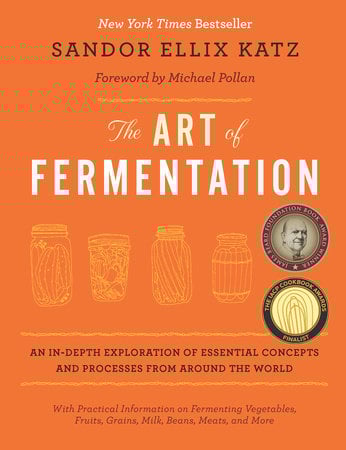
The Art of Fermentation
With Practical Information on Fermenting Vegetables, Fruits, Grains, Milk, Beans, Meats, and More
The most comprehensive guide to do-it-yourself home fermentation ever published, with more than a quarter million copies sold!
Named by The New York Times as one of the 25 most influential cookbooks from the last 100 years, and with a foreword by Michael Pollan
The ultimate guide for kraut, kombucha, kimchi, kefir, kvass, mead, wine, cider, pickles and relishes, tempeh, koji, miso, sourdough and so much more! Packed with extensive resources and illustrations, this classic of food literature from fermentation expert Sandor Katz provides extensive wisdom on the concepts and processes behind fermentation.
Readers will find detailed information on:
• Fermenting vegetables, beans, seeds, nuts, fish, meat, and eggs
• Sugars into alcohol (meads, wines, and ciders) plus beers and other grain-based alcoholic beverages
• Sour tonic beverages, milk, plus grains and starchy tubers
• Growing mold cultures
• Using fermentation in agriculture, art, and energy production
• Considerations for commercial enterprises
Whether you’re a first timer making your first batch of sauerkraut or yogurt, or you’re an experienced practitioner looking for a deeper understanding and appreciation for food preservation, this compendium provides over 500 pages of practical information on fermentation processes, parameters for safety, techniques for effective preservation, and troubleshooting.
“The bible for the D.I.Y set: detailed instructions for how to make your own sauerkraut, beer, yogurt and pretty much everything involving microorganisms.”—The New York Times
**Winner of the James Beard Foundation Book Award**
Reviews & Praise
"The Art of Fermentation is an extraordinary book, and an impressive work of passion and scholarship. It lays the foundation for fermenting all kinds of foods, and whoever reads it will be able to negotiate any recipe for ferments (and conquer any lingering nervousness about fermentation) with impunity. I am so impressed - and ready to begin! Thank you, Sandor Katz."—Deborah Madison, author of Vegetarian Cooking for Everyone and Local Flavors
"Sandor Katz has captured the essence of fermentation in this new book, which bubbles over with scientific, historical, and practical information about humankind's first biotechnology and earth's first energy source. The mystery and sensory allure of naturally fermented products ranging from fruit, honey, milk, all manner of starchy grain, tuber and stalk--even fish and meat--are laid bare and enthusiastically and lucidly brought to life for both epicure and the do-at-homer."—Patrick E. McGovern, Scientific Director, Biomolecular Archaeology Laboratory, University of Pennsylvania Museum, and author of Ancient Wine and Uncorking the Past
"The Art of Fermentation appeals to our personal and fundamental well being, with a thoroughly engaging account of wild, tamed, and unaccounted-for microorganisms. Based on theory, science, and practical observations, Sandor Katz casts thousands of dots onto the pages for us to connect with our own experiences and interests. There are things he writes in this book that are relevant to everyone. Whether we are at war or peace with the tiny creatures we call microorganisms, we can't help but conclude that they are the building blocks of the communities we observe as organisms. His obsession with ferment is contagious. With the flip of a page it's easy to find oneself discovering our own personal journey embedded in this thoroughly engaging book."—Charlie Papazian, author of The Complete Joy of Homebrewing and many other books on beer
"This is, quite simply, the finest book on fermentation available. It is comprehensive, erudite, and surprisingly profound. Sandor Katz is the guru of a large and growing tribe of fermentation enthusiasts and this book will awaken you to the thrilling world of benign bacteria all around us. Not only do they provide us with pickles, cheese, bread, alcohol - but our existence depends on bacteria and they deserve our reverence and respect."—Ken Albala, Food Historian and Coauthor of The Lost Arts of Hearth and Home: The Luddite's Guide to Domestic Self-Sufficiency
"Sandor Katz has proven himself to be the king of fermentation with this new book, an exhaustive yet very readable compendium of fermentation wisdom and techniques from around the world. A must-have in the libraries of anyone interested in food and nutrition."—Sally Fallon Morell, President, The Weston A. Price Foundation
"The Art of Fermentation is a remarkable testimony to the astonishing passion that Sandor Katz has for all matters fermentative. History, science, and simple how-to wisdom are woven together in this extensive journey through the amazing diversity of foods and beverages that are founded upon fermentation."—Dr. Charlie Bamforth, Professor, Department of Food Science and Technology, University of California, Davis and author of Food, Fermentation and Microorganisms
"The Art of Fermentation is much more than a cookbook...Sure, it tells you how to do it, but much more important, it tells you what it means, and why an act as quotidian and practical as making your own sauerkraut represents nothing less than a way of engaging with the world. Or rather, with several different worlds, each nested inside the other: the invisible world of fungi and bacteria; the community in which you live; and the industrial food system that is undermining the health of our bodies and the land. This might seem like a large claim for a crock of sauerkraut, but Sandor Katz's signal achievement in this book is to convince you of its truth. To ferment your own food is to lodge an eloquent protest-of the senses-against the homogenization of flavors and food experiences now rolling like a great, undifferentiated lawn across the globe. It is also a declaration of independence from an economy that would much prefer we were all passive consumers of its commodities, rather than creators of unique products expressive of ourselves and the places where we live."—Michael Pollan, from the Foreword
“This is not a line-by-line recipe cookbook, but it contains detailed instructions on fermenting (or creating via fermentation) nearly every imaginable food or beverage. After a foreword by Michael Pollan, Katz ("Wild Fermentation") explores the scientific basis of fermentation, then gives details for creating everything from yogurts to prosciutto to wines, beer, and kombucha. He emphasizes how fermentation influenced human development. Used to preserve food, it affected human biology so that humans could eat foods that would be poisonous otherwise, and it had an impact on global human culture as a reflection of indigenous cultural identity. Simply put, fermentation allows lactic acid bacteria naturally found in the air to overcome and exclude bacteria that are harmful to humans, and it increases advantageous chemical compounds, such as vitamins, in the process. There is a generous photo section of tools, containers, and processes; along with fascinating electron microscope photos of bacteria, which convey a sense of wonder at the unseen world of fermentation. VERDICT: Katz takes fermentation down to the molecular level while keeping it conversational and accessible to the generalist. Fermentation foodies will be ecstatic.”— Library Journal

About Sandor Ellix Katz
Sandor Ellix Katz is a fermentation revivalist. A self-taught experimentalist who lives in rural Tennessee, his explorations in fermentation developed out of his overlapping interests in cooking, nutrition, and gardening. He is the author of four previous books: Wild Fermentation, The Revolution Will Not Be Microwaved, The Art of Fermentation—which won a James Beard Foundation Award in 2013—and Fermentation as Metaphor. The hundreds of fermentation workshops he has taught around the world have helped catalyze a broad revival of the fermentation arts. The New York Times calls Sandor “one of the unlikely rock stars of the American food scene.” For more information, check out his website: www.wildfermentation.com.
Connect with Sandor Ellix Katz
Books by Sandor Ellix Katz


You may also like...
-
 $34.95
 -
$29.95
-
$29.95

