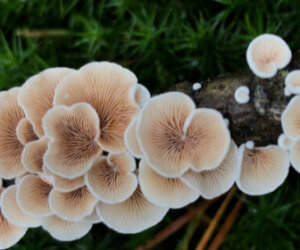
You can grow them on a log, a compost pile, or even your jeans. Throw them in your favorite dish, or save them to brew beer and infuse spirits– the possibilities are endless. So go ahead, make friends with the fungi!
Permaculture designer and author Michael Judd gets really excited about mushrooms. So when he found this recipe for a mushroom infused cocktail, he was barely able to contain himself. It may sound strange, but Judd swears this sweet mushroomy cocktail is magically delicious.
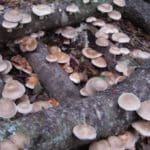
Some of the most expensive and delicious gourmet mushrooms on the market are shiitakes, which also are credited in Asia with healthful properties such as lowering cholesterol and improving immunity to cancer. They are simple to grow in logs and take about 6 to 18 months to emerge.
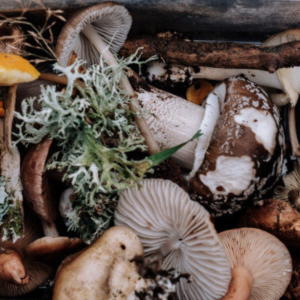
Fungi are fundamental to life. As decomposers, they are critical to the formation and sustenance of soils and ecosystems. As endlessly innovative chemists, they devise and secrete enzymes that can break down a vast variety of materials, mitigate bacterial and viral infections, and interact—for better or worse—with the bodies and brains of animals that consume their fruiting bodies, commonly called mushrooms.
Grow your own mushrooms outdoors with this simple four-step tutorial from Tradd Cotter, author of Organic Mushroom Farming and Mycoremediation. All you need is a log, some mushroom starter, and a couple of basic tools and you are on your way to producing gourmet mushrooms for years to come.
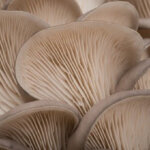
Add oyster mushrooms to the list of food that can be grown indoors! This fungus can grow almost anywhere from a log to a straw. Plus, you can pick the size of your oyster mushrooms from a wide variety, both big and small.
In the United States, an average of 35 percent of home waste and 60 percent of business waste is suitable for use as a mushroom growing substrate. Mushrooms can be grown on toilet and paper towel rolls, egg cartons, newspapers, magazines, coffee grounds, tea bags, old cotton clothing, tissue boxes, shredded paper, cardboard boxes, and more. Open your cupboards, look in your refrigerator, and peek in your cellar! You may be surprised at what you can grow mushrooms on. Not only yielding a bountiful mushroom harvest but also reducing your waste too.
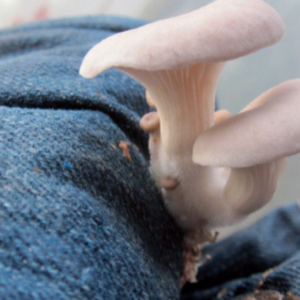
Thinking about getting rid of that pair of worn out jeans? Think again. You could use them to grow mushrooms. That’s right, mushrooms.
Mycologist Tradd Cotter has been experimenting with mushroom cultivation for more than 20 years. Through his ongoing research he has not only discovered the best ways to successfully grow morels but also how to use fungi to help manage invasive species and reduce our dependence on herbicides.
How do mushrooms grow? How do they eat, reproduce, or spread? What exactly is a mushroom?
All of these answers and more can be found in the intricate, web-like fiber found underneath these fungi: the mycelium. Understanding this “vegetative” part of the fungus is key to understanding the whole system. Thankfully Doug Bierend, author of In Search of Mycotopia, has spent several years studying and learning about the mycelium and all the secrets it holds.
Do you have an old, worn-out pair of jeans in your dresser? Instead of throwing them out, try to grow mushrooms on them. Follow these guidelines to get started.
Discover the magic of oyster mushrooms! They can grow almost anywhere. Straw is a surprisingly simple way to cultivate the ever-popular oyster mushrooms.
Known for their tall stature and distinctive flower heads, cattails thrive near lakes and marshes. From edible shoots and nutrient-rich roots to pollen used in baking, cattails offer a wealth of uses.
These much-loved titles are the perfect books for Mother’s Day! Gardening books, cookbooks, memoirs and more — there’s a book for every mom on this list.