
Everything They Want to Do Is Illegal
|
Tweet this story! Support our efforts for a sustainable world.
|
|

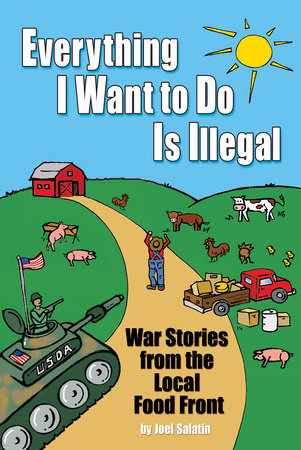
Joel Salatin, author of Everything I Want to Do Is Illegal: War Stories from the Local Food Front, knows exactly how these kids feel.
From the book description:
From child labor regulations to food inspection, bureaucrats provide themselves sole discretion over what food is available in the local marketplace. Their system favors industrial, global corporate food systems and discourages community-based food commerce, resulting in homogenized selection, mediocre quality, and exposure to nonorganic farming practices.
And for an extreme, couldn’t-have-said-it-better-myself, real-world example, take a look at this article from abcnews.com:
… Katie and Sabrina Lewis’ veggie stand, in the town of Clayton, Calif., where they sold homegrown watermelons for $1, has been shuttered by town officials who told the girls’ parents that their daughters’ venture violated local zoning ordinances.
“I think that they’re wrong,” dad Mike Lewis said of the town officials. “Kids should be able to be kids.”
…
The stand started about two years ago when Katie, now 11, decided she wanted to start selling produce from the family’s ever-expanding garden. The family had been growing its own fruits and vegetables on its half-acre lot and giving away armfuls of extras to friends and family.
“I thought, ‘No one’s going to buy melons,’” Lewis said, before telling his eldest daughter to “go ahead.”
Two hours later, Katie had sold out of melons.
Lewis said his daughter, now assisted by 3-year-old Sabrina, operated her stand on weekends, maybe 20 or so times during the year. They’d bring in about $10 to $20 a week.
“I take it and once I’ve got about $20 to $30, I’ll bring it to the bank and put it in my bank account for college,” Katie told ABCNews.com.
…
Lewis said the family got a call after the stand went up from a town employee saying that as long as the stand ran only on weekends it was fine.
But Clayton Mayor Gregory Manning said he first heard of the girls’ operation this past April, after two residents called to ask if it was legal. Two months later, a police officer was sent to the stand to tell the Lewises that the girls were violating zoning regulations that prohibit commercial activities in a residential area.
The stand also violates health regulations, he said, which state that food can’t be sold without a permit.
And while only two citizens complained, Manning said, “I find that for every person who calls you or writes a letter, there are 100 that feel the same.”
Clayton, located about 30 miles east of San Francisco, is home to about 11,000 residents.
Lewis compared his daughters’ stand to a more-common lemonade stand. But Manning said those, too, are illegal in Clayton, though officials typically don’t pay much attention because they don’t last more than a day or two.
“This is a pretty good operation,” he said of the Lewis girls’ stand. “I’m sure it’s very nice stuff.”
Katie said her most popular seller was the watermelons. Also big were zucchinis (75 cents for four small zucchinis and $1.25 for four of the larger ones) and eggplant, which was priced at six for $1.
Little sister Sabrina, Katie said, helped by picking flowers and hauling produce from the garden.
Manning said he’s not trying to be the bad guy in this situation, but that he has to consider the residents’ best interests.
“It’s not like we’re the Gestapo going out and closing down fruit stands,” he said.


August 25th, 2008 at 11:47 am
I gotta ask, who are these “neighbors” who called the police and complained? I mean, the mayor went overboard for sure, but I’m more annoyed by the original complainers than the enforcers whose job it is to apply the law. Cops and mayors can (and should) ignore things sometimes, but it gets harder for them to look the other way when gadflies are shouting at them, “look, a scofflaw!” Too bad there aren’t laws that prevent neighbors from being jerks. (Okay, maybe not too bad. Can you imagine what a nightmare society we’d live in if that law really were on the books? Would there be anyone at all who wouldn’t be convicted at some point?)