

The (Big) Year that Flew By
Twelve Months, Six Continents, and the Ultimate Birding Record

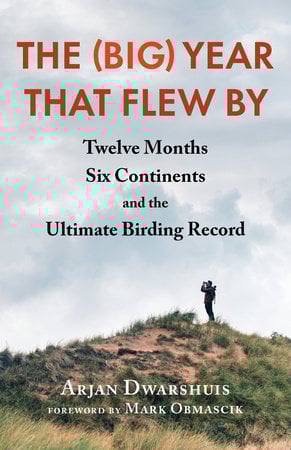
| Pages: | 256 pages |
| Size: | 5-1/2 x 8-1/2 inch |
| Publisher: | Chelsea Green Publishing |
| Pub. Date: | February 21, 2023 |
| ISBN: | 9781645021919 |
The (Big) Year that Flew By
Twelve Months, Six Continents, and the Ultimate Birding Record
“A fast-paced page-turner and a unique adventure story . . . filled with insights about landscapes, people, and a world of wonderful birds.”―Kenn Kaufman, author of Kingbird Highway
An epic tale of one passionate birder’s record-breaking adventure through 40 countries over 6 continents—in just one year—to see 6,852 bird species, rare and common, before many go extinct.
When Arjan Dwarshuis first heard of the “Big Year”—the legendary record for birdwatching—he was twenty years old, it was midnight, and he was sitting on the roof of a truck in the Andean Mountains. In that moment he promised himself that, someday, somehow, he would become a world-record-holding birder.
Ten years later, he embarked on an incredible, arduous, and perilous journey that took him around the globe; over uninhabited islands, through dense unforgiving rainforests, across snowy mountain peaks and unrelenting deserts—in just a single year. Would he survive? Would he be able to break the “Big Year” record, navigating through a world filled with shifting climate and geopolitical challenges?
The (Big) Year that Flew By is an unforgettable, personal exploration of the limits of human potential when engaging with the natural world. It is a book about birds and birding and Arjan’s attempts to raise awareness for critically endangered species, but it is also a book about overcoming mental challenges, extreme physical danger, and human competition and fully realizing your passions through nature, adventure, and conservation.
“Dwarshius’ exhilarating race against time across 40 countries and 6 continents in his attempt to break the world record will thrill armchair readers and bird enthusiasts alike.”―Booklist
“I sped through [this] book, trying to ignore feelings of jealousy as Dwarshuis described moments with species I’ve dreamed of seeing.”—The Washington Post
Reviews & Praise
“Arjan artistically weaves together the beauty of the birds, the importance of conservation, and the complex logistics of non-stop travel. The roller coaster highs of seeing a target bird, paired with the lows of absolute fatigue and exhaustion, are an innate undertone of any birder’s big year.”—Tiffany Kersten, birding guide and continental U.S. Big Year record holder
“The (Big) Year that Flew By is not simply a celebration of a broken record but a global call to action to protect the habitats that birds rely on for survival. A Big Year of birding is a massive undertaking, requiring a Herculean effort to successfully plan and execute. While this quest involves daunting logistics and emotional hurdles, the most notable achievement is distilling so much lived experience into a single book. Arjan has conquered both, beautifully capturing remote wild places and conveying the intensity endured to find and observe nearly three-quarters of the world’s bird species. Arjan’s contagious passion for birds infuses his account of a global avian scavenger hunt like no other.” —Christian Hagenlocher, author of the Falcon Freeway
An astonishing achievement! Arjan Dwarshuis’s year was so big it covered an entire planet. His eagle eyes took in almost 7,000 species of bird and brought into sharp focus their often-fragile existence. Dwarshuis’s heartfelt prose reminds us that many of these species are living on the edge—just a generation or two away from extinction. Yet this is a story of hope—Dwarshuis shines a light on the many communities around the world banding together to save their local birdlife. This book is a glorious tribute to the wealth of beauty and diversity found in birds, and a clarion call for us all to care about the future of birds everywhere. “—Neil Hayward, author of Lost Among the Birds
“The (Big) Year that Flew By is somehow both a fast-paced race through and an in-depth immersion in an amazing birding big year. Arjan Dwarshuis does an excellent job of portraying the excitement, stress, and exertion that are part of any Big Year, but that was even more so in his record-breaking worldwide Big Year. I very much enjoyed reading his account, sometimes with my heart pounding, as I lived his journey with him, feeling joy when he managed to find another rarity, concern with his bird-seeking struggles, and sorrow in his very rare misses. As I read, I continued to be impressed by the logistics required for all his travels, and by the excellent people who helped him find all these bird species. His interspersing of tales of his early birding years helped me better understand the how and why he was able to pull off his remarkable feat as well as his passion for birding. Throughout this book, he also explained conservation concerns and advances as they relate to the birds he sought, providing words of wisdom and words of hope. In his conclusion, he admits that while flying all over the world does use much energy, ecotourism in many far-flung places has been and continues to be of great importance in saving birds and habitats. I especially appreciate his conclusion in which he asks his readers to adopt a positive attitude and do their part—'enjoy nature and look up to the sky.’”—Lynn Barber, author of Extreme Birder
“Arjan’s story is brilliantly told. I was with him every step of the way. It is much more than just a story about one man’s bid to see as most of the world’s bird species in one year as humanly possible. No, this is an epic journey by a man who’s not only obsessed with birds but who has a deep spiritual connection with the planet as he observes the environments and habitats he encounters. It is clear that we have to do more to take care of our world and all its inhabitants, including us.” —David Lindo, author of How to be an Urban Birder
"[An] entertaining debut . . . . [that] offers colorful glimpses into the locales the author visits. . . . Part birding journal, part travelogue, this will appeal to backyard birders."—Publisher's Weekly
"Dwarshius’ exhilarating race against time across 40 countries and 6 continents in his attempt to break the world record will thrill armchair readers and bird enthusiasts alike."—Booklist
"I sped through [this] book, trying to ignore feelings of jealousy as Dwarshuis described moments with species I’ve dreamed of seeing.”—The Washington Post

About Arjan Dwarshuis
Arjan Dwarshuis, a professional bird guide, writer, and lecturer, holds the current Guinness Book World Record for observing the largest number of bird species in a single year. In 2016, he launched his global “Big Year” and ultimately observed 6,852 of the world’s roughly 10,700 bird species, setting a record that stands to this day. His yearlong adventure raised nearly $50,000 for the BirdLife Preventing Extinctions Program.
Arjan also starred in the award-winning documentary Arjan’s Big Year and appears regularly on radio, television, and podcast programs in the Netherlands and beyond. He is a columnist for several magazines about nature, and as the ambassador for the IUCN NL Land Acquisition Fund, he is committed to the protection of birds across the globe.
Books by Arjan Dwarshuis
You may also like...
-
 $25.00
 -
$17.95
-
$28.00


