

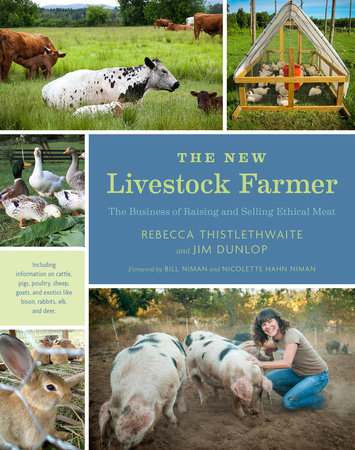
The New Livestock Farmer
The Business of Raising and Selling Ethical Meat

EXCERPTS
| Pages: | 336 pages |
| Size: | 7-1/2 x 9-1/2 inch |
| Publisher: | Chelsea Green Publishing |
| Pub. Date: | May 27, 2015 |
| ISBN: | 9781603585538 |
The New Livestock Farmer
The Business of Raising and Selling Ethical Meat
Foreword by Bill Niman
Includes information on cattle, pigs, poultry, sheep, and goats, and exotics like bison, rabbits, elk, and deer and offers a clear, thorough, well-organized guide to a subject that will become increasingly important as the market demand for pasture-raised meat grows stronger.
How can anyone from a backyard hobbyist to a large-scale rancher go about raising and selling ethically produced meats directly to consumers, restaurants, and butcher shops? With the rising consumer interest in grass-fed, pasture-raised, and antibiotic-free meats, how can farmers most effectively tap into those markets and become more profitable? The regulations and logistics can be daunting enough to turn away most would-be livestock farmers, and finding and keeping their customers challenges the rest.
Farmer, consultant, and author Rebecca Thistlethwaite (Farms with a Future) and her husband and coauthor, Jim Dunlop, both have extensive experience raising a variety of pastured livestock in California and now on their homestead farm in Oregon. The New Livestock Farmer provides pasture-based production essentials for a wide range of animals, from common farm animals (cattle, poultry, pigs, sheep, and goats) to more exotic species (bison, rabbits, elk, and deer).
Each species chapter discusses the unique requirements of that animal, then delves into the steps it takes to prepare and get them to market. Profiles of more than fifteen meat producers highlight some of the creative ways these innovative farmers are raising animals and direct-marketing superior-quality meats.
In addition, the book contains information on a variety of vital topics:
• Governmental regulations and how they differ from state to state;
• Slaughtering and butchering logistics, including on-farm and mobile processing options and sample cutting sheets;
• Packaging, labeling, and cold-storage considerations;
• Principled marketing practices; and
• Financial management, pricing, and other business essentials.
This book is must reading for anyone who is serious about raising meat animals ethically, outside of the current consolidated, unsustainable CAFO (Concentrated Animal Feeding Operations) system.
“[This] is what my father Wendell Berry would call the best of books because it is a tool. It fills a cultural need, and will give beginning farmers just the information they need, just the way they need it.”—Mary Berry, executive director, The Berry Center
“Great practical advice on choosing the species to raise, humane treatment, and marketing. Informative chapters on processing, regulations, and starting a business.”—Temple Grandin, author of Humane Livestock Handling and Improving Animal Welfare: A Practical Approach
Reviews & Praise
“The real question for the reform of livestock agriculture in the US is whether we can move from a media saturated with images of what we can’t stomach—digestively or culturally—to a more sophisticated understanding of practical and ethical alternatives that make ecological and economic sense. As a farmer and a teacher, I have yet to find a guiding text that does it so well or so comprehensively. Thistlethwaite and Dunlop take us step by step from the open-ended question of breed selection to the finality of slaughter options, providing clear pathways of decision-making for farmers, students, consumers, and advocates.”—Philip Ackerman-Leist, professor, Green Mountain College, and author, Rebuilding the Foodshed
"The livestock farmer of today must master not only the vast skills necessary to be an ethical rancher but also marketing, sales, processing, packaging and so many others. Rebecca and Jim’s book is a humble and deeply informative guide from a couple that has been deep in the metaphorical and literal weeds of this challenging work. Without thriving agricultural-based communities, resources like this book are invaluable substitutes, creating a network of like-minded land stewards. Rebecca and Jim have done a good turn in sharing their knowledge in this straightforward and honest primer."— Marissa Guggiana, co-founder, The Butcher’s Guild, and author, Primal Cuts: Cooking with America’s Best Butchers
“My husband and I have farmed for a living all of our adult lives, and farmed with our parents before that. So we had the good fortune of being surrounded by people with deep generational knowledge when we started out. I can’t imagine how new farmers are making it today without that kind of support. Recently we added Large Black hogs to our small farm in north-central Kentucky. The New Livestock Farmer came to us just when we needed it. It is what my father Wendell Berry would call the best of books because it is a tool. It fills a cultural need, and will give beginning farmers just the information they need, just the way they need it.”—Mary Berry, executive director, The Berry Center
“Great practical advice on choosing the species to raise, humane treatment, and marketing. Informative chapters on processing, regulations, and starting a business.”—Temple Grandin, author of Humane Livestock Handling and Improving Animal Welfare: A Practical Approach
“When it comes to raising healthy livestock in harmony with the land and the local community, this book shows why the old ways are new again… and why they work better than the industrial methods that are all too popular today. The detailed instructions in these pages are all you need to start raising livestock ethically and sustainably. In fact, I’d say it’s a better investment than an agricultural degree from a land grant university.”—Mike Callicrate, owner, Callicrate Cattle Co. and Ranch Foods Direct
“Responsible and healthful meat consumption starts on the farm, literally from the ground up, with solid and ethical animal husbandry practices. The New Livestock Farmer provides a clear understanding of how to achieve fulfilling and delicious results. The authors share their proven wisdom to help small-scale, grass-based farmers avoid the pitfalls of an often confusing and intimidating agricultural landscape.”—Adam Danforth, author of Butchering Beef and Butchering Poultry, Rabbit, Lamb, Goat, and Pork

About Rebecca Thistlethwaite
Rebecca Thistlethwaite is the author of Farms with a Future (Chelsea Green, 2012). She runs Sustain Consulting, which specializes in food and farm issues, working with both nongovernmental organizations and for-profit businesses. Her website is http://rebeccathistlethwaite.com.
Rebecca also operates a small farm and a community farm stand in Oregon with her husband and coauthor, Jim Dunlop, and their daughter, Fiona. They previously owned TLC Ranch in Watsonville, California, where they raised organic, pastured livestock and poultry, selling to direct markets across Northern California.
Connect with Rebecca Thistlethwaite
Books by Rebecca Thistlethwaite

About Jim Dunlop
Jim Dunlop works as a horticultural research manager for a progressive fruit orchard in the Columbia River Gorge.
Jim also operates a small farm and a community farm stand in Oregon with his wife and coauthor, Rebecca Thistlethwaite, and their daughter, Fiona. They previously owned TLC Ranch in Watsonville, California, where they raised organic, pastured livestock and poultry, selling to direct markets across Northern California.
Books by Jim Dunlop

About Nicolette Hahn Niman
Nicolette Hahn Niman served as senior attorney for Waterkeeper Alliance, running their campaign to reform the concentrated production of livestock and poultry. In recent years, she has gained a national reputation as an advocate for sustainable food production and improved farm-animal welfare. She is the author of Righteous Porkchop and Defending Beef, and has written for numerous publications, including the New York Times, Los Angeles Times, HuffPost, and The Atlantic online. She lives on a ranch in Northern California with her husband, Bill Niman, and their two sons.
Connect with Nicolette Hahn Niman
Books by Nicolette Hahn Niman


You may also like...
-
 $34.95
 -
$24.95
-
$35.00


