

The Independent Farmstead
Growing Soil, Biodiversity, and Nutrient-Dense Food with Grassfed Animals and Intensive Pasture Management

EXCERPTS
| Pages: | 336 pages |
| Book Art: | Full-color photographs full-color illustrations |
| Size: | 8 x 10 inch |
| Publisher: | Chelsea Green Publishing |
| Pub. Date: | August 25, 2016 |
| ISBN: | 9781603586221 |
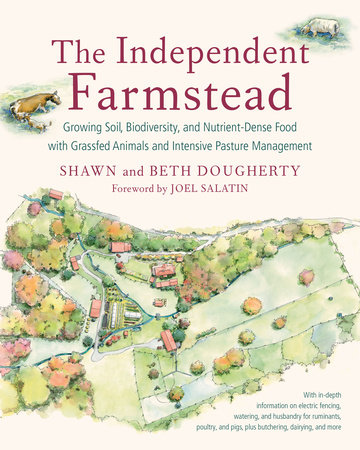
The Independent Farmstead
Growing Soil, Biodiversity, and Nutrient-Dense Food with Grassfed Animals and Intensive Pasture Management
With in-depth information on electric fencing, watering, and husbandry for ruminants, poultry, and pigs, plus butchering, dairying, and more
“If we work hard, we sleep well.”
Twenty years ago, when authors Shawn and Beth Dougherty purchased the land they would come to name the Sow’s Ear, the state of Ohio designated it “not suitable for agriculture.” Today, their family raises and grows 90% of their own food.
Such self-sufficiency is largely the result of basing their farming practices around intensive pasture management. Pioneered by such luminaries as Allan Savory, Greg Judy, and Joel Salatin, the tenets of holistic grazing—employed mostly by larger-scale commercial operations—have been adapted by the Doughertys to fit their family’s needs. In The Independent Farmstead, The Sow’s Ear model for regenerating the land and growing food—“the best you ever tasted”—is elucidated for others to use and build upon.
In witty and welcoming style, The Independent Farmstead covers everything from choosing a species of ruminant and incorporating it into a grass-based system to innovative electric fencing and watering systems, to what to do with all of the milk, meat, and, yes, manure that the self-sustaining farm produces. Within these pages, the Doughertys discuss how to:
- Find and improve poor, waste, or abused land and develop its natural water resources;
- Select and purchase the appropriate ruminant for regenerating your farmstead;
- Apply fencing strategies and pasture management basics;
- Implement basic, uncomplicated food processing, including large and small animal butchering and cheese making; and
- Integrate grass, gardens, and livestock to minimize or eliminate the need for off-farm inputs.
As the Doughertys write, more and more people today are feeling “the desire for clean, affordable food, unmodified, unprocessed, and unmedicated and the security of local food sourcing for ourselves and our children.” The Independent Farmstead is a must-have resource for those who count themselves as part of this movement: both new and prospective farmers and homesteaders, and those who are interested in switching to grass-based systems. Best of all it’s the kind of rare how-to book that the authors themselves view not as a compendium of one-size-fits-all instructions but as “the beginning of a conversation,” one that is utterly informative, sincere, and inspiring.
Reviews & Praise
“With grace and grit, Shawn and Beth show you how to cultivate and care for an often overlooked but integrally important part of our food chain—grass—as well as the diverse livestock that transform pasture into the most wholesome foods on earth.”—David Asher, author of The Art of Natural Cheesemaking
“Shawn and Beth cover a broad range of topics in this readable and user-friendly book. They manage to touch on most of the essential information a small-scale farmer needs to graze a cow and make cheese, feed the waste milk to the pigs and make bacon, and practice sustainable land use and animal husbandry along the way.”—Sarah Flack, author of The Art and Science of Grazing
“Playing off its title, this informative, companionable book could be called The Interdependent Farmstead: It notes how a successful operation relies on interactions among animals, soil, grass, sunlight, and community as well as human ingenuity and, invariably, humor. The book’s wisdom is that building on these synergies helps one realize the potential of any given piece of land.”—Judith D. Schwartz, author of Cows Save the Planet and Water In Plain Sight
“In The Independent Farmstead, Shawn and Beth Dougherty have rooted a wealth of practical and useful farming information in the fertile soil of social and economic reality and timeless ecological wisdom. Their farm is a grass-based homestead, and their personal story is compelling, but their insights are important for beginning or experienced farmers of any type or scale who don’t yet know—or have forgotten—what real farming is about.”—John Ikerd, professor emeritus of agricultural economics, University of Missouri
“Literature about small, independent farms might be divided into books that focus broadly on sustainable farming and those that constitute a how-to guide. Here Shawn Dougherty and Beth Dougherty (both have been farmers for several decades) offer a whimsical fusion of practical application and agrarian philosophy to great effect. Unlike most monographs on the subject, this volume begins with the assertion that plant life, pasture, and forage (in particular) form the core of an effective small farmstead. From this foundation, the Dougherty’s discuss practical aspects of forage, including water, grasses, and fencing, as well as the dynamics of intensive rotational processes. A good portion of the book is devoted to leveraging forage using livestock, particularly ruminants. Their clear favorite is the dairy cow, although they do discuss the virtues of sheep, goats, and swine—but little on beef. The latter part of the work discusses the harvesting of meat and milk and the appropriate use of by-products. The book’s entertaining approach is tempered by a realistic view of the mindset required to productively nurture and incorporate the rigors of an independent farmstead into one’s lifestyle. Summing Up: Recommended. All readers.”— Choice
"As mortifying and implausible as creating one’s own self-sustaining farmstead might sound to most city folk, the Doughertys, who embarked on their own farmstead 20 years ago, make the venture entirely feasible—even ennobling in the face of climate change—on as little as a half-acre of land. In a conversational style that is both welcoming and reality-based, the authors offer a big-picture plan—selecting property, sourcing water, building soil, choosing ruminants (chickens, goats, sheep, pigs, or cattle)—that is fully supported by a level of detail both practical and comforting to anyone new to the idea. Some examples: milking techniques for cows and goats, what grasses or fencing to consider for which animals, slaughtering techniques, watering tanks, and using paddocks for livestock. Highly recommended for libraries where such farmsteads are even remotely possible.”—Booklist
"Husband and wife Shawn and Beth Dougherty have written about the 'self-sustaining' grass-based farming movement on their blog, onecowrevolution.wordpress.com. Their first book, a well-organized overview of managing a diversified ‘farmstead,' takes the concept of backyard hobby farming to the next level. Drawing on their 20 years of experience on the Sow’s Ear Farm in eastern Ohio, the Doughertys offer practical know-how on a variety of farming topics, with photos and philosophical considerations of their methods. Although not exhaustive on any given issue, there is enough information for most readers to get started with confidence. They encourage readers to adopt holistic and creative problem-solving techniques. Oft-ignored subjects such as seasonal rhythms and interpersonal dynamics—the 'people aspect' of the farm ecosystem—are addressed. Easily navigable sections let readers skim as needed, but the conversational style lends a cohesive narrative. With a compelling foreword by holistic farmer Joel Salatin, this is right at home on a workbench or bedside table. VERDICT A solid choice for those embarking on a serious animal-based hobby or enterprise, aspiring homesteaders, and sustainable farmers who already have basic knowledge of animal husbandry and agriculture. The authors’ blog provides a nice supplement; for more introductory guides, try Carleen Madigan’s 'Backyard Homestead' books.”— Library Journal, Starred Review

About Beth Dougherty
Shawn and Beth Dougherty have been farming together for over thirty years, the last twenty in eastern Ohio on their home farm, the Sow’s Ear, where they and their children raise grass, dairy and beef cows, sheep, pigs, and poultry. They identify intensive grass management as the point of union between good stewardship and good food. Their ongoing goal is to rediscover the methods and means by which a small parcel of land, carefully husbanded with the application of ruminants, pigs, and poultry, can be made to gain fertility and resilience while feeding the animals and humans living on it.
Connect with Beth Dougherty
Books by Beth Dougherty

About Shawn Dougherty
Shawn and Beth Dougherty have been farming together for over thirty years, the last twenty in eastern Ohio on their home farm, the Sow’s Ear, where they and their children raise grass, dairy and beef cows, sheep, pigs, and poultry. They identify intensive grass management as the point of union between good stewardship and good food. Their ongoing goal is to rediscover the methods and means by which a small parcel of land, carefully husbanded with the application of ruminants, pigs, and poultry, can be made to gain fertility and resilience while feeding the animals and humans living on it.
Connect with Shawn Dougherty
Books by Shawn Dougherty

About Joel Salatin
Joel Salatin and his family own and operate Polyface Farm in Virginia’s Shenandoah Valley. The farm produces pastured beef, pork, chicken, eggs, turkeys, rabbits, lamb and ducks, servicing roughly 6,000 families and 50 restaurants in the farm’s bioregion. He has written 14 books to date, is editor of Stockman Grass Farmer Magazine, and lectures around the world on land healing and local food systems. Polyface Farm operates a formal apprenticeship program and conducts many educational workshops and events.
Books by Joel Salatin


You may also like...
-
 $25.00
 -
$19.95
-
$39.95


