
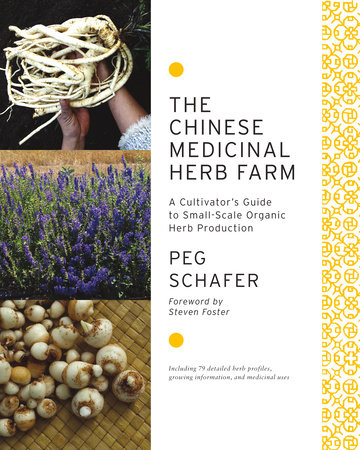
The Chinese Medicinal Herb Farm
A Cultivator’s Guide to Small-Scale Organic Herb Production

| Pages: | 324 pages |
| Book Art: | Color illustrations maps |
| Size: | 8 x 10 inch |
| Publisher: | Chelsea Green Publishing |
| Pub. Date: | November 23, 2011 |
| ISBN: | 9781603583305 |
The Chinese Medicinal Herb Farm
A Cultivator’s Guide to Small-Scale Organic Herb Production
Foreword by Steven Foster
This the first cultivation guide of its kind—delivering invaluable information for growers interested in producing high-quality efficacious herbs in all climates, with the historical connectedness of ancient practitioners
It has become increasingly important-especially as the market for herbal medicine continues to grow-that we transition to local and domestic medicinal cultivation. Increasingly there are concerns in regards to not only the quality but the purity of imported herbs, and wild herbs picked for medicinal purposes are ever more endangered than in past years both at home and abroad.
Peg Schafer, longtime grower and teacher, guides readers with information on propagating, cultivating, and harvesting Chinese herbs, and presents fascinating new scientific data that reveal the age-old wisdom of nature and the traditional systems of Chinese medicine. Through 79 detailed herb profiles–all tested and trialed on Schafer’s certified organic farm-Schafer offers easy-to-follow information, suitable for both growers and practitioners, for growing efficacious wild-simulated herbs. Also included is important information on species conservation, crop integration, and how to avoid the introduction of invasive species. Sidebars on traditional medicinal uses for each herb and delicious recipes are also featured throughout.
Vegetable and CSA farmers will find this book of great interest for adding value-added crops to their repertoire, and beginner growers looking to incorporate medicinals into their gardens will find this an invaluable guide to understanding where herbal medicine comes from, and will make eating-your-medicine more accessible than ever.
“Peg Schafer understands in more ways than one that good health springs from the land. . . Every plant person will instantly recognize the gift waiting within this book—Schafer shares many astute observations of how each plant garners medicinal oomph, what she calls the vital qi (chi) of each herb. And that’s the right sort of inspiration to launch any thinking gardener!”—Michael Phillips, author of The Holistic Orchard, and co-author Nancy Phillips of The Herbalist’s Way
Reviews & Praise
"For the practitioner of Chinese medicine, The Chinese Medicinal Herb Farm is a teacher, drawing us closer to the herbs we use. For the casual gardener, it is a handbook for growing fresh Chinese herbs as part of a healthy diet. For anyone who has an interest in growing their own Chinese herbs, Peg Schafer gives us a new reason to look forward to spring."—Andrew Ellis, author of Notes from South Mountain: A Guide to Concentrated Herb Granules
"Peg Schafer, the most experienced Chinese medicinal herb grower in North America, charts a new course in Chinese medicinal plant cultivation by providing the guidance needed to grow the most important of these herbs domestically. This book offers more than just cultivation tips, but also an assurance of proper plant identification, optimal growing and harvesting conditions, freshness of materials, and the ability to access Chinese medicinals with the lowest carbon footprint possible."—Roy Upton, Executive Director, American Herbal Pharmacopoeia
"Peg Schafer understands in more ways than one that good health springs from the land. Herbs from the Chinese tradition perfectly complement more familiar healing plants. The concept of "regional medicine farms" resonates so well with the growing desire to eat more locally. But of course! We are what we eat, and that includes the medicinal plants that work with our bodies to create wholeness. Every plant person will instantly recognize the gift waiting within this book-Schafer shares many astute observations of how each plant garners medicinal oomph, what she calls the vital qi (chi) of each herb. And that's the right sort of inspiration to launch any thinking gardener!"—Michael Phillips, author of The Holistic Orchard, and co-author Nancy Phillips of The Herbalist's Way
"Peg Schafer is the best artisanal grower I know. For this book, she has distilled the knowledge of the small group who, over the past two decades, has pioneered North American production of Chinese medicinal herbs, and tested it through direct experience. This book clearly explains the whys as well as the how-tos, and delivers information into the eager hands of all perennial polyculturalists who will grow us a post-peak oil healthcare system; it is a gift to us all."—Jean Giblette, owner, High Falls Gardens and co-founder, LocalHerbs.org
"This is by far the most detailed and thorough book that addresses the urgent issue of organic cultivation and processing of Chinese herbs. It will have a profound effect on future land use, herb availability, pesticide burdens, and sustainability in a field that is expanding rapidly around the world. I can't stress enough how valuable and rare this information is to practitioners and users of Chinese herbal medicine. I highly recommend this book for all TCM herbalists, as well as gardeners and farmers who want to learn the art of the organic cultivation of Chinese medicinals."—Bill Schoenbart, L.Ac., D.A.O.M

About Peg Schafer
Peg Schafer is recognized as one of the pioneers and leaders in the field of the cultivation of Asian herbs. After more than fifteen years of commercial herb cultivation and research at the Chinese Medicinal Herb Farm in Petaluma, California, Schafer has distilled her findings into a guide for growers and practitioners of Chinese medicine. Schafer has played an influential role in establishing a network of organizations including Fu Tian Herbs, the first company in the United States to solely offer certified organic, domestically grown Chinese herbs (which she co-founded), The Sonoma County Herb Association, and The Medicinal Herb Consortium. Along with offering seed and field-grown herbs, Schafer's own Chinese Medicinal Herb Farm operates as an experimental farm to investigate herb cultivation and aid herb conservation. Its internship program gives people hands-on knowledge experience in all aspects of growing and harvesting Chinese herbs.
Books by Peg Schafer
You may also like...
-
 $35.00
 -
$34.95
-
$44.95


