
Get to Know the Storytellers of Wild Folk
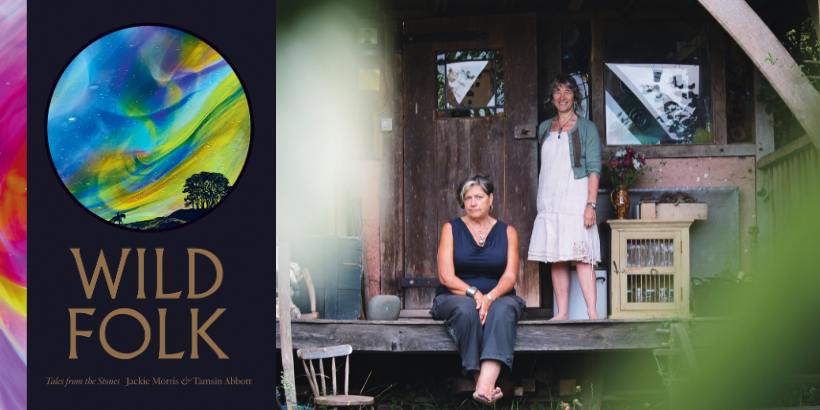
From a unique collaboration between the co-author of The Lost Words and The Lost Spells and an acclaimed visual artist comes seven richly illustrated fables of transformation and power, summoned from the ancient stones beneath our feet and transformed by word and image into portals between past and future.
Jackie Morris is an author and illustrator. She studied illustration at Hereford College of Art and Bath Academy and has illustrated many books, and written some. The Lost Words, co-authored with Robert Macfarlane, won the Kate Greenaway Medal 2019.
Tamsin Abbott has been creating painted stained-glass panels from her Herefordshire home for over twenty years. Her work is inspired by the British landscape, folklore and fairytale. Her pursuit of rural life began at Stirling University, where she studied Medieval Literature. Wild Folk is her first book as a stained-glass illustrator.
What is the view from your writing and creating space?
JM:

TA:

Do you have a favorite place to read?
JM: On the hill above my house, by the fireside in winter, taking a book for a walk, by the edge of the sea, by a river, in bed in the morning before the cares of the day kick in, last thing at night before sleeping, but always in between the pages of a book.
TA: In the winter, snuggled up with Seren, our spaniel, in our cottage by the fire.

During summer, in the garden.

Describe Wild Folk in three words.
TA: Resilient, beautiful, tenacious.
What are you currently reading?
JM: I have been rereading over winter a trilogy called The Bear and the Nightingale, The Girl in the Tower and The Witch in Winter by Katherine Arden. But also Ragwort, second book in a trilogy by Sam K Horton.
TA: The End of Drum Time by Hanna Pylvainen
If you could have any superpower, what would it be?
JM: Flight
TA: To wave a magic wand so that all of humanity would come together to bring about global harmony and climate renewal.
What’s the last book you recommended to a friend, and why?
JM: The Katherine Arden Trilogy, because of the quiet brilliance of the writing.
TA: Black Woods, Blue Sky by Eowyn Ivey. It is the perfect combination of mystical realism, suspense, wildness and love.
Tell us a bit about growing up. What instilled a passion for nature in you?
TA: I grew up in the cities of Liverpool and Derby in a vicarage. I longed for the countryside and these yearnings were fulfilled temporarily by wonderful camping holidays in beautiful, wild places in Scotland, Wales and England. I grew up surrounded by books, music and reading and spent much of my spare time was spent drawing and making up my own nature quiz books! The worlds of nature and imagination were perfectly combined.
How have your life experiences shaped your craft?
TA: I have always drawn and painted from a very young age and my subjects were always animals, trees and plants. I also read prodigiously and loved pouring over the beautiful line drawings of illustrators such as BB, Charles Keeping, Victor G. Ambrus, Kathleen Hale and Edward Ardizzone to name but a few.
I studied and practised art at school until I was 18 and then continued to draw and paint for pleasure, also later taking a ten month Art Foundation course as well as many evening classes in printmaking and stained glass. As soon as I left the home where I grew up, I made choices to enable me to live in rural areas so that I could immerse myself in the British countryside. I have since lived in Wales, Scotland, the north of England, and now Herefordshire in the West Midlands. I am drawn to the light: the light through the trees, through foliage, at the end of a track or lane, and all these things have shaped my work with stained glass, which is a way of working with light itself, of illuminating an image.
What inspired you to create Wild Folk?
JM: Wild Folk was born of a collaboration and a friendship. Both Tamsin and I love the wilder world and the world of folk stories, and really wanted the ‘folk’ to be seen as not simply the humans, but the wild connectivity of our ecosystem.
TA: I always intended to make a book illustrated with stained glass but somehow everything aligned in the autumn of 2022 at a house on Exmoor, to make it happen. I was ready for a new experience, a new way of directing my work and I wanted to bring colour and enchantment into a world of reading for adult children like myself who wanted/needed more joy, and magic in their lives. I wanted to create a world to escape into. All this coincided with the fact that my great friend Jackie Morris was keen to work together and bring some of her tales to life with me.
What do you hope readers take away from Wild Folk?
JM: There’s a magic about Wild Folk. It has survived a difficult time in publishing, and somehow prospered. It feels very much as if the book has a life of its own and every person who reads it brings something new to it. I want to learn about it from its readers rather than be prescriptive about what it might offer. But I hope it will become a harbour for people to rest in through these troubled times, and to emerge from reinvigorated.
TA: A sanctuary and an enchantment that will make the world feel a more bearable place.
Recommended Reads
The Magic of Exploring the Outdoors After Dark: Q&A with Chris Salisbury
Read The Book

Wild Folk [North American Edition]
Tales from the Stones
$35
You may like...
-
 $19.95
 -
$24.95
-
$17.95


Recent Articles

Do you have an old, worn-out pair of jeans in your dresser? Instead of throwing them out, try to grow mushrooms on them. Follow these guidelines to get started.
Read More
Discover the magic of oyster mushrooms! They can grow almost anywhere. Straw is a surprisingly simple way to cultivate the ever-popular oyster mushrooms.
Read More
Known for their tall stature and distinctive flower heads, cattails thrive near lakes and marshes. From edible shoots and nutrient-rich roots to pollen used in baking, cattails offer a wealth of uses.
Read More
There are several ways to embrace nature – no matter the size of your garden. It’s time to rebug & rewild our gardens, lawns, and parks!
Read More
These much-loved titles are the perfect books for Mother’s Day! Gardening books, cookbooks, memoirs and more — there’s a book for every mom on this list.
Read More