

Integrated Forest Gardening
The Complete Guide to Polycultures and Plant Guilds in Permaculture Systems

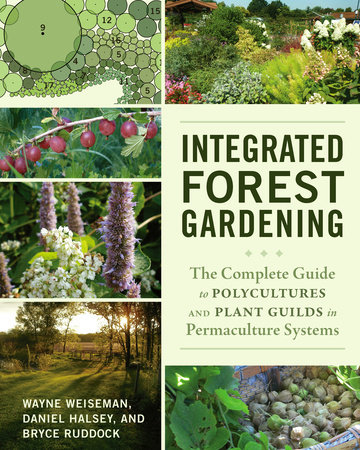
| Pages: | 320 pages |
| Size: | 8 x 10 inch |
| Publisher: | Chelsea Green Publishing |
| Pub. Date: | July 28, 2014 |
| ISBN: | 9781603584975 |
Integrated Forest Gardening
The Complete Guide to Polycultures and Plant Guilds in Permaculture Systems
This book is the first, and most comprehensive, guide about plant guilds ever written, and covers in detail both what guilds are and how to design and construct them, complete with extensive color photography and design illustrations.
One of the essential practices of permaculture is to develop perennial agricultural systems that thrive over several decades without expensive and harmful inputs: perennial plant guilds, food forests, agroforestry, and mixed animal and woody species polycultures.
The massive degradation of conventional agriculture and the environmental havoc it creates has never been as all pervasive in terms of scale, so it has become a global necessity to further the understanding of a comprehensive design and planning system such as permaculture that works with nature, not against it. The guild concept often used is one of a “functional relationship” between plants–beneficial groupings of plants that share functions in order to bring health and stability to a plant regime and create an abundant yield for our utilization. In other words, it is the integration of species that creates a balanced, healthy, and thriving ecosystem. But it goes beyond integration. A guild is a metaphor for all walks of life, most importantly a group of people working together to craft works of balance, beauty, and utility.
Included in Integrated Forest Gardening is information on:
• What we can observe about natural plant guilds in the wild and the importance of observation;
• Detailed research on the structure of plant guilds, and a portrait of an oak tree (a guild unto itself);
• Animal interactions with plant guilds;
• Steps to guild design, construction, and dynamics: from assessment to design to implementation;
• Fifteen detailed plant guilds, five each from the three authors based on their unique perspectives;
• Guild project management: budgets, implementation, management, and maintenance.
Readers of any scale will benefit from this book, from permaculture designers and professional growers, to backyard growers new to the concept of permaculture. Books on permaculture cover this topic, but never in enough depth to be replicable in a serious way. Finally, it’s here!
“Integrated Forest Gardening fills a major gap in the canon of permaculture books, giving us, at last, a detailed guide to guild and polyculture design. No longer is this subject mysterious and daunting . . . This is an essential book for all food foresters and ecological designers.”—Toby Hemenway, author of Gaia’s Garden: A Guide to Home-Scale Permaculture
Reviews & Praise
"Weiseman, Halsey, and Ruddock define integrated forest gardening as the 'integration of all aspects of a land base into the development of healthy food, medicinal, and utility landscapes,' giving equal importance to the built environment, the waste stream, animals, plants, and stones. Drawing on their extensive design, consultation, and teaching experience, these three Midwestern permaculturalists discuss plant guilds ('a beneficial grouping of plants that support one another in all their many functions') and their design, optimal species integration, and plant propagation; profile four trees, which are the centerpieces of polycultures; outline the process of implementing a forest-garden design; and detail fifteen plant-guild case studies across hardiness zones 3–9, illustrated with helpful anecdotes. This passionate and practical manual gives landscapers, landscape architects, and householders enough in-depth information and methodology to begin their own experiments with an emerging, ecologically sensitive alternative to conventional horticulture.”—Publishers Weekly
"Reading Integrated Forest Gardening was like taking a walk through a well-orchestrated whole systems design! As a plant enthusiast and systems thinker this book spoke my language. It is rare to find in one book such depth of user-friendly detail. It demystifies the mythical nature of the “Forest Garden’’ and brings its strategies to easy application. This book is a must for all plant lovers."—Jude Hobbs, Cascadia Permaculture
"Integrated Forest Gardening fills a major gap in the canon of permaculture books, giving us, at last, a detailed guide to guild and polyculture design. No longer is this subject mysterious and daunting; in this book we now have specific instructions for designing and installing multi-species plant groups. Chapter 7, which describes 15 guilds and their plant members, is a golden nugget worth the price of the book alone. This is an essential book for all food foresters and ecological designers."—Toby Hemenway, author of Gaia's Garden: A Guide to Home-Scale Permaculture
"This rich feast of nature love by three experienced and working permaculture designers pushes into the hard task of creating recombinant ecosystems, a field where few have gone before. The authors expose the logic and lore of working guilds, the symbiotic plant assemblies of productive landscapes. Full of design insight into the needs and opportunities of both plants and the people who live with them, Integrated Forest Gardening offers a panoply of example guilds, work procedures, and luscious images to inspire and guide the perennial food gardener onto a path of ecological renewal.”—Peter Bane, author of The Permaculture Handbook and publisher of Permaculture Activist magazine
"For the design work we do at Midwest Permaculture, when we need experienced advice on planting systems we turn to the three gentlemen who collaborated on this impressive work. The book is thorough, accessible, and timely. So wish we had this insightful compilation when we first started. It’s a gem!"—Bill and Becky Wilson, Midwest Permaculture
“This is an intimate insight into the world of plant guilds. The authors have taken the broad land based overview and zoom the reader into the micro detail of these plant polycultures. Details of root structure, seeding patterns, and relationships with the surrounding environment have been carefully observed and are well laid out in the plant guild lists. This book is an important contribution to every permaculture designer’s library and will appeal to all those wishing to grow sustainable polycultures whether broadscale or in the garden.”—Ben Law, author The Woodland Way and Roundwood Timber Framing
"We stand at a new threshold. The history of food production has tended ever more narrowly towards monoculture, whereas a sustainable future can only be based on polyculture. But we're desperately short of knowledge on polycultures. While mainstream research still chases the chimera of fossil-fueled monoculture, a small band of visionaries is working to develop the knowledge we need to carry us forward to the future. Just such are the authors of this book and the wisdom it contains is part of that movement."—Patrick Whitefield, permaculture teacher and author of The Earth Care Manual
“Integrated Forest Gardening makes the process of creating complex agroecosystems more understandable and achievable. It is a fine guide to designing forest garden and polycultural systems using Permaculture principles.”—Martin Crawford, author of Creating a Forest Garden

About Daniel Halsey
Daniel Halsey is a certified permaculture designer and teacher for the Permaculture Research Institute. Certified by the Permaculture Research Institute, Daniel travels nationally and internationally teaching permaculture and ecological design to permaculture design certification students, homesteaders, and landscape designers.
Daniel and his wife Ginny manage self-sustaining forest gardens of fruiting trees, shrubs and nut crops at SouthWoods Forest Gardens, a permaculture design, demonstration, and educational site located on a twenty-five-acre wetland savannah in Prior Lake, Minnesota.
Connect with Daniel Halsey
Books by Daniel Halsey

About Bryce Ruddock
Bryce Ruddock is certified as an instructor of permaculture teaching by the Permaculture Institute USA and Cascadia Permaculture Institute since 2010. He authored the Plant Guilds e-book, a training manual used in classes by Midwest Permaculture. His interest in perennial polycultures began in 1980. Since 1984 Bryce and his partner, Debby, have been implementing permaculture-based polyculture designs at their sixth of an acre urban home site in southeastern Wisconsin, where they have transformed an average suburban yard into a thriving food and medicinals food forest.
Connect with Bryce Ruddock
Books by Bryce Ruddock

About Wayne Weiseman
Wayne Weiseman is certified by the Permaculture Institute of Australia and the Worldwide Permaculture Network as an instructor of the Permaculture Design Certificate Course. He is the director of Kinstone Academy of Applied Permaculture (KAAP) in Fountain City, Wisconsin, the Permaculture Project LLC, and the Permaculture Design-Build Collaborative LLC, full-service, international consulting and educational businesses promoting the ideas of eco-agriculture, renewable energy resources, and eco-construction methods. For many years he managed a land-based, self-reliant community project combining organic crop/food production, ecologically built shelters, renewable energy, and appropriate technologies.
Connect with Wayne Weiseman
Books by Wayne Weiseman
You may also like...
-
 $39.95
 -
$42.95
-
$150.00


