

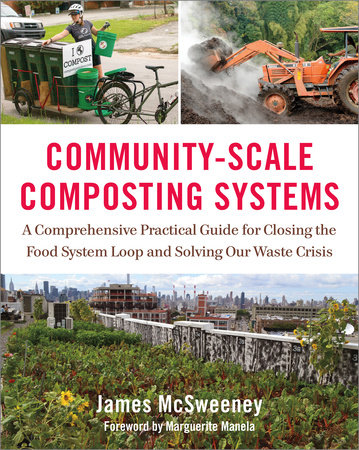
Community-Scale Composting Systems
A Comprehensive Practical Guide for Closing the Food System Loop and Solving Our Waste Crisis

EXCERPTS
| Pages: | 464 pages |
| Book Art: | Full-color photographs illustrations throughout |
| Size: | 8 x 10 inch |
| Publisher: | Chelsea Green Publishing |
| Pub. Date: | January 17, 2019 |
| ISBN: | 9781603586542 |
Community-Scale Composting Systems
A Comprehensive Practical Guide for Closing the Food System Loop and Solving Our Waste Crisis
Online exclusive! Get the Introduction as a free audio download here...
Whether you’re an engineer, community organizer, permaculturalist, public sector waste manager, farmer, or just a dirt lover, Community-Scale Composting Systems is the definitive manual on composting.
Composting at scales large enough to capture and recycle the organic wastes of a given community, whether a school, neighborhood, or even a small city, is coming of age, propelled by a growing awareness not only of our food waste crisis, but also the need to restore natural fertility in our soils. In-depth yet accessible, Community-Scale Composting Systems is a technical resource for farmers, designers, service providers, organics recycling entrepreneurs, and advocates of all types, with a focus on developing the next generation of organics recycling infrastructure that can enable communities to close the food-soil loop in their local food systems.
The main scope of the book is dedicated to compost system options and design, from basic sizing and layout to advanced techniques such as aerated static pile composting. Management techniques and operational considerations are also covered, including testing, feedstock characteristics, compost recipe development, and system-specific best management practices.
Though focused on recycling systems that include food scraps—the fastest growing sector of community-scale composting—the book is informed by and relevant to other composting sectors and will be a vital resource for anyone invested in diverting organic materials away from landfilling and incineration.
Topics covered include:
- Community-scale models
- Estimating organics from individual generators and whole communities
- Food scrap collection
- Compost system sizing
- Aerated static pile (ASP) systems design
- In-vessel systems selection
- Integrating animals with composting
- Compatibility with compost heat recovery, vermicomposting, and other specialized methodologies
- Composting best management practices
- Nuisance management
- Mitigating persistent herbicides
- End uses, marketing, and sales
“This book provides a good and detailed consideration of the broad range of possible approaches and challenges to community aspirations to feed the soil while mitigating wastefulness. If you are thinking of rescuing wasted food in your community, you would be well advised to start by reading this book.”—Karl Hammer, founder and president, Vermont Compost Company
Reviews & Praise
“Community-Scale Composting Systems is far and away the best reference on composting at the community scale. Indeed, it is one of the best references about composting altogether. The book’s range is impressive, offering current and practical advice to practitioners of many applications of composting, from small, on-site systems to larger systems that border on commercial scale. Community-scale and on-site composting are often the most logical and most sustainable options for managing organic residuals, especially food waste. Mr. McSweeney comprehensively covers this important recycling niche within this useful and enjoyable book.”—Robert Rynk, professor, SUNY Cobleskill
“If agriculture is to transition away from a dependence on petroleum-based fertilizers to local fertility sources in a meaningful way, then we will need to relearn the art of using our neighbors’ leaves, grasses, manures, and other ‘wastes’ to fuel our farms. This book shows how to do just that on a community scale. It is the most urgent and important work I know of, and McSweeney explains it better than anyone.”—Ben Hartman, author of The Lean Farm and The Lean Farm Guide to Growing Vegetables
“Too often we hear that food waste cannot be diverted from landfills and incinerators due to lack of composting facilities. Community-Scale Composting Systems debunks that myth by providing a much-needed roadmap for how to compost successfully at a community scale. Micro-composting is now the fastest growing segment of the composting industry and will undoubtedly grow even faster with this resource.”—Brenda Platt, director, Composting for Community Initiative, Institute for Local Self-Reliance
“James has written an almost encyclopedic handbook to address the needs of small- to medium-sized community compost efforts. This book provides a good and detailed consideration of the broad range of possible approaches and challenges to community aspirations to feed the soil while mitigating wastefulness. If you are thinking of rescuing wasted food in your community, you would be well advised to start by reading this book.”—Karl Hammer, founder and president, Vermont Compost Company
“Community-Scale Composting Systems is a well-written and organized practical guide to the diverse systems used for food waste composting. It presents community collection program examples; methods for the design of small- to large-scale composting facilities; and the properties used to characterize feedstocks, the composting process, and finished composts. Detailed case studies are used to describe creative and successful circular food systems. It is essential reading for ‘rotstars’ committed to understanding and mastering the complexities of organics recycling.”—Frederick C. Michel, Jr., professor of biosystems engineering, The Ohio State University
“As composting is increasingly being adopted by neighborhoods, farms, community gardens, schools, businesses, and entrepreneurs, James McSweeney’s timely book provides comprehensive information to help them effectively recycle organic waste into soil amendments that can be used to grow more food. McSweeney’s in-depth guide provides the answers needed to design and manage successful composting operations.”—Rhonda Sherman, author of The Worm Farmer’s Handbook
“Community-Scale Composting Systems taps into James McSweeney’s experience as both a community composting practitioner and educator. His guidance and how-to tips are invaluable to newcomers and old-timers alike.”—Nora Goldstein, editor, BioCycle

About James McSweeney
James McSweeney is a composting consultant and educator. Through his work at the Highfields Center for Composting and current consultancy, Compost Technical Services, James has worked with hundreds of composters, large and small, on everything from site planning, design, and management to compost heat recovery and livestock feeding systems. He coauthored Growing Local Fertility: A Guide to Community Composting and has been an ardent proponent and collaborator in the community composting movement in the United States. With a background in agroecology and permaculture, restoring ecological integrity to our local farm and food systems is at the heart of James’s work. He lives in Massachusetts with his wife, Amanda, and three kids.
Connect with James McSweeney
Books by James McSweeney
You may also like...
-
 $29.95
 -
$24.95
-
$29.95


