

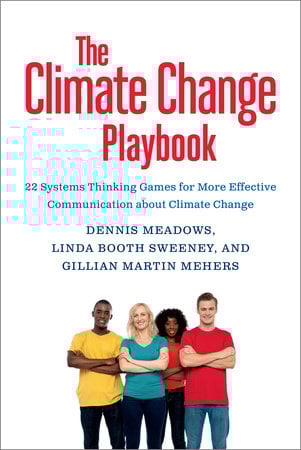
The Climate Change Playbook
22 Systems Thinking Games for More Effective Communication about Climate Change

EXCERPTS
| Pages: | 192 pages |
| Book Art: | Black-and-white illustrations |
| Size: | 6 x 9 inch |
| Publisher: | Chelsea Green Publishing |
| Pub. Date: | April 20, 2016 |
| ISBN: | 9781603586764 |
The Climate Change Playbook
22 Systems Thinking Games for More Effective Communication about Climate Change
Advocates and teachers often find it difficult to communicate the complexities of climate change, because the people they are trying to reach hold so many mistaken assumptions. They assume, for example, that when climate change becomes an obvious threat to our everyday lives, there will still be time enough to make changes that will avoid disaster. Yet at that point it will be too late. Or they assume we can use our current paradigms and policy tools to find solutions. Yet the approaches that caused damage in the first place will cause even more damage in the future.
Even the increasingly dire warnings from scientists haven’t shaken such assumptions. Is there another way to reach people?
The simple, interactive exercises in The Climate Change Playbook can help citizens better understand climate change, diagnose its causes, anticipate its future consequences, and effect constructive change. Adapted from The Systems Thinking Playbook, the twenty-two games are now specifically relevant to climate-change communications and crafted for use by experts, advocates, and educators. Illustrated guidelines walk leaders through setting each game up, facilitating it, and debriefing participants. Users will find games that are suitable for a variety of audiences—whether large and seated, as in a conference room, or smaller and mobile, as in a workshop, seminar, or meeting.
Designed by leading thinkers in systems, communications, and sustainability, the games focus on learning by doing.
Reviews & Praise
“I have lectured and consulted in many dozens of nations, trying to help people understand carrying capacity and its relevance for their communities. Often, I have called upon the teaching tools now shared in The Climate Change Playbook in trainings, with staff, in workshops, and in my own presentations. This book is a treasure trove: It is a practical tool kit for any public policy practitioners who want to engage their counterparts and accelerate learning.”—Mathis Wackernagel, founder and CEO of Global Footprint Network
“Many of us experience the problems of climate change as so overwhelming and beyond our control that we don’t know where to start to solve them. This book does the reverse: It makes the issues so palpable that it not only motivates us to do more but also gives us 22 tools we can easily use to mobilize others. If you believe that experience is the best teacher and that we have precious little time to influence changes that have serious long-term consequences for everyone on the planet, this book is an invaluable asset.”—David Peter Stroh, author of Systems Thinking for Social Change: A Practical Guide for Solving Complex Problems, Avoiding Unintended Consequences, and Achieving Lasting Results
“Using a game to exemplify a point made in a lecture makes all the difference: The audience, large or small, is eager to participate and remembers the message. The beauty of the games in the Playbook is their simplicity and flexibility. They can be used with school children, university professors, politicians, and business people, and they lend themselves to debriefing that might consist of a just few sentences or an elaborate discussion. I have become a games enthusiast. The Playbook also inspires the creation of variations and even new games to meet specific purposes. We need games to get these vital messages across!”—Helga Kromp-Kolb, head, Center for Global Change and Sustainability, University of Natural Resources and Life Sciences, Vienna, Austria
“Thousands of government and corporate officials have participated in training programs that I organize in Japan to convey principles related to environment, climate, food, and energy. I have become a fan of the exercises in the Playbook. They are easy to learn and quick to use. They are incredibly effective teaching tools, and they work with participants that do not have English as their first language.”—Riichiro Oda, president and CEO, Change Agent Inc.
“Few subjects are more crucial, more discussed, and more poorly understood than climate change. This is a tragedy because there are a few simple, intuitive insights that can be understood by all and could form a consensual foundation that would allow us to focus more clearly on the complex tradeoffs and choices obscured by our misunderstandings. The Climate Change Playbook is a great way to understand and more importantly help others understand these insights.”—Peter M. Senge, senior lecturer, MIT; founding chair, Academy for Systemic Change; author of The Fifth Discipline
“One of the major obstacles we face in addressing the climate crisis is the general lack of understanding of the climate system, and complex systems in general. The Climate Change Playbook provides a novel approach to overcoming this barrier through creative and engaging activities that help move the climate crisis from an abstract threat to a clear and present reality that we can and must act upon today.”—Asher Miller, executive director, Post Carbon Institute
“The effort to secure a livable planet for future generations just got a little bit easier thanks to The Climate Change Playbook. Whether you are working to educate and empower an audience of students, business leaders, or policy makers, the Playbookwill help you add interactive learning exercises to your teaching and outreach. With clear and detailed instructions, it is a great resource for anyone working to build sound understanding and a collective will to act on climate change.”—Elizabeth Sawin, codirector, Climate Interactive
“In my current work as an environmental scholar and my former work heading the UN-affiliated University for Peace and the International Union for Conservation of Nature, my major goal has always been to help others understand the crucial causes and consequences of environmental issues. These authors are masters of using simple exercises to convey complex issues, and this new book compiles many of their best tools."—Julia Marton-Lefèvre, Yale Institute for Biospheric Studies, Yale School of Forestry and Environmental Studies
“How can we learn about tough problems like climate change? The research shows that showing people the research doesn’t work. To learn, people need to interact, experiment, play. The Climate Change Playbook encourages just that through a diverse set of interactive games. Useful with all ages and in groups large and small, these games help us learn critical lessons about difficult topics―and they are a load of fun.”—John Sterman, professor, MIT Sloan School of Management; author of Business Dynamics: Systems Thinking and Modeling for a Complex World
“Climate change, like most of our global problems, is a systemic problem―a web of interconnected issues that is difficult to analyze with conventional linear thinking. This book offers a playful, nonlinear, and largely nonverbal, method for learning how to think systemically―in other words, in terms of relationships, patterns, and context. I highly recommend it to anyone who wants to experience systemic thinking firsthand.”—Fritjof Capra, author of The Web of Life; coauthor of The Systems View of Life

About Dennis Meadows
Dennis Meadows is emeritus professor of systems policy and social science research at the University of New Hampshire, where he was also director of the Institute for Policy and Social Science Research. In 2009 he received the Japan Prize for his contributions to world peace and sustainable development. He has authored ten books and numerous educational games, which have been translated into more than 15 languages for use around the world. He earned his Ph.D. in Management from MIT, where he previously served on the faculty, and has received four honorary doctorates for his contributions to environmental education.
Connect with Dennis Meadows
Books by Dennis Meadows


About Linda Booth Sweeney
Linda Booth Sweeney, Ed. D., is an educator, researcher and writer dedicated to helping people of all ages integrate an understanding of complex, living systems into learning, decision making and design. She has worked with Outward Bound, MIT's Sloan School of Management, and Schlumberger Excellence in Educational Development (SEED). She is the author of The Systems Thinking Playbook; When a Butterfly Sneezes: A Guide for Helping Children Explore Interconnections in Our World Through Favorite Stories; Connected Wisdom: Living Stories about Living Systems
Connect with Linda Booth Sweeney
Books by Linda Booth Sweeney

About Gillian Martin Mehers
Gillian Martin Mehers is a learning and capacity development practitioner working within the global sustainability community for over 20 years and the Founder of Bright Green Learning @Atadore SARL. Previously Gillian was the head of learning and leadership at IUCN (International Union for Conservation of Nature) and prior to that the director of capacity development for LEAD International (Leadership for Environment and Development.) Gillian's expertise is in creating dynamic experiential learning environments, interactive learning design, and process facilitation for diverse stakeholder communication and learning. With a particular passion for working inter-culturally, she has worked as a facilitator and trainer in over 50 countries, from Armenia to Zambia. For more information see her blog: You Learn Something New Every Day (www.welearnsomething.org).
Books by Gillian Martin Mehers
You may also like...
-
 $22.50
 -
$24.95
-
$22.95

