

| Pages: | 256 pages |
| Book Art: | Black and white illustrations maps |
| Size: | 6 x 9 inch |
| Publisher: | Chelsea Green Publishing |
| Pub. Date: | January 3, 2013 |
| ISBN: | 9781603585064 |
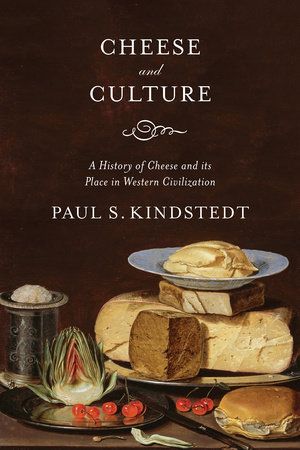
Cheese and Culture
A History of Cheese and its Place in Western Civilization
This refreshingly original book will appeal to anyone who loves history, food, and especially good cheese.
Behind every traditional type of cheese there is a fascinating story. By examining the role of the cheesemaker throughout world history and by understanding a few basic principles of cheese science and technology, we can see how different cheeses have been shaped by and tailored to their surrounding environment, as well as defined by their social and cultural context. Cheese and Culture endeavors to advance our appreciation of cheese origins by viewing human history through the eyes of a cheese scientist.
There is also a larger story to be told, a grand narrative that binds all cheeses together into a single history that started with the discovery of cheese making and that is still unfolding to this day. This book reconstructs that 9000-year story based on the often fragmentary information that we have available. Cheese and Culture embarks on a journey that begins in the Neolithic Age and winds its way through the ensuing centuries to the present. This tour through cheese history intersects with some of the pivotal periods in human prehistory and ancient, classical, medieval, renaissance, and modern history that have shaped western civilization, for these periods also shaped the lives of cheesemakers and the diverse cheeses that they developed. The book offers a useful lens through which to view our twenty-first century attitudes toward cheese that we have inherited from our past, and our attitudes about the food system more broadly.
“I love this book—accessible in its prose and style with the breadth and depth of an academic work. . . Paul Kindstedt has produced a seminal work in Cheese and Culture.”—Mateo Kehler, cheesemaker, Jasper Hill Farm
“This book will fascinate anyone who loves cheese. With a sweeping perspective, from the earliest prehistoric domestication of goats and sheep to the present, it chronicles how social, technological, and political developments gave rise to the vast array of cheeses we know and love.”—Sandor Ellix Katz, author of The Art of Fermentation and Wild Fermentation
Reviews & Praise
“Cheese scientist Kindstedt (Univ. of Vermont) has written a lively history of cheese through an examination of the cultural environments from which specific types of cheese-making traditions were born and, in some cases, have continued to the present. Kindstedt begins as early as possible with archaeological evidence of early fresh cheese making in the Fertile Crescent and its role in pre-Christian religious ritual. He quickly moves on to the introduction of rennet in cheese making and cheese in Greek and Roman civilizations and incorporation into daily life, both mundane and sacred. The last half of the book concentrates on the European cheese-making tradition and the role of monasteries in the development of aged cheeses. Surprisingly, Kindstedt does not spend too much time discussing factory-made cheese and the move away from traditional cheese making. But he does end with a timely discussion on raw milk safety and multinational trade laws that impact traditional cheeses, as well as a brief discussion on the artisanal cheese movement. Cheese and Culture is a well-researched, concise, and valuable addition to any food history collection. Summing Up: Highly recommended. Lower-division undergraduates through graduate students; general readers.”—Choice
"All honor and respect to Aristaious -- the Greek god who taught us to make cheese -- and to Paul Kindstedt, who in Cheese and Culture teaches us its glorious history ever since."—Rob Kaufelt, proprietor, Murray's Cheese NYC
"From the Garden of Eden to the dairy industries of today, Paul S. Kindstedt unfolds the monumental story of cheese. Vast in scope, rich in detail, Cheese and Culture is a casein-inspired epic."—Eric LeMay, author of Immortal Milk
"Cheese and Culture is the book both cheese professionals and cheese geeks have been waiting for. Professor Kindstedt gives us the mostly untold history of cheese and its societal import from 6500 BC to the present, answering all my cheese questions -- even the ones I didn't know I had. Cheese and Culture is the most comprehensive cheese book ever written by an American, a great addition to our collective cheese library."—Gordon Edgar, cheese buyer, Rainbow Grocery Cooperative, San Francisco, and author of Cheesemonger: A Life on the Wedge
"In this painstakingly researched yet passion-laced book, Paul Kindstedt shows us how cheese, from its rudimentary beginnings to today's manufacturing, is inextricably linked to culture and, no less, to our future. Cheese and Culture is essential reading for anyone who loves cheese and, equally, cares about the future of food itself."—Laura Werlin, author, Laura Werlin's Cheese Essentials
"I love this book - accessible in its prose and style with the breadth and depth of an academic work. All those interested in the role that cheesemaking has played in the development of the world we live in will come away after reading this book with context and understanding, and an intellectual appreciation of why cheese appeals to so many people at an emotional level. Paul Kindstedt has produced a seminal work in Cheese and Culture."—Mateo Kehler, cheesemaker, Jasper Hill Farm
"Paul Kindstedt has fashioned a remarkable book about one of humankind's most distinctive foods. Drawing upon comprehensive evidence from archaeology to contemporary artisan cheese making, Dr. Kindstedt shapes the complex story of cheese. He examines the impact of geography and climate, religion, social status and wealth, transportation and commerce... to describe and explain the 8,500-year evolution of cheese from Neolithic humans to present-day America. From archaeologists and anthropologists and historians to cheesemakers and consumers who want to deepen their understanding and appreciation of cheese, Dr. Kindstedt's book will enlighten, entertain, and reveal the fascinating history and culture of cheese. Bravissimi e complimenti!"—Jeffrey Roberts, New England Culinary Institute, and author of The Atlas of American Artisan Cheese
"Only a true scholar could weave together the complexity of history, anthropology, language, geography, religion and science to inform and enlighten our understanding of the evolution of cheese making throughout the millennia. Kindstedt, first and foremost with his discerning scientific mind, helps historians inform the heretofore mysteries in the cheese making continuum."—Catherine Donnelly, PhD, co-director, Vermont Institute for Artisan Cheese
"Dr. Kindstedt's love and passion for the artisan cheese movement is inspiring. In his latest book, he has presented a beautiful and historically rich mosaic of the history of cheese on our little green planet. With reference to the past, and detailed attention paid to the present, as well as extrospection for the future, Dr. Kindstedt has created an amalgamation of artisan cheese reference, the like of which has not been attempted before."—Matt Jennings, co-owner/executive chef, Farmstead/La Laiterie, Providence, RI
"This book will fascinate anyone who loves cheese. With a sweeping perspective, from the earliest prehistoric domestication of goats and sheep to the present, it chronicles how social, technological, and political developments gave rise to the vast array of cheeses we know and love."—Sandor Ellix Katz, author of The Art of Fermentation, The Revolution Will Not Be Microwaved, and Wild Fermentation
“No cheese lover or cheesemaker's education will be complete without reading of the epic journey of cheese as it influences and is influenced by human civilization. Paul Kindstedt steers the reader through a vast sea of history with the steady, inspired hand and confidence of a seasoned captain of his subject. What a gift to the world of cheese!"—Gianaclis Caldwell, cheesemaker, Pholia Farm, and author of The Farmstead Creamery Advisor
"Given the vast amount that's been written about cheese down the centuries, the surprising absence of a scholarly work on the history of cheese is all the more remarkable. With Cheese and Culture, noted dairy scientist and author Paul Kindstedt has admirably filled this gap to an extent that should satisfy even the most avid cheese geek."—Kate Arding, co-founder, Culture magazine

About Paul Kindstedt
Paul Kindstedt is a Professor of Food Science in the Department of Nutrition and Food Sciences at the University of Vermont. He has authored numerous research articles and invited conference proceedings on dairy chemistry and cheese science, as well as many book chapters. He is the author of Cheese and Culture: A History of Cheese and its Place in Western Civilization, and the co-author of American Farmstead Cheese (2005) with the Vermont Cheese Council. He has received national professional recognition for both his research and teaching and currently serves as the Co-Director of the Vermont Institute for Artisan Cheese at the University of Vermont. He is married and blessed with three children who are the joy of his life.
Books by Paul Kindstedt

You may also like...
-
 $40.00
 -
$75.00
-
$17.95


