

| Pages: | 368 pages |
| Book Art: | Full-color photographs illustrations throughout |
| Size: | 8 x 10 inch |
| Publisher: | Chelsea Green Publishing |
| Pub. Date: | October 12, 2018 |
| ISBN: | 9781603587617 |
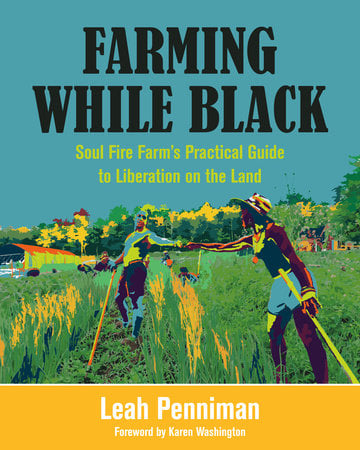
Farming While Black
Soul Fire Farm’s Practical Guide to Liberation on the Land
Recipient of the 28th Heinz Awards for the Economy: Leah Penniman
James Beard Foundation Leadership Award 2019: Leah Penniman
Choice Reviews, Outstanding Academic Title
“An extraordinary book…part agricultural guide, part revolutionary manifesto.”—VOGUE
Named a “Best Book on Sustainable Living and Sustainability” by Book Riot
In 1920, 14 percent of all land-owning US farmers were black. Today less than 2 percent of farms are controlled by black people—a loss of over 14 million acres and the result of discrimination and dispossession. While farm management is among the whitest of professions, farm labor is predominantly brown and exploited, and people of color disproportionately live in “food apartheid” neighborhoods and suffer from diet-related illness. The system is built on stolen land and stolen labor and needs a redesign.
Farming While Black is the first comprehensive “how to” guide for aspiring African-heritage growers to reclaim their dignity as agriculturists and for all farmers to understand the distinct, technical contributions of African-heritage people to sustainable agriculture. At Soul Fire Farm, author Leah Penniman co-created the Black and Latinx Farmers Immersion (BLFI) program as a container for new farmers to share growing skills in a culturally relevant and supportive environment led by people of color. Farming While Black organizes and expands upon the curriculum of the BLFI to provide readers with a concise guide to all aspects of small-scale farming, from business planning to preserving the harvest. Throughout the chapters Penniman uplifts the wisdom of the African diasporic farmers and activists whose work informs the techniques described—from whole farm planning, soil fertility, seed selection, and agroecology, to using whole foods in culturally appropriate recipes, sharing stories of ancestors, and tools for healing from the trauma associated with slavery and economic exploitation on the land. Woven throughout the book is the story of Soul Fire Farm, a national leader in the food justice movement.
The technical information is designed for farmers and gardeners with beginning to intermediate experience. For those with more experience, the book provides a fresh lens on practices that may have been taken for granted as ahistorical or strictly European. Black ancestors and contemporaries have always been leaders—and continue to lead—in the sustainable agriculture and food justice movements. It is time for all of us to listen.
“A moving and powerful how-to book for Black farmers to reclaim the occupation and the contributions of the BIPOC community that introduced sustainable agriculture.”—BookRiot.com
“Leah Penniman is . . . opening the door for the next generation of farmers.”—CBS This Morning
Reviews & Praise
“Nothing is more important than the increasingly visible and energetic role of Black people in moving toward creating and building a food system that actually works for people—one that provides nourishing food and provides a fair standard of living for workers while stewarding the land. Farming While Black is a brilliant guide to moving in that direction, regardless of your skin color.”—Mark Bittman
“Kwame Nkrumah, the first president of post-colonial Ghana, once said, ‘Practice without thought is blind; thought without practice is empty.’ If we are serious about creating justice and equity, our practice informs our theory and our theory gives meaning to our work. Leah Penniman’s Farming While Black is rooted in Leah’s real experience at Soul Fire Farm, which she cofounded. The book effortlessly weaves together theoretical strands on land and food justice, gender, racism, and movement building with best practices on soil health, crop planning, seed keeping, and a variety of other topics.
“Farming While Black makes an important contribution to the growing body of literature on Black farming and foodways. The book affirms our sacred relationship to the Earth and calls for us to move beyond the extractive mindset that guides conventional agriculture and, all too often, organic agriculture as well. This unique how-to guide reflects Leah’s clear analysis of the impacts of ‘the system of white supremacy’ and colonialism on the food system and calls for us to reclaim our ‘real power and dignity’ through creating systems that serve our needs and are rooted in justice, equity, and spirituality. In her usual generous way, Leah also highlights others doing this critical work including Karen Washington, chef Njathi Kabui, and the National Black Food and Justice Alliance.
“Small farms that grow food using sustainable, regenerative practices and foster an understanding of our sacred relationship to the Earth are necessary if humanity is to survive. Farming While Black provides ideas and best practices to move us in that direction. It should be read by both new and experienced rural and urban farmers, and by all wanting to participate in creating a just, equitable, earth-friendly food system.”—Malik Yakini, executive director, Detroit Black Community Food Security Network
“The gift Leah has so generously offered within these pages is a glorious invitation to heal; at the heart of the movement for liberation is the opportunity to heal intergenerational trauma. The most authentic way to do so is to cultivate the earth, eat the foods of your ancestors, reweave yourself back into the story that has been sprouting from the village hearth since time immemorial. With these teachings of resilience, channeled from her countless generations of wise ancestors, she has watered seeds of hope that will nourish many beyond our time.”—Rowen White, Mohawk farmer; Indigenous Seed Keepers Network
“Farming While Black is such an incredible gift to our movement. From Black history to soil health to movement building to land preservation, this book is incredibly generous in offering a roadmap for Black people to return to our rich, land-based heritage. Calling all farmers, organizers, and lovers of freedom to pick up this book, read, share, study, and build together. In the words of freedom fighter Assata Shakur: ‘Carry on the tradition.’ Our movement needs this.”—Dara Cooper, National Black Food and Justice Alliance
“Farming While Black is a beautiful and timely work that manages to live at once as a stunning memoir of the extraordinary life of Leah Penniman and her Soul Fire Farm; a methodical and innovative instruction manual for a sustainable farm practice; and a clear-eyed manifesto that uses the rich history of the Black farming legacy as the guiding ethos for an effective modern day resistance movement.”—Therese Nelson, chef and writer; founder of blackculinaryhistory.com
“Indeed, Farming While Black: Soul Fire Farm’s Practical Guide to Liberation on the Land lives up to its full title, but author/farmer/activist/healer Leah Penniman’s book does much more than that. Planting deep in ancient agrarian wisdom and cultivating fearlessly with love and compassion, Farming While Black offers up a bounty of hope and inspiration, not just for farmers of color—but for all of us. A practical and visionary book that challenges us to change how we farm, how we live, and how we treat each other.”—Eric Holt-Giménez, executive director, Food First/Institute for Food and Development Policy
“Equal parts practical farm instruction and spiritual reflection on mind, body, spirit, and land, Farming While Black honors Black folks’ connections to land and agriculture while recognizing structural constraints that have ruptured those connections. Farming While Black is an important text that (re)centers Blackness and Black people in a conversation about being growers and responsible stewards of land.”—Ashanté Reese, PhD, assistant professor of anthropology; codirector of the Food Studies Program, Spelman College
“Farming While Black is a rich and culturally relevant how-to manual for Black and Brown farmers. Filled with uplifting stories of Black contributions to agriculture and the ongoing work at Soul Fire Farm to build an anti-racist and just food system, this is the most inspiring book I have read in years.”—Ira Wallace, owner of Southern Exposure Seed Exchange; author of The Timber Press Guide to Vegetable Gardening in the Southeast
“Leah Penniman’s Farming While Black is a remarkably thorough—and beautiful!—handbook for successful farming, with step-by-step instructions on how to acquire land, how to restore land, how to keep seed, and so on. If this book were only that, it would be one of the best on the subject. But this book is not only that. Farming While Black shows us how we might repair our relationships with the land, which, given as we are the land, means repairing our relationships to ourselves. And each other. In other words, this book, born of the brilliant work and study that is Soul Fire Farm, is a handbook for repairing our souls. It can feel difficult to believe in the possibility of such repair, but this book gives me faith.”—Ross Gay, poet; author of Catalog of Unabashed Gratitude
“Leah Penniman’s powerful, informative, and lyrical work reflects her profound love for Black people and her unwavering commitment toward achieving Black land justice—a Black land classic!”—Owusu Bandele, PhD, cofounder of Southeastern African American Farmers Organic Network
“Soul Fire Farm is not just a farm; it is a place of refuge. It is where intergenerational, queer, and trans Black and Brown people go to be nourished in their mind, body, and soul. My family and I are blessed to be part of this community. So, wherever you are, after you read Farming While Black, make a trip to Grafton, New York, and visit this liberated land.”—Rosa Clemente, journalist and scholar-activist; 2008 Green Party vice-presidential candidate
“Farming While Black is freedom. A true gift from our ancestors, reminding us that they are always our teachers and inspiring us with the work being carried forward today. This book is a long awaited toolbox for Black farmers by Black farmers, rooting us to the land and empowering us to grow in our own skin.”—Natasha Bowens, farmer; author of The Color of Food: Stories of Race, Resilience, and Farming
“Farming While Black is a genuinely beautiful read, providing a critical guide for self-determination and community sustainability presented in a most accessible, tangible, thoughtful, and clear way; providing for our people the tools to use land as a means to meet the needs of our families, friends, and communities; and moving us a step closer toward our over all goal of creating a ‘just’ economy rooted in true democracy and shared resources where all of us, not some of us, have what we need to thrive.”—Rukia Lumumba, founder and executive director of the People’s Advocacy Institute
“Leah is a griot! I could feel my own ancestors talk to me as I read each chapter. The message is a clear call to arms for what it takes to be of African descent and to be liberated in these times: we must connect with the Earth, we must put our hands in the soil. I thank the ancestors for guiding her heart, protecting her as child, and whispering to her as she penned Farming While Black! A’se.”—Matthew Raiford, farmer and chef; owner of Gilliard Farms, The Farmer & Larder, and Strong Roots Provisions
“The racial dynamics of Ms. Penniman’s ancestral history gives a unique perspective on her present life’s journey and commitment to food justice. As a reader, pulling back the pages of Farming While Black is like pulling back the layers of Ms. Penniman’s thought process, which eloquently transpires while she interweaves the perplexing history of Black agriculture. As an agricultural attorney and founder of Family Agriculture Resource Management Services, I find Ms. Penniman’s convictions regarding advocacy resonate personally with my own work. From the basic definition of soil testing to the technicalities of lending, Ms. Penniman’s book thoroughly defines what Farming While Black truly means.”—Jillian Hishaw, Esq., founder of Family Agriculture Resource Management Services (F.A.R.M.S.)
“A tour de force commentary on black liberation and farming . . . Penniman holds nothing back, offering no apologies for reintroducing what is often left out of other scholarly books on farming: homage to our ancestors, correcting falsehoods about farming, and confronting colonial US history and current racism head on . . . The beauty of this book can be found in the inserts of the chapters that feature inspiring stories about real-life community successes, or that highlight racial justice programs, scholarships, or advice ranging from the legalities of agriculture business to decision-making.”— Choice Reviews

About Leah Penniman
Leah Penniman, the 2019 recipient of the James Beard Foundation Leadership Award, is a Black Kreyol farmer who has been organizing for an anti-racist food system for over fifteen years. She began with the Food Project in Boston, Massachusetts, and went on to work at Farm School in Athol, Massachusetts, and Many Hands Organic Farm in Barre, Massachusetts. She cofounded Youth Grow urban farm in Worcester, Massachusetts. She currently serves as founding co-executive director of Soul Fire Farm in Grafton, New York, a people-of-color led project that works to dismantle racism in the food system through a low cost fresh food delivery service for people living under food apartheid, training programs for Black, Latinx, and Indigenous aspiring farmer-activists, Uprooting Racism training for food justice leaders, and regional-national-international coalition building between farmers of color advocating for policy shifts and reparations. She has dedicated her life’s work to racial justice in the food system and has been recognized by the Soros Equality Fellowship, NYSHealth Emerging Innovator Awards, The Andrew Goodman Foundation Hidden Heroes Award, Fulbright Distinguished Awards in Teaching Program, New Tech Network National Teaching Award, Presidential Award for Excellence in Teaching (New York finalist), among others. She has contributed to two published volumes, authored numerous online articles, and given dozens of public talks on the subject.
Connect with Leah Penniman
Books by Leah Penniman


You may also like...
-
 $39.95
 -
$29.95
-
$34.95


