

Leeks: The Ultimate Winter Crop
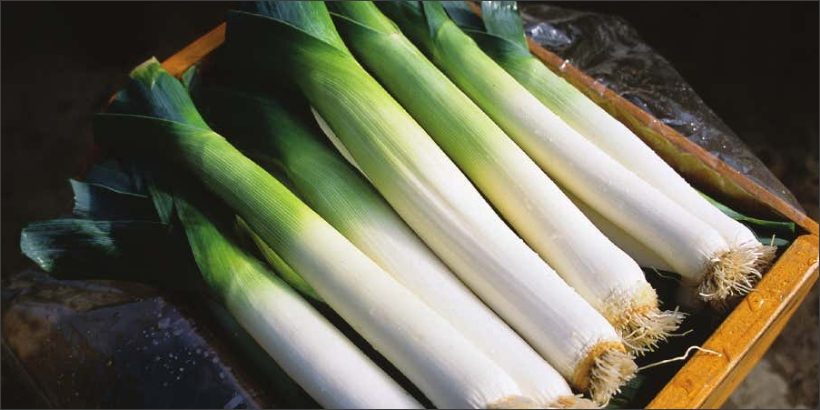
Looking for a veggie to grow and harvest through winter? Try leeks!
With some careful planning, a bit of elbow grease, and some insight from Eliot Coleman, you’ll enjoy leeks from your garden all year long.
The following is an excerpt fromThe Winter Harvest Handbook by Eliot Coleman. It has been adapted for the web.
What Are Leeks?
Leeks are almost a year-round crop for us and would be all-year if the winter leeks did not sell out so quickly.
We get our first crop in May from transplanting extra early seedlings to a cold house. (Seeds are sown February 15 in our plant-starting greenhouse.) Then we sell outdoor-grown summer leeks through September and the fall leeks through November.
Leeks In Every Season
Winter leeks are available from early December until we are sold out, usually in early March. We use a different leek variety for each season.
The summer and fall leeks are harvested directly from the field with the additional protection of a sheet of plastic over the last of the fall leeks during the second half of November.
We protect the winter leeks with a movable greenhouse starting in early December. We add an inner layer from mid-December on until all the leeks are sold.
Cooking & Eating Leeks
The edible part of a leek is the white blanched stem. The more length a blanched leek stem has, the better the product.
Blanching can be accomplished by hilling soil up against the stems of the leeks. However, in our experience, the key to growing leeks efficiently and intensively is to grow your own transplants and dibble them into deep planting holes.
By dibbling in the transplants rather than having to hill-up soil as the leeks grow, we are able to plant them more intensively—as closely as three rows on a 30-inch bed with the leeks 4 inches apart in the row.
Growing Leek Transplants

Unlike many of our other crops, we don’t grow our leek transplants in soil blocks.
Instead, we grow them on the floor in our plant-starting greenhouse in 30-inch-wide-by-8-foot-long-by-3- inch-deep seedbeds with wooden sides filled with potting soil.
We sow leek seeds directly into these beds using the six-row seeder. We allow the seedlings to grow in these beds until they are at least 10 inches tall.
We dig them out of the seedbed by loosening the potting soil under them with a trowel.
To prepare the young plants for transplanting, we trim their roots to 1 inch long and trim the top part to 10 inches long.
The Dibble Method
Our dibble is a 36-inch-long, 1-inch-diameter dowel with the end tapered to a spatulate tip.
We sometimes attach a shovel handle to the upper end of the dowel and add a 6-inch-diameter plate 9 inches above the tip.
In use, we push it into the soil to the full 9-inch depth and then twist the handle so the spatulate tip flattens out the bottom of a 9-inch-deep tubular hole.
Make Sure the Soil is Moist
This is more successful if the soil is moist, as dry soil will tend to collapse back into the hole when the dibble is removed. Thus, we water the surface before transplanting when conditions are dry.
We make a hole every four inches along the row and simply drop a leek transplant vertically into each hole.
Starting Leek Plants
Once the seedlings are in the holes, only an inch or so of green top sticks up above the soil. Then we irrigate the field and let the leeks grow.
We don’t intentionally refill the holes, but soil slowly migrates in every time we irrigate or cultivate.
The leek plants grow beautifully, each with a guaranteed nine inches of blanched shank. If you have never grown leeks this way before you may find it hard to believe that it will work—but it does.
Baby Leeks
Our restaurant customers love early baby leeks. These we grow in a cold greenhouse at five rows to a 30-inch bed, setting them 3 inches apart in the row.
At that spacing they can be cultivated with the long-handled wire weeder. Once when we had no other space, we planted single rows of leeks between the edge bed and the wall of the greenhouse.
The dibble-and-drop method is the only way we could have done that.
Recommended Reads
Read The Book

The Winter Harvest Handbook
Year Round Vegetable Production Using Deep-Organic Techniques and Unheated Greenhouses
$29.95
You may like...
-
 $45.00
 -
$29.95
-
$34.95


Recent Articles

Do you have an old, worn-out pair of jeans in your dresser? Instead of throwing them out, try to grow mushrooms on them. Follow these guidelines to get started.
Read More
If you’re planning out a forest garden, or are just looking for a plant to use as ground cover, garden strawberries are a great option.
Read More
Discover the magic of oyster mushrooms! They can grow almost anywhere. Straw is a surprisingly simple way to cultivate the ever-popular oyster mushrooms.
Read More
Wondering how to get your goats to stay in one place? The secret is all in choosing the right fences and gates to keep them safe, happy, and healthy.
Read More
Beets can be grown year-round and are a perfect, flavorful addition to meals. Get started on growing your own no-till beets with help from these tips!
Read More